


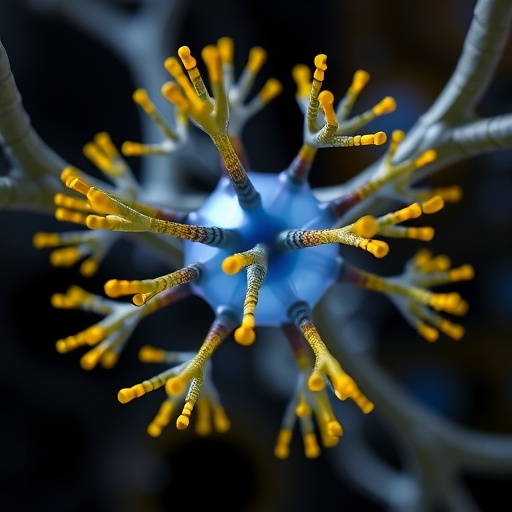
In a groundbreaking advancement for neuromorphic hardware, engineers have successfully developed an artificial neuron that exemplifies intrinsic plasticity, a critical feature for mimicking the human brain’s complex learning and memory processes. This innovative neuron design incorporates monolayer molybdenum disulfide films, leveraging their unique properties to create a dynamic and adaptive system capable of replicating the neuronal behaviors found in biological organisms. The development holds significant promise for enhancing edge intelligence, where computing needs to occur in real-time close to data sources, facilitating applications ranging from unmanned aerial vehicles to smart sensors.
The artificial neuron operates through a synergy of a dynamic random-access memory (DRAM) component paired with an inverter, which collectively mimics the action potential generation of biological neurons. At the core of this system lies the ability to modulate the voltage within the DRAM capacitor, effectively mimicking the neuronal membrane potential. This approach allows for the emulation of intrinsic plasticity—an essential aspect of how biological neurons adjust their synaptic strength in response to varying stimuli. The integration of such adaptable hardware can elevate artificial intelligence systems, enabling them to learn from their environments much like humans and animals do.
Moreover, the researchers have extended the functionalities of this artificial neuron to emulate the photopic and scotopic adaptations of the human visual system. In biological terms, photopic vision enables us to perceive well-lit environments, while scotopic vision adjusts our view in low-light conditions. The incorporation of these adaptive features not only signifies an engineering milestone but also opens avenues for applying this technology in fields such as computer vision, enabling machines to better interpret and respond to visual stimuli under diverse lighting conditions.
One of the most striking demonstration of the artificial neuron’s capabilities is the fabrication of a 3 x 3 photoreceptor neuron array. This array serves as a functional model that replicates the light coding and visual adaptation seen in biological systems. Through this array, the researchers showcase how the integration of multiple neurons can produce sophisticated responses to varying light inputs, leading to a better understanding of how networks of artificial neurons may behave in dynamic environments.
In practical applications, this novel technology can significantly impact image recognition systems, which often rely heavily on the ability to adapt to different lighting conditions and scenarios. The artificial neuron model is utilized in a bioinspired neural network that exhibits remarkable efficiency in processing visual data. By drawing inspiration from the asymmetric levels of light sensitivity found in human sight, this network demonstrates superior performance in recognizing patterns and objects under varied conditions compared to traditional systems.
Additionally, this research program brings forward an enhanced focus on the potential benefits of synaptic plasticity in neural network learning. By including intrinsic plasticity into the design ethos, machines can now learn continuously from incoming data streams. Rather than relying solely on pre-defined datasets, these neurons exhibit the ability to adapt and refine their operational parameters in real-time. Such flexibility has the potential to reduce the training time for machine learning algorithms, making them more efficient and effective in practical applications.
The choice of using monolayer molybdenum disulfide in this design is particularly strategic. This two-dimensional material possesses exceptional electronic properties and environmental stability, making it an ideal substrate for building neuromorphic components. By harnessing the physical characteristics of this material, the engineers are capable of developing a miniature yet powerful hardware solution that can perform complex neuronal functions without occupying extensive physical space.
To fully appreciate the advancements made in this research, it is essential to consider the implications of creating hardware capable of simulating the full spectrum of neuronal activities. Acknowledging that real-world learning experiences often involve a multitude of stimuli and responses, developing hardware that embodies the principles of intrinsic plasticity will arguably push the boundaries of what artificial intelligence can achieve. The journey toward capable edge intelligence systems could, at this transformative juncture, mark a turning point in autonomous systems, ushering in an era where machines showcase learning behaviors akin to human cognition.
This research pushes the boundaries of contemporary neuromorphic engineering, illuminating path forward for hardware that mirrors the intricate dynamics of neuronal interactions. With the potential to bridge the gap between artificial and natural intelligence, the work done by Wang and his colleagues lays the groundwork for further explorations into the creation of intelligent systems, which not only interpret the world around them but actively learn and adapt, contributing their insights to a major leap in artificial intelligence.
The rigorous experimentation involved in crafting this artificial neuron showcases the interdisciplinary efforts that inform modern scientific research. Through the collaboration of materials scientists, electrical engineers, and neurologists, the foundation is built for systems that may soon surpass conventional limitations imposed by current technology. By combining insights across various fields, researchers can cultivate a comprehensive understanding of how to best apply neuromorphic principles in real-world applications.
In conclusion, what Wang and his team have accomplished encapsulates a significant leap toward realizing the long-pursued goal of creating machines that replicate the unique functionalities of biological neurons. This will not only revolutionize artificial intelligence sectors but may also eventually lead to smarter, more responsive devices that augment human capabilities in everyday life. The time is ripe for innovators to harness this research as the groundwork for the intelligent systems of tomorrow—where machines learn, adapt, and evolve alongside us.
By offering a glimpse into the future of computing, the development of this biologically inspired artificial neuron is an exciting fusion of biology and technology. As research in this domain progresses, the dream of truly intelligent machines may be on the horizon, with profound implications for society as a whole.
Wang, Y., Gou, S., Dong, X. et al. A biologically inspired artificial neuron with intrinsic plasticity based on monolayer molybdenum disulfide. Nat Electron 8, 680–688 (2025). https://doi.org/10.1038/s41928-025-01433-y
Cite Scienmag News
Cassandra Pierce. (October 15, 2025). Novel Artificial Neuron Utilizes Molybdenum Disulfide Plasticity. Scienmag. https://scienmag.com/novel-artificial-neuron-utilizes-molybdenum-disulfide-plasticity/
Cassandra Pierce. "Novel Artificial Neuron Utilizes Molybdenum Disulfide Plasticity." Scienmag, 15 October 2025, https://scienmag.com/novel-artificial-neuron-utilizes-molybdenum-disulfide-plasticity/. Accessed 4 September 2026.
Cassandra Pierce. "Novel Artificial Neuron Utilizes Molybdenum Disulfide Plasticity." Scienmag. October 15, 2025. https://scienmag.com/novel-artificial-neuron-utilizes-molybdenum-disulfide-plasticity/


