


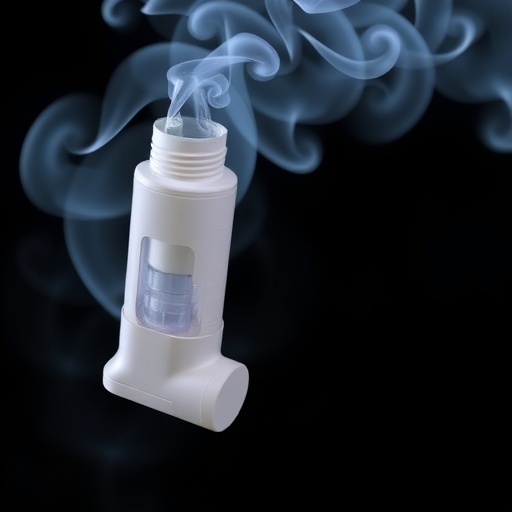
The landscape of pulmonary drug delivery is on the verge of a significant transformation, driven by groundbreaking research into carrier materials for dry powder inhalers (DPIs). A team led by Kim B., Kim K., and Yoon Y.B. has unveiled an innovative approach that utilizes amorphous lactose solid dispersions co-spray-dried with magnesium stearate, presenting a novel lactose carrier designed to enhance powder performance dramatically. This refinement in carrier technology, as published in the 2026 issue of the Journal of Pharmaceutical Investigation, promises to address long-standing challenges associated with DPI formulations.
Dry powder inhalers have gained widespread acceptance for delivering therapeutic agents directly to the respiratory tract, especially for conditions such as asthma and chronic obstructive pulmonary disease (COPD). However, the effectiveness of these inhalers largely hinges on the selection and performance of carrier particles, which influence drug dispersion and deposition in the lungs. Traditional lactose carriers, mostly crystalline in nature, have limitations including poor flowability, variable aerosolization performance, and difficulty in maintaining drug stability and uniformity during manufacturing and storage.
This pioneering study explores the potential of amorphous lactose, a less explored but highly promising form of lactose, to serve as a DPI carrier. Unlike its crystalline counterpart, amorphous lactose exhibits distinct physicochemical properties such as altered solubility, hygroscopicity, and surface energy, which can significantly influence the interaction between carrier and drug particles. The researchers innovatively employed a co-spray drying technique, integrating magnesium stearate into the amorphous lactose matrix, thereby enhancing the carrier’s cohesiveness and lubricating attributes, factors critical for improving powder flow and drug detachment.
Spray drying is a well-established pharmaceutical processing method utilized to convert liquid feeds into dry powders with controlled size and morphology. By co-spray drying amorphous lactose and magnesium stearate, the research team created homogeneous solid dispersions characterized by uniform particle size distribution and modified surface properties. This amalgamation is particularly significant because magnesium stearate is widely recognized for its anti-adherent and lubricating effects, which reduce inter-particle friction and adhesion, thereby facilitating better aerosolization of the loaded drug.
A key technical advancement from this research lies in the material’s microstructural dynamics. The co-spray dried amorphous lactose carriers exhibit an optimized balance of surface roughness and interactive potential, which was rigorously characterized via advanced microscopy and spectroscopy techniques. These structural traits play a crucial role in the detachment forces between the carrier and drug particles within the inhaler device, influencing the emitted dose and fine particle fraction – two critical parameters for effective lung deposition.
Moreover, the amorphous nature of the lactose carrier lends itself to enhanced solubility and dissolution rates once deposited in the moist environment of the respiratory tract. This property offers an additional therapeutic advantage by potentially accelerating the release and absorption of the active pharmaceutical ingredient (API). However, amorphous materials are notorious for their physical instability, primarily due to their tendency to recrystallize over time. Impressively, the inclusion of magnesium stearate in the co-spray dried matrix not only improves the mechanical properties of the particles but also appears to stabilize the amorphous phase against recrystallization, as evidenced by prolonged stability studies under accelerated conditions.
Drug-carrier interaction profiles uncovered in this research shed light on the intricate balance necessary for optimal DPI performance. Excessive adhesion leads to drug particle retention on the carrier surface, hampering aerosolization, whereas insufficient interaction can result in particle segregation during manufacturing and handling. The solid dispersions demonstrated an ideal interaction threshold, ensuring both adequate drug loading efficiency and efficient release upon actuation of the inhaler.
In vitro performance testing simulated the aerosol generation and lung deposition patterns, revealing superior flow and dispersion characteristics compared to conventional crystalline lactose carriers. These experimental outcomes suggest the new carrier design could significantly improve the consistency and reproducibility of delivered doses, minimizing patient-to-patient variability—a critical factor for therapeutic efficacy and patient compliance.
Importantly, the manufacturing implications of this new carrier system cannot be overstated. The scalability of co-spray drying processes coupled with the physicochemical robustness of the produced solid dispersions offers pharmaceutical manufacturers a practical pathway to adopt this technology. This integrates seamlessly into existing production lines, potentially reducing costs while enhancing product performance and longevity.
With mounting evidence from this study, the pharmaceutical community is poised to reevaluate the conventional paradigms of DPI formulation. The tailored physicochemical landscape of amorphous lactose solid dispersions paves the way for the next generation of inhalation therapies, encompassing a broader spectrum of drugs, including biologics and novel molecules with challenging delivery profiles.
Moreover, the significance of this carrier system extends beyond enhanced delivery; it signals a move toward designing excipients and carriers as active participants in drug performance rather than as inert fillers. This opens new frontiers for precision medicine, where carrier design can be tuned to match the pharmacokinetic and pharmacodynamic goals of specific treatments.
The researchers also highlight the environmental and patient-centric benefits associated with this innovation. Improved flow and dispersion reduce dose variability and waste, ultimately leading to more sustainable and cost-effective therapies. For patients, the enhanced pulmonary deposition and consistent dosing translate into improved therapeutic outcomes and potentially reduced side effects.
Future directions emanating from this study include exploring the compatibility of amorphous lactose solid dispersions with a variety of drugs and investigating the potential of multi-carrier blends to fine-tune release profiles further. Additionally, in vivo studies assessing clinical performance and patient usability will be critical for translating these promising in vitro results into real-world applications.
This landmark publication not only advances pharmaceutical sciences but also underscores the multidisciplinary nature of modern drug delivery research—interfacing materials science, chemistry, engineering, and clinical pharmacology to solve pressing healthcare challenges. The work of Kim and colleagues stands as a beacon guiding the development of inhalation therapies into a new chapter defined by innovation and patient-centric design.
Cite Scienmag News
Ophelia Keating. (June 22, 2026). Novel Amorphous Lactose-Magnesium Stearate Carrier Revolutionizes Inhalers. Scienmag. https://scienmag.com/novel-amorphous-lactose-magnesium-stearate-carrier-revolutionizes-inhalers/
Ophelia Keating. "Novel Amorphous Lactose-Magnesium Stearate Carrier Revolutionizes Inhalers." Scienmag, 22 June 2026, https://scienmag.com/novel-amorphous-lactose-magnesium-stearate-carrier-revolutionizes-inhalers/. Accessed 4 September 2026.
Ophelia Keating. "Novel Amorphous Lactose-Magnesium Stearate Carrier Revolutionizes Inhalers." Scienmag. June 22, 2026. https://scienmag.com/novel-amorphous-lactose-magnesium-stearate-carrier-revolutionizes-inhalers/


