


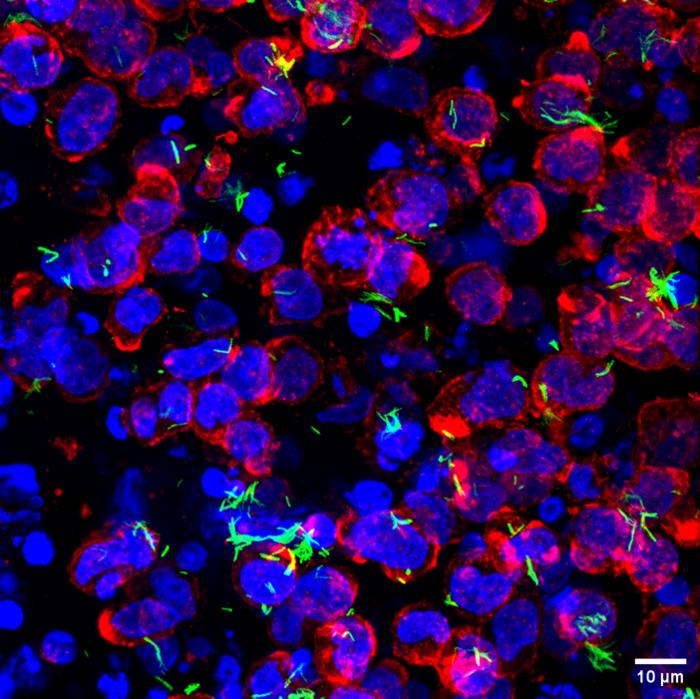
Researchers from the Department of Bioengineering (BE), Indian Institute of Science (IISc), have designed a novel 3D hydrogel culture system that mimics the mammalian lung environment. It provides a powerful platform to track and study how tuberculosis bacteria infect lung cells and test the efficacy of therapeutics used to treat TB.

Credit: Vijaya V Vaishnavi
Researchers from the Department of Bioengineering (BE), Indian Institute of Science (IISc), have designed a novel 3D hydrogel culture system that mimics the mammalian lung environment. It provides a powerful platform to track and study how tuberculosis bacteria infect lung cells and test the efficacy of therapeutics used to treat TB.
Mycobacterium tuberculosis (Mtb) is a dangerous pathogen. In 2022, it affected 10.6 million people and caused 1.3 million deaths, according to the WHO. “It is a very old bug, and it has evolved with us quite a bit,” says Rachit Agarwal, Associate Professor at BE and corresponding author of the study published in Advanced Healthcare Materials. Mtb primarily infects the lungs.
Current culture models used to study Mtb infection have several limitations. They are typically culture plates that are monolayered and do not accurately mimic the 3D microenvironment inside the lungs. The microenvironment experienced by the cells in such 2D culture is vastly different from the actual extracellular matrix (ECM) surrounding lung tissue. “In a tissue culture plate, there are no ECM molecules, and even if a very thin layer of ECM is coated on these plates, the lung cells ‘see’ the ECM on one side at best,” explains Vishal Gupta, PhD student at BE and first author.
The 2D culture plates are also extremely hard compared to the soft lung tissues. “You are looking at a rock versus a pillow,” explains Agarwal.
He and his team have now designed a novel 3D hydrogel culture made of collagen, a key molecule present in the ECM of lung cells. Collagen is soluble in water at a slightly acidic pH. As the pH is increased, the collagen forms fibrils which cross-link to form a gel-like 3D structure. At the time of gelling, the researchers added human macrophages – immune cells involved in fighting infection – along with Mtb. This entrapped both the macrophages and the bacteria in the collagen and allowed the researchers to track how the bacteria infect the macrophages.
The team tracked how the infection progressed over 2-3 weeks. What was surprising was that the mammalian cells stayed viable for three weeks in the hydrogel – current cultures are only able to sustain them for 4-7 days. “This makes it more attractive because Mtb is a very slow-growing pathogen inside the body,” says Agarwal.
Next, the researchers carried out RNA sequencing of the lung cells that grew in the hydrogel, and found that they were more similar to actual human samples, compared to those in traditional culture systems.
The team also tested the effect of pyrazinamide – one of the four most common drugs given to TB patients. They found that even a small amount (10 µg/ml) of the drug was quite effective in clearing out Mtb in the hydrogel culture. Previously, scientists have had to use large doses of the drug – much higher compared to concentrations achieved in patients – to show that it is effective in tissue culture. “Nobody has shown that this drug works in clinically relevant doses in any culture systems … Our setup reinforces the fact that the 3D hydrogel mimics the infection better,” explains Agarwal.
Agarwal adds that they have already filed an Indian patent for their 3D culture, which can be scaled up by industries and used for drug testing and discovery. “The idea was to keep it quite simple so that other researchers can replicate this,” he adds.
Moving forward, the researchers plan to mimic granulomas – clusters of infected white blood cells – in their 3D hydrogel culture to explore why some people have latent TB, while others show aggressive symptoms. Gupta says that the team is also interested in understanding the mechanism of action of pyrazinamide, which may help discover new drugs that are more or just as efficient.
Journal
Advanced Healthcare Materials
Article Title
3D Hydrogel Culture System Recapitulates Key Tuberculosis Phenotypes and Demonstrates Pyrazinamide Efficacy
Article Publication Date
24-Apr-2024
Cite Scienmag News
Kristina Jarvis. (June 25, 2024). Novel 3D hydrogel culture to study TB infection and treatment. Scienmag. https://scienmag.com/novel-3d-hydrogel-culture-to-study-tb-infection-and-treatment/
Kristina Jarvis. "Novel 3D hydrogel culture to study TB infection and treatment." Scienmag, 25 June 2024, https://scienmag.com/novel-3d-hydrogel-culture-to-study-tb-infection-and-treatment/. Accessed 4 September 2026.
Kristina Jarvis. "Novel 3D hydrogel culture to study TB infection and treatment." Scienmag. June 25, 2024. https://scienmag.com/novel-3d-hydrogel-culture-to-study-tb-infection-and-treatment/

