

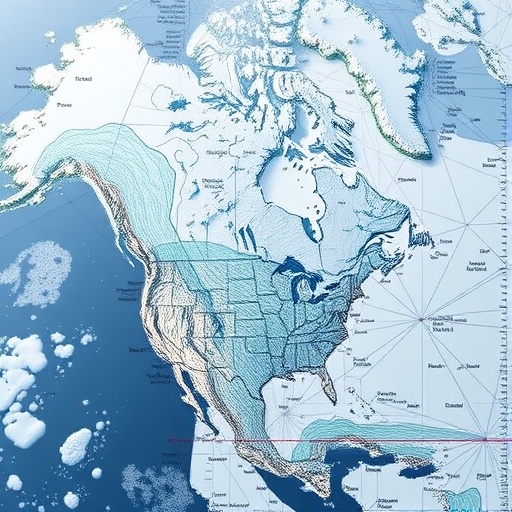
In the relentless pursuit to understand Earth’s climatic future, scientists have turned their gaze backward—far beyond modern records—to the epochs of the planet’s past interglacials. A recent groundbreaking study led by Creel, Kopp, and Dutton, published in Nature Communications (2026), challenges prevailing assumptions about the fate of North American ice sheets during these warmer periods. Their findings reveal that these colossal icy formations persisted much longer into past interglacial phases than previously believed, a discovery with profound implications for predicting the trajectory of future ice sheet stability and subsequent global sea level rise.
For decades, the conventional paradigm held that during interglacials—periods of warmer climate between glacial maxima—continuous ice sheet retreat resulted in the near-total disappearance of the massive ice accumulations that characterized the last glaciation. Yet, this narrative overlooked crucial geological and climatic feedback mechanisms that may have sustained substantial ice volumes beyond initial warming phases. The research team synthesized a wealth of geological, geochemical, and ice core data, alongside advanced ice sheet modeling techniques, to reconstruct a more nuanced timeline of ice sheet evolution throughout these transitional epochs.
Methodological innovation was at the heart of this inquiry. Utilizing refined cosmogenic nuclide dating and radiometric stratigraphies, the researchers could pinpoint the chronology of ice margin fluctuations with unprecedented precision. These temporal benchmarks, when integrated with high-resolution climate proxies such as sediment cores and isotopic records, painted a detailed portrait of ice sheet dynamics during critical intervals. Computational simulations further probabilized the interaction between atmospheric temperatures, precipitation, ice flow mechanics, and underlying topography, yielding robust models of ice sheet persistence under varying interglacial forcings.
A principal revelation emerged: extensive sections of the North American ice sheet endured well into interglacial periods marked by global mean temperature increases comparable to or exceeding those predicted for the 21st century. This contradicted simplistic assumptions of a swift dismantling of ice masses once warming set in. Instead, complex feedback processes—such as local albedo effects, ice elevation climate interactions, and subglacial topographic barriers—contributed to a lag in ice retreat. This temporal inertia allowed for substantial continental ice to persist during phases once assumed to be largely ice-free.
This longevity of ice sheets has critical ramifications. It suggests that forecasts of future ice sheet melt and sea level rise, which often rely on modern analogs and short-term observational datasets, may systematically underestimate the resilience of ice masses and the consequent timing and magnitude of sea level responses. Such underestimations bear direct consequences for coastal planning, infrastructure resilience, and global climate mitigation strategies. By integrating paleoclimate insights, models can incorporate more realistic delays and nonlinearities in ice sheet decay, thus refining predictions crucial for policy decisions.
Moreover, the research highlights the importance of regional climate heterogeneity during interglacial periods. Not all sectors of the ice sheet responded uniformly; some regions, particularly those buttressed by favorable topography or influenced by cooler ocean currents, remained relatively stable. Conversely, peripheral zones showed more pronounced fluctuations, reflecting sensitivity to local climate variability. These spatial disparities underscore the danger of oversimplifying ice sheet dynamics in global models, advocating for more detailed regional assessment frameworks.
One of the study’s most striking elements is its emphasis on the coupling of climatic and cryospheric systems on timescales exceeding human lifespans. The protracted ice sheet presence into warm intervals points to feedbacks that operate over millennia, involving processes such as isostatic rebound, basal hydrology, and ice-sheet-ocean interactions. Understanding these mechanisms is paramount, as they can dramatically alter ice sheet behavior, triggering thresholds that either stabilize or accelerate mass loss.
Furthermore, this research advances the dialogue on tipping points within the Earth system. The persistence of ice sheets into warm interglacials implies that thresholds for irreversible ice loss may be more complex and contingent on interactions beyond mere surface temperature metrics. Identifying these thresholds requires integrating geological records with modern observations, enabling a predictive framework sensitive to abrupt transitions that have historical precedence.
The implications for sea level projections are equally profound. Given that North American ice sheets contributed significantly to past global sea levels, their unexpected persistence recalibrates estimates of how much ice volume might be lost during current warming trends. This recalibration is critical for modeling future coastal inundation scenarios, freshwater influxes into oceans that affect thermohaline circulation, and associated climate feedback loops.
Equally notable is the potential that these findings carry for improving ice sheet parameterizations in Earth system models. The new data on ice volume persistence, spatial variability, and response timings provide benchmark constraints for simulating ice-climate interactions. With improved fidelity, these models can better forecast future changes in the cryosphere with real-world applicability.
From a broader perspective, this work exemplifies the transformative power of synthesizing paleoclimate reconstructions with advanced modeling. As global climate change continues to accelerate, leveraging Earth’s long-term climatic history provides a vital context for anticipating future developments. Interglacial periods serve as natural laboratories, testing grounds where the planet experienced warm climates and evaluated the endurance of ice sheets under varying conditions analogous to those anticipated in the near future.
Moreover, the interdisciplinary approach adopted—melding geology, climatology, glaciology, and computational science—illustrates the necessity of cross-domain collaboration to unravel complex Earth system phenomena. Such unified efforts ensure that insights from the distant past are translated into actionable knowledge for the present and future.
This research not only enriches our scientific understanding but also delivers an urgent message to policymakers and society at large. The ice sheets may not disappear overnight with rising temperatures; their slow yet inexorable retreat poses significant long-term risks that demand proactive adaptation strategies. Anticipating these protracted but impactful changes enhances societal preparedness and resilience.
In conclusion, Creel, Kopp, Dutton, and their colleagues have opened a vital new window onto the past dynamics of North American ice sheets during interglacials. Their findings challenge existing dogma, offering a more complex but realistic narrative of ice sheet evolution under warming conditions. As climate change progresses, embracing these insights will be essential for refining projections, guiding mitigation efforts, and reinforcing the global commitment to understanding and addressing Earth’s changing cryosphere.
Subject of Research: Persistence of North American ice sheets during past interglacial periods and implications for future projections.
Article Title: North American ice sheet persistence into past interglacials should inform future projections.
Article References:
Creel, R.C., Kopp, R.E., Dutton, A. et al. North American ice sheet persistence into past interglacials should inform future projections. Nat Commun (2026). https://doi.org/10.1038/s41467-026-70032-y
Image Credits: AI Generated


