

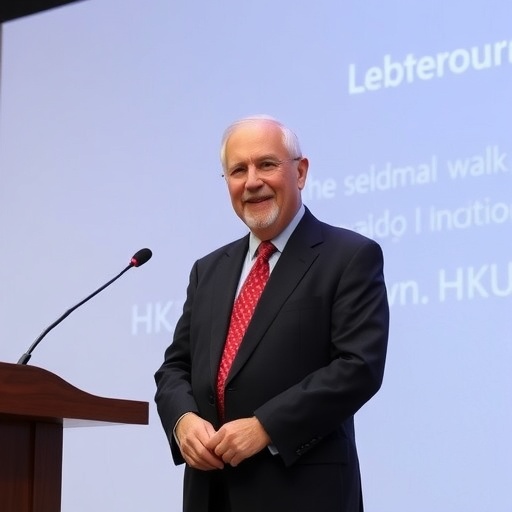
In a landmark event that captivated the scientific community, Professor Sir Andre Geim, Nobel Laureate and Chair Professor in the Department of Physics at the University of Hong Kong (HKU), delivered his insightful inaugural lecture titled “Random Walk to Graphene” on June 9th at the prestigious Lee Shau Kee Lecture Centre. The lecture was a profound exploration of the serendipitous journey and relentless curiosity that culminated in the isolation of graphene, a revolutionary material that has redefined the landscape of condensed matter physics and materials science. The grand hall was filled to capacity, drawing an audience of approximately 800 participants from diverse backgrounds including academia, policy-making, industrial practitioners, and students, all eager to delve into the narrative behind this extraordinary scientific breakthrough.
The event commenced with an inspiring welcome by Professor Xiang Zhang, President and Vice-Chancellor of HKU, who emphasized the transformative power of fundamental research. Highlighting Professor Geim’s pioneering work, Zhang remarked on the essential role that curiosity-driven science plays in spawning disruptive technological innovations and entrepreneurship. He articulated a vision where the insights and experiences shared by Professor Geim would ignite the spirit of inquiry in emerging scholars, encouraging them to rethink and reshape future scientific frontiers. This context underscored HKU’s aspiration to be a crucible for world-class scientific talent and groundbreaking discoveries.
Taking the stage, Professor Geim offered a candid recounting of his academic odyssey, encapsulating a narrative punctuated by unexpected turns, moments of serendipity, and unrelenting curiosity. He reframed the nature of scientific discovery as a complex, nonlinear process that often defies conventional expectations. Far from a tale of unidirectional success, his story portrayed how embracing unpredictability and the willingness to experiment with unorthodox approaches can lead to pivotal milestones. Geim’s reflections resonated strongly with the audience, serving as a reminder that the path to innovation is frequently marked by trial, error, and fortuitous chance encounters.
At the core of the lecture was the fascinating saga of graphene, a material that was long considered a theoretical impossibility by many physicists due to its perceived instability as a standalone two-dimensional crystal. Contrary to prevailing dogma, Geim and his collaborators employed an elegantly simple yet effective technique involving Scotch tape to mechanically exfoliate graphene sheets from bulk graphite. This method yielded stable, single-atom-thick carbon layers—the thinnest known material—ushering in a new paradigm in materials research. Their successful isolation and characterization earned them the Nobel Prize in Physics in 2010, fundamentally altering our understanding of atomic-scale materials.
Beyond the momentous achievement of isolating graphene, Professor Geim’s ongoing research initiative explores the expansive domain of two-dimensional (2D) materials. By investigating a variety of atomically thin crystals—ranging from transition metal dichalcogenides to insulating hexagonal boron nitride—his team has pioneered methods to assemble these layers into heterostructures with tailor-made electronic, optical, and mechanical properties. This “atomic Lego” approach to material design enables researchers to engineer novel quantum phenomena and functionalities previously unattainable in bulk form. Such innovations hold transformative potential across multiple fields, including nanoelectronics, photonics, and quantum information science.
Within the vibrant research environment at HKU, Professor Geim is further advancing this visionary agenda of “atomic architecture.” His strategic focus lies in systematically expanding the library of 2D materials and perfecting the techniques to stack them with atomic precision. These designer materials leverage interlayer interactions and quantum effects to realize emergent behaviors not found in nature, potentially enabling breakthroughs in energy harvesting, sensing technologies, and catalysis. Geim’s insight draws a parallel between this nascent materials revolution and epochal technological shifts in human history—for example, humanity’s progression from the Stone Age to the Bronze Age—heralding a new technological era shaped by control at the atomic scale.
HKU’s appointment of such a pioneering figure as Professor Geim underscores the university’s profound commitment to bridging curiosity-led fundamental science with practical applications that can drive societal progress. It symbolizes their aspiration to foster a dynamic research ecosystem where interdisciplinary collaboration and innovation converge. By hosting Professor Geim, HKU not only elevates their research stature internationally but also inspires a new generation of scientists to embrace bold, unconventional thinking that will shape the future of technology and industry.
The lecture illuminated the profound role of serendipity, resilience, and intellectual openness in research, creating a powerful narrative that extends beyond the technicalities of graphene science. Professor Geim’s journey exemplifies how deep theoretical understanding combined with simple experimental ingenuity can overcome entrenched scientific skepticism. His tale stands as a testament to the value of maintaining a playful curiosity and readiness to reevaluate assumptions—qualities essential for trailblazing discovery in any scientific endeavor.
From an academic perspective, Professor Geim’s work challenges traditional material classifications and calls for a re-examination of the dimensionality constraints that govern material properties. His approach leverages quantum confinement and surface effects which become pronounced at two-dimensional scales, thereby unlocking novel physical phenomena such as high carrier mobility, unconventional superconductivity, and robust quantum Hall effects. These insights provide a rich platform for both fundamental investigations and the development of cutting-edge technologies.
The broader implications of the materials designed under Professor Geim’s stewardship extend into future electronic devices that could surpass current silicon-based technologies by orders of magnitude in efficiency and miniaturization. Moreover, these advances hold promise for the realization of quantum computing architectures by enabling coherent control of electron spins and valley degrees of freedom within atomically thin platforms. As such, the research trajectory pioneered by Geim and his team constitutes a cornerstone in the growing field of quantum materials science.
Professor Geim’s vision of an emergent “atomic age” accentuates an exciting transition where humanity’s mastery of materials at the atomic scale will redefine the landscape of engineering, medicine, and environmental sustainability. This ongoing revolution promises to enable eco-friendly energy solutions, advanced biomedical devices, and resilient infrastructures through the strategic design of materials with unparalleled precision. His lecture poignantly encapsulated the excitement and potential that lie ahead in this cutting-edge domain of science.
In conclusion, Professor Sir Andre Geim’s inaugural lecture at HKU was both an inspirational chronicle of scientific discovery and a compelling exposition of future directions in two-dimensional materials research. It underscored the indispensability of fundamental science as a driver of technological innovation and societal advancement. The event also reaffirmed HKU’s position as an international hub for research excellence, fostering world-leading scientific breakthroughs with far-reaching impact.
News Publication Date: June 9, 2023
Keywords
Physical sciences, materials science, physics, scientific community, graphene, two-dimensional materials, Nobel Prize, quantum materials, atomic architecture, nanotechnology, innovation, fundamental research
Cite Scienmag News
Neil Sanderson. (June 12, 2026). Nobel Laureate Professor Sir Andre Geim Delivers Inaugural Lecture: “Random Walk to Graphene” at HKU. Scienmag. https://scienmag.com/nobel-laureate-professor-sir-andre-geim-delivers-inaugural-lecture-random-walk-to-graphene-at-hku/
Neil Sanderson. "Nobel Laureate Professor Sir Andre Geim Delivers Inaugural Lecture: “Random Walk to Graphene” at HKU." Scienmag, 12 June 2026, https://scienmag.com/nobel-laureate-professor-sir-andre-geim-delivers-inaugural-lecture-random-walk-to-graphene-at-hku/. Accessed 4 September 2026.
Neil Sanderson. "Nobel Laureate Professor Sir Andre Geim Delivers Inaugural Lecture: “Random Walk to Graphene” at HKU." Scienmag. June 12, 2026. https://scienmag.com/nobel-laureate-professor-sir-andre-geim-delivers-inaugural-lecture-random-walk-to-graphene-at-hku/


