


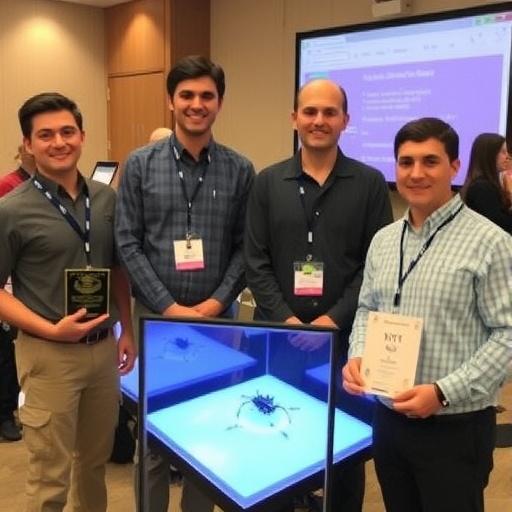
Ants, often regarded as mere nuisances at outdoor gatherings, possess an astonishing complexity that could revolutionize engineering, robotics, and materials science. Recent research by a dedicated student-faculty team at the New Jersey Institute of Technology (NJIT) has shed light on the fascinating dynamics of ant swarms. Recent graduate Matthew Loges, along with Assistant Professor Tomer Weiss, has taken a unique approach by studying these tiny creatures to unlock secrets that may lead to groundbreaking innovations such as self-healing materials and sophisticated multi-agent systems.
The duo’s presentation on their research titled “Simulating Ant Swarm Aggregation Dynamics” garnered significant attention at the prestigious ACM SIGGRAPH Symposium for Computer Animation (SCA), where they were awarded for the best presentation. Their work also earned them a nomination for a qualifying poster in the undergraduate research competition at the upcoming 2025 ACM SIGGRAPH conference. The recognition received at SIGGRAPH, known as one of the foremost platforms for discussions on computer graphics and artificial intelligence, underscores the importance of their research.
Loges’ interest in this pioneering research was ignited during an elective class, IT 360 Computer Graphics for Visual Effects, which he took under Professor Weiss. The summer of 2024 saw the beginning of their collaborative work, dedicated to understanding the intricate behaviors exhibited by ant swarms. Inspired by the observation that ant swarms exhibit properties akin to both fluid and elastic materials, Loges and Weiss delved into the behaviors of these insects, with a vision to replicate their actions through computational simulations.
Ants, as active matter, possess a remarkable ability to adjust and reform in response to external stressors. This elasticity in their behavior is not merely a survival mechanism; it suggests a level of collective intelligence that may be leveraged in various fields, ranging from engineering materials to traffic control systems. According to Weiss, the goal of their study is to innovate by translating the observed behaviors of ants into practical applications, such as the development of smart concrete that repairs itself when damaged or systems that enhance the navigation of multi-agent robots.
The research team aimed to capture this complex behavior through a computational simulation algorithm, meticulously designed to account for both fluidic and elastic characteristics of ant swarms. By integrating their findings from laboratory observations with advanced computer modeling techniques, they successfully created a simulation that mirrors real-world ant behavior. The implications of this work extend far beyond the laboratory; it aims to inspire new methodologies in material sciences and robotics.
Weiss’s overarching research interests include physics-based simulations, AI-driven modeling, and the intersection of biological systems with computational science. Understanding how biological agents, like ant swarms, exhibit properties that challenge traditional categorizations of matter can foster the development of new algorithms that bridge the gap between biology and computer science, ultimately contributing to advancements in multiple domains.
Part of the allure of this research lies in its potential for real-world applications. The insights gained from studying ant swarms can inform the development of intelligent systems that mimic their natural counterparts. For example, advancements in swarm robotics might take cues from the adaptive behaviors of ants, leading to enhanced functionality in environments where traditional robotic designs fall short. The collaborative nature of ant swarms showcases an effective approach to problem-solving that can inspire innovations in fields that require coordinated efforts among multiple agents.
In addition to robotics, the findings have profound implications for materials science. The concept of self-healing materials has gained traction in recent years, and the behaviors observed in ant swarms could lead to the creation of innovative materials with adaptable functionalities. Imagine concrete that can mend itself when cracked or smart materials that remain resilient against environmental stressors, ultimately propelling construction and engineering into new realms of possibility.
As technology continues to evolve, the interplay between biological insights and computational algorithms will be crucial in shaping the future of engineering and robotics. The continued exploration of natural phenomena, like ant behavior, will unveil mechanics that lead to innovative solutions for everyday challenges. By bringing together insights from biology, physics, and computer science, researchers are paving the way for intelligent systems that integrate seamlessly into human-made environments.
This research not only enhances our understanding of ant swarms but also serves as a testament to the incredible potential of biomimicry in scientific endeavors. The lessons learned from these humble insects push the boundaries of what is achievable with technology while emphasizing the intricate connections that exist within nature. With further developments in both simulation techniques and real-world applications, the evolution of smart materials and robotic systems may soon be upon us, inspired by the seemingly simple yet profoundly complex world of ants.
As the research gains traction and anticipation builds for its practical applications, the horizon looks promising for interdisciplinary collaboration that could ultimately lead to transformative changes across various industries. The collaboration between students and faculty at NJIT exemplifies the power of academia to drive innovation and discovery, setting a remarkable precedent for future investigations.
In conclusion, as we reconsider the small yet mighty ant, it becomes increasingly clear that they have much to teach us not just about their own ecosystems, but about the technologies we develop and the materials we rely on every day. The ongoing research at NJIT is a vivid reminder of the complex interplays within our world and a hopeful sign of what could be achieved when we look to nature for inspiration.
Keywords
Cite Scienmag News
Denise Maddox. (September 15, 2025). NJIT Student-Faculty Team Recognized with Best Presentation Award for Innovative Ant Swarm Simulation. Scienmag. https://scienmag.com/njit-student-faculty-team-recognized-with-best-presentation-award-for-innovative-ant-swarm-simulation/
Denise Maddox. "NJIT Student-Faculty Team Recognized with Best Presentation Award for Innovative Ant Swarm Simulation." Scienmag, 15 September 2025, https://scienmag.com/njit-student-faculty-team-recognized-with-best-presentation-award-for-innovative-ant-swarm-simulation/. Accessed 4 September 2026.
Denise Maddox. "NJIT Student-Faculty Team Recognized with Best Presentation Award for Innovative Ant Swarm Simulation." Scienmag. September 15, 2025. https://scienmag.com/njit-student-faculty-team-recognized-with-best-presentation-award-for-innovative-ant-swarm-simulation/


