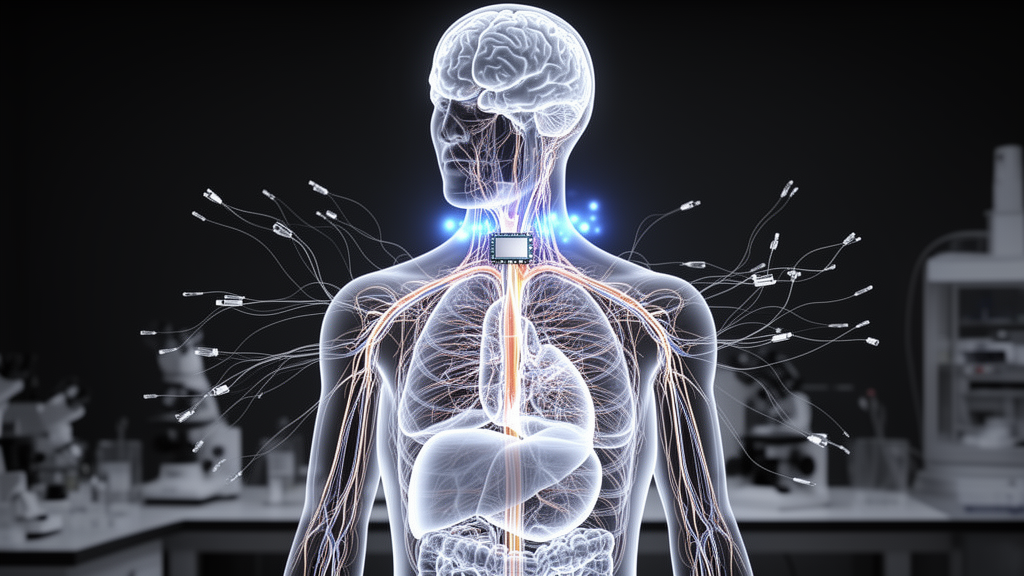
A decade after the National Institutes of Health launched one of its most ambitious efforts to jump-start a struggling field, the program’s own leaders have published a detailed accounting of what the investment produced. The review, published in the journal Bioelectronic Medicine, describes the origins, structure and measurable outputs of the Stimulating Peripheral Activity to Relieve Conditions, or SPARC, initiative, a Common Fund program established in 2015 to accelerate the development of neuromodulation therapies. According to the authors, the program distributed a total of 247 million dollars across 77 awards in its first phase and a further 105 million dollars across 24 awards in its second, generating hundreds of datasets, protocols and publications now openly available to researchers worldwide.
Neuromodulation, as the review explains, is the use of advanced medical device technology to enhance or suppress the activity of the nervous system for the treatment of disease. Bioelectronic devices deliver electrical current to nerves and neurons to produce therapeutic effects, and they may be implanted within the body or used externally to stimulate electrically active tissues such as the brain, spinal cord, peripheral nerves, heart and other muscles. Because the autonomic nervous system innervates all tissues of the body, the field has long promised a way to treat a wide variety of diseases by regulating the nerves that supply affected organs, potentially with high specificity and few side effects, an advantage over pharmacological treatments whose effects are often felt throughout the body.
The field, however, entered the 2010s with a credibility problem. The review recounts a history of study failures, including the failure of Transneuronix devices to consistently influence weight loss during clinical trials, which resulted in limited investment and innovation. Lengthy clinical studies, questionable relevance of animal models, and challenges with national reimbursement coverage further dampened enthusiasm. Technical limitations were prevalent as well: imprecise targeting, a lack of quantitative endpoints or biomarkers, and incomplete knowledge of the mechanisms of therapeutic action. What the field needed, the authors argue, was substantial investment to understand how the autonomic nervous system interacts with organ systems, along with new tools, technologies and data resources that researchers could readily build upon.
The path to SPARC began in 2013, when representatives from the NIH, the Defense Advanced Research Projects Agency and GlaxoSmithKline organized a Bioelectronic Medicines Summit, bringing together experts from academia, industry and the federal government. The feedback from that meeting and pre-meeting webinars produced a research roadmap that identified four critical priority areas: the need for biological maps of structure and function, advancements in interface technology, early establishment of therapeutic feasibility, and collaborative data mining and standards enabled by what the roadmap called an emerging community of bioelectricians. Informed by this roadmap, an NIH Working Group developed a concept proposal for the new Common Fund program, which was cleared by the NIH Council of Councils in June 2014. SPARC was then initiated by the NIH Office of the Director in partnership with the National Center for Advancing Translational Sciences, the National Institute of Biomedical Imaging and Bioengineering, the National Institute of Diabetes and Digestive and Kidney Diseases, and the National Institute of Neurological Disorders and Stroke.
SPARC’s first phase, launched by September 2015 and spanning fiscal years 2015 through 2021, was organized around four interdependent initiatives. The mapping initiative supported the creation of new anatomical and functional connectivity datasets, covering the coursing and branching of peripheral nerves, the distribution of axon terminals, nerve-organ synapses, the cross-sectional organization of nerves, and the functional effects that firing patterns mediate in internal organs. The technology initiative fostered cutting-edge tools for studying and interfacing with the autonomic nervous system and internal organs. The translation initiative explored new indications for existing devices and funded clinical studies to gain greater mechanistic understanding of targeted neuromodulation therapeutics. Finally, the data initiative built the tools and resources needed to make all SPARC-funded data, models and research outcomes FAIR, meaning findable, accessible, interoperable and reusable, including the SPARC Portal at sparc.science, where all program-supported outcomes are openly available.
As the first phase drew to a close in 2020, the NIH SPARC Working Group assessed the program and found wide-ranging progress: novel techniques and large animal and human tissue studies were advancing understanding of autonomic connectivity, proof-of-concept studies were exploring new therapeutic strategies and state-of-the-art neurostimulation modalities, and data, maps and models were being shared through the SPARC Portal to support a neuromodulation knowledge base and artificial intelligence-driven device development. After receiving Council of Councils clearance in January 2021, SPARC launched a three-year second phase in fiscal year 2022 with a strategic focus on the vagus nerve, which innervates many internal organs and is an established therapeutic target, yet whose current treatments rest on a rudimentary understanding of how they work. Phase 2 also aimed to build an ecosystem of open-specification neuromodulation device components, creating open-source hardware, software, firmware and other modules needed to build neuromodulation systems, in part to reduce regulatory burdens on researchers.
Among the most visible outputs of the second phase was the Neuromod Prize, a 9.8 million dollar, multi-phase competition to develop breakthrough peripheral nerve stimulation technologies capable of independently regulating two or more desired autonomic functions without unintended effects on non-target organs. Eight winners were awarded the first phase prize and continued into a second phase conducting proof-of-concept studies. Four winners advanced to the third phase, and two final winners were selected and announced in fall 2025 based on their technology’s high safety and efficacy as required for an Investigational Device Exemption or a clinical trial, and the likelihood of maturing along the commercial pathway toward clinical use.
The review also quantifies the program’s scholarly footprint. Since SPARC began in 2015, at least 711 research articles citing SPARC Phase 1 grants had been published as of December 2, 2025, with the number of SPARC-funded publications growing steadily each year. The body of work has been cumulatively cited over 18,091 times, with a weighted relative citation ratio of over 100 every year since 2017, a threshold the authors note indicates a body of literature that is highly impactful to the broader research landscape. Public attention followed a similar pattern: as of January 23, 2025, 522 articles in the SPARC portfolio had Altmetric attention scores, 250 articles, or 38 percent of the entire portfolio, had above-average attention scores normalized to their journal and publication period, and 37 articles, or 5.6 percent, ranked in the top 5 percent. SPARC publications were discussed in 14,397 posts on the social media platform X and mentioned in 1,575 news articles.
Collaboration was engineered into the program’s design. Mapping teams tested early technology prototypes and gave end-user feedback; technology teams worked with mapping teams to improve capabilities; modeling teams supported technology safety assessment and efficacy optimization for stimulation and sensing; and translation teams leveraged devices and sensors from technology groups in large animal and human studies. A network analysis of Phase 1 co-authorships using Cytoscape showed the effect: through 2019, SPARC researchers who co-authored more than one paper with another SPARC author averaged approximately six co-authorships with other principal investigators, while in the second half of Phase 1 the co-authorship networks grew much larger and less dense, with authors on average connected to nine other authors and three of the largest early networks becoming strongly connected. The SPARC Data and Resource Center also linked its metadata and processed data to the NIH Common Fund Data Ecosystem, expanding interoperability with other biomedical datasets.
The authors point to signs that the program’s influence extends beyond its own awards. Between fiscal years 2014 and 2023, NIH research spending on extramural awards increased by 64 percent overall, while spending related to bioelectronic medicine increased by 96 percent excluding SPARC awards and 113 percent including them, rising every year in that span except 2021. Nearly all NIH institutes, centers and offices with such awards in 2014 increased their spending by 2023, with the National Heart, Lung, and Blood Institute, NINDS, NIDDK, the Office of the Director and the National Institute on Aging funding the most awards in this area in 2023. Four additional NIH initiatives, including the HEAL RE-JOIN and PRECISION programs and two NCCIH-supported efforts, have adopted the SPARC Portal for their own data sharing, and in 2025 the NIH Blueprint for Neuroscience Research began co-funding the data resource as a standalone grant. SPARC also ran in parallel with the BRAIN Initiative, the HEAL Initiative’s translational device programs and the Blueprint MedTech program, forming what the authors describe as a continuum of NIH investment in neuromodulation technologies. With Phase 2 complete, the authors conclude that the program’s maps, tools and openly shared data provide a strong foundation for more efficient clinical studies and more effective neuromodulation solutions, positioning SPARC as what they call the crystal seed for highly targeted bioelectronic treatments for whole-body conditions poorly served by small molecules.
Subject of Research: Overview and impact of the NIH SPARC bioelectronic medicine initiative
Article Title: Accelerating the development of bioelectronic medicine: overview and impact of the NIH Stimulating Peripheral Activity to Relieve Conditions (SPARC) initiative
Article References: Milora, K. A., Black, R. M., Weitz, A. C., Wolfson, M. B., Falcone, J., Hudak, E., Gross, B., Langhals, N., Kukke, S. N., Casco, D. A., Faulk, K., Berzhanskaya, J., Chen, W. G., Horgusluoglu, E., & Qashu, F. (2026). Accelerating the development of bioelectronic medicine: overview and impact of the NIH Stimulating Peripheral Activity to Relieve Conditions (SPARC) initiative. Bioelectronic Medicine, 12(1), Article 18. https://doi.org/10.1186/s42234-026-00212-0
Image Credits: AI Generated
DOI: 10.1186/s42234-026-00212-0
Keywords: bioelectronic medicine, neuromodulation, NIH, SPARC, vagus nerve stimulation, autonomic nervous system, neural mapping, SPARC Portal, Neuromod Prize, research funding, Accelerating, development
Cite Scienmag News
Denise Maddox. (October 28, 2026). NIH’s SPARC program spent a decade building the foundations of bioelectronic medicine. Scienmag. https://scienmag.com/nihs-sparc-program-spent-a-decade-building-the-foundations-of-bioelectronic-medicine/
Denise Maddox. "NIH’s SPARC program spent a decade building the foundations of bioelectronic medicine." Scienmag, 28 October 2026, https://scienmag.com/nihs-sparc-program-spent-a-decade-building-the-foundations-of-bioelectronic-medicine/. Accessed 28 October 2026.
Denise Maddox. "NIH’s SPARC program spent a decade building the foundations of bioelectronic medicine." Scienmag. October 28, 2026. https://scienmag.com/nihs-sparc-program-spent-a-decade-building-the-foundations-of-bioelectronic-medicine/