

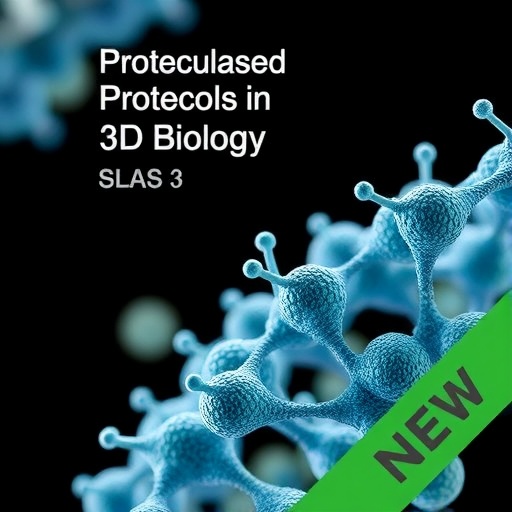
A groundbreaking new volume of SLAS Discovery, Volume 38, has been released, marking a significant advance in the field of drug discovery and cellular biology. This issue brings together a diverse collection of cutting-edge research articles, reviews, and a special editorial spotlighting revolutionary protocols in three-dimensional (3D) biology. The work featured in this volume not only highlights technical innovations but also showcases transformative methodologies that are reshaping how 3D cell culture systems are implemented for drug discovery and biomedical research.
At the forefront, the review article titled “From Large to Small Cytokine Receptor Antagonists” offers an insightful exploration into the transition from biological drugs to small molecule modulators targeting cytokine receptors. By examining the lessons learned from pivotal cytokines such as TNFα and IL-17, the article unpacks the challenges and opportunities in designing antagonists that can modulate immune signaling pathways effectively. It also discusses the future potential of novel therapeutic modalities, including extracellular degraders and oral peptides, which could revolutionize treatments for previously elusive cytokine targets like TSLP and TL1A.
In the realm of screening technologies, one of the original research pieces introduces a novel application of the enzyme-linked immunosorbent assay (ELISA) adapted for discovering protein-protein interaction inhibitors. Utilizing the spirochete flagellar hook as a test case, the research demonstrates how this assay effectively identifies compounds that disrupt lysinoalanine crosslinking between protein subunits. Screening a substantial chemical library of approximately 700 molecules, the study not only reaffirms the inhibitory effects of known compounds but also uncovers promising new candidates, including honokiol and zafirlukast. This innovative assay platform promises to accelerate the identification of small molecules capable of targeting intricate protein interfaces, which have historically been challenging to drug.
Another pioneering work addresses throughput bottlenecks in cellular thermal shift assays (CETSA), a technique used to confirm drug-target engagement in biological contexts. Two remarkable technological advancements are presented: an isothermal 1536-well ultra-high throughput screening (uHTS) platform featuring controlled thermal ramp-up combined with luminescence detection, and a Gradient Peltier Device that facilitates comprehensive melt curve analysis in a single assay plate. These technological strides overcome longstanding limitations of scale and resolution in thermal shift assays. Validation against fluorescence polarization data using the androgen receptor as a benchmark affirms the robustness and sensitivity of these improvements, underscoring their suitability for large-scale screening campaigns.
Further advancing drug-target engagement quantification, the MICRO-TAG method emerges as a novel fluorescence-based split-RNase S complementation assay. Unlike traditional thermal shift methods that rely on a single melting temperature, MICRO-TAG quantifies binding across programmable temperature series within living cells. Tested on key oncogenic and cellular proteins including MAPK1, KRAS, and UBE2N, this approach offers a sensitive, scalable, and physiologically relevant alternative to in vitro biophysical assays. Such advances could substantially improve early-stage drug discovery by providing accurate engagement data directly in cell-based contexts.
Volume 38 also prominently features a Special Issue editorial and collection focusing on “Protocols in 3D Biology: Technologies and Methodologies Reshaping 3D Cell Culture.” This thematic cluster presents an integrated vision where bioprinting, automated bioreactors, and artificial intelligence-driven analytical tools coalesce to push 3D cell culture beyond experimental setups into practical, high-throughput New Approach Methodologies (NAMs). These cutting-edge platforms have demonstrated efficacy in modeling complex human tissues and disease states — ranging from patient-derived cancer organoids to engineered skeletal muscle spheroids and organotypic barrier models. The synergistic deployment of these approaches heralds a new era of predictive, human-relevant platforms for pharmaceutical development, promising to reduce reliance on traditional animal models and improve translational outcomes.
The integration of enzyme complementation techniques, sophisticated thermal profiling, and scalable screening platforms within living cellular environments represents a notable advance in drug discovery sciences. These innovations collectively enhance the fidelity, throughput, and applicability of target engagement assessments, crucial parameters for optimizing lead compounds during the drug development pipeline. By embracing these technologies, scientists can better characterize molecular interactions and pharmacodynamics within physiologically relevant systems, accelerating the path from hit identification to clinical candidates.
Through its rigorous editorial standards and focus on translational impact, SLAS Discovery continues to cement its role as a pivotal journal at the intersection of advanced technology and biology in drug discovery. Volume 38 represents a vibrant testament to the journal’s commitment to publishing high-impact research that bridges the gap between fundamental biological insights and applied therapeutic innovation. Researchers, academicians, and industry professionals alike will find the curated content invaluable for navigating the evolving landscape of drug discovery tools and methodologies.
This volume not only equips researchers with new experimental tools but also illustrates the importance of adopting automated, integrated workflows in modern biological research. The application of large-scale screening approaches combined with precise quantification methods underscores a broader trend towards data-rich, high-throughput experimentation. These capabilities are particularly transformative in the context of 3D cell cultures, where replicating physiological conditions poses unique challenges that conventional two-dimensional cultures cannot address.
SLAS Discovery’s focus on enveloping emerging technologies such as AI-driven analysis within biological protocols reflects an acute understanding of the future trajectory of drug discovery. Automation, high-content imaging, and machine learning algorithms are poised to revolutionize data analytics, enabling unprecedented resolution and predictive modeling in complex biological systems. The special issue protocols illuminate these trends, demonstrating practical platforms that incorporate real-time data acquisition, temperature regulation, and biophysical assessment for a mechanistic understanding of drug action.
As 3D cell culture platforms become increasingly integrated with scalable automation and analytical tools, their utility in personalized medicine and disease modeling expands. The research featured in this volume showcases patient-derived organoid systems and tissue models that recapitulate disease heterogeneity and microenvironmental factors, fostering improved drug screening and therapeutic development workflows. By embracing these sophisticated technologies, the field moves closer to realizing more human-relevant testing platforms that can replace or complement traditional animal models, thereby enhancing ethical standards and translational fidelity.
In summary, SLAS Discovery Volume 38 provides a vibrant snapshot of state-of-the-art innovations pushing the frontiers in drug discovery and 3D biology. From novel assay platforms capable of tackling protein-protein interactions, to advanced thermal profiling techniques and the systematic deployment of automation in 3D cell culture, this issue exemplifies the dynamic, interdisciplinary nature of contemporary biomedical research. It sets a benchmark for future studies striving to unravel molecular complexity within biologically relevant contexts and underscores the critical role of technology in shaping next-generation therapeutic discovery.
Subject of Research: Advances in drug discovery technologies, 3D cell culture methodologies, and cellular assays for protein-target engagement.
Article Title: SLAS Discovery Volume 38: Protocols and Innovations Transforming 3D Biology and Drug Discovery.
News Publication Date: 2024
Web References:
- SLAS Discovery Journal
- Review – From Large to Small Cytokine Receptor Antagonists
- ELISA for Protein-Protein Interaction Inhibitors
- Streamlining Cellular Thermal Shift Assay
- MICRO-TAG Enzyme Complementation
Image Credits: SLAS Publishing
Keywords: Drug discovery, High-throughput screening, Protein-protein interaction inhibitors, Cellular thermal shift assay, 3D cell culture, Bioprinting, Automation, Artificial intelligence, Organotypic models, Small molecule therapeutics.


