


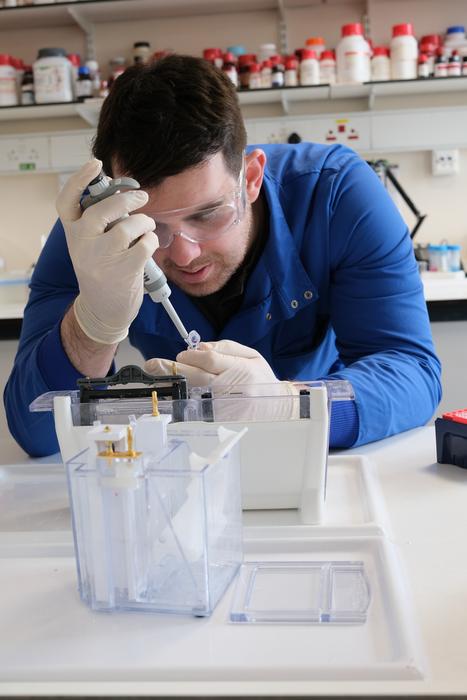
Researchers have developed a new vaccine technology that has been shown in mice to provide protection against a broad range of coronaviruses with potential for future disease outbreaks – including ones we don’t even know about.

Credit: Jacqueline Garget
Researchers have developed a new vaccine technology that has been shown in mice to provide protection against a broad range of coronaviruses with potential for future disease outbreaks – including ones we don’t even know about.
This is a new approach to vaccine development called ‘proactive vaccinology’, where scientists build a vaccine before the disease-causing pathogen even emerges.
The new vaccine works by training the body’s immune system to recognise specific regions of eight different coronaviruses, including SARS-CoV-1, SARS-CoV-2, and several that are currently circulating in bats and have potential to jump to humans and cause a pandemic.
Key to its effectiveness is that the specific virus regions the vaccine targets also appear in many related coronaviruses. By training the immune system to attack these regions, it gives protection against other coronaviruses not represented in the vaccine – including ones that haven’t even been identified yet.
For example, the new vaccine does not include the SARS-CoV-1 coronavirus, which caused the 2003 SARS outbreak, yet it still induces an immune response to that virus.
“Our focus is to create a vaccine that will protect us against the next coronavirus pandemic, and have it ready before the pandemic has even started,” said Rory Hills, a graduate researcher in the University of Cambridge’s Department of Pharmacology and first author of the report.
He added: “We’ve created a vaccine that provides protection against a broad range of different coronaviruses – including ones we don’t even know about yet.”
The results are published today in the journal Nature Nanotechnology.
“We don’t have to wait for new coronaviruses to emerge. We know enough about coronaviruses, and different immune responses to them, that we can get going with building protective vaccines against unknown coronaviruses now,” said Professor Mark Howarth in the University of Cambridge’s Department of Pharmacology, senior author of the report.
He added: “Scientists did a great job in quickly producing an extremely effective COVID vaccine during the last pandemic, but the world still had a massive crisis with a huge number of deaths. We need to work out how we can do even better than that in the future, and a powerful component of that is starting to build the vaccines in advance.”
The new ‘Quartet Nanocage’ vaccine is based on a structure called a nanoparticle – a ball of proteins held together by incredibly strong interactions. Chains of different viral antigens are attached to this nanoparticle using a novel ‘protein superglue’. Multiple antigens are included in these chains, which trains the immune system to target specific regions shared across a broad range of coronaviruses.
This study demonstrated that the new vaccine raises a broad immune response, even in mice that were pre-immunised with SARS-CoV-2.
The new vaccine is much simpler in design than other broadly protective vaccines currently in development, which the researchers say should accelerate its route into clinical trials.
The underlying technology they have developed also has potential for use in vaccine development to protect against many other health challenges.
The work involved a collaboration between scientists at the University of Cambridge, the University of Oxford, and Caltech. It improves on previous work, by the Oxford and Caltech groups, to develop a novel all-in-one vaccine against coronavirus threats. The vaccine developed by Oxford and Caltech should enter Phase 1 clinical trials in early 2025, but its complex nature makes it challenging to manufacture which could limit large-scale production.
Conventional vaccines include a single antigen to train the immune system to target a single specific virus. This may not protect against a diverse range of existing coronaviruses, or against pathogens that are newly emerging.
Journal
Nature Nanotechnology
Method of Research
Experimental study
Subject of Research
Animals
Article Title
Proactive vaccination using multiviral Quartet Nanocages to elicit broad anti-coronavirus responses.
Article Publication Date
6-May-2024
Cite Scienmag News
Kristina Jarvis. (May 6, 2024). New vaccine effective against coronaviruses that haven’t even emerged yet. Scienmag. https://scienmag.com/new-vaccine-effective-against-coronaviruses-that-havent-even-emerged-yet/
Kristina Jarvis. "New vaccine effective against coronaviruses that haven’t even emerged yet." Scienmag, 6 May 2024, https://scienmag.com/new-vaccine-effective-against-coronaviruses-that-havent-even-emerged-yet/. Accessed 3 September 2026.
Kristina Jarvis. "New vaccine effective against coronaviruses that haven’t even emerged yet." Scienmag. May 6, 2024. https://scienmag.com/new-vaccine-effective-against-coronaviruses-that-havent-even-emerged-yet/

