


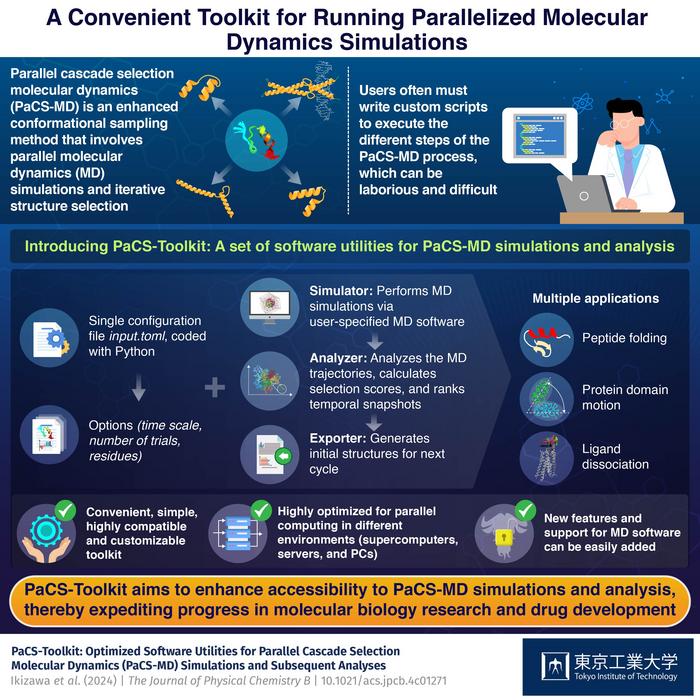
Molecular dynamics (MD) simulations have become a powerful tool in the ever-growing fields of molecular biology and drug development. While many MD simulation techniques exist, parallel cascade selection MD (PaCS-MD) is a particularly useful one when studying the folding (or ‘conformation’) of proteins or the interactions between proteins and ligands.

Credit: Tokyo tech
Molecular dynamics (MD) simulations have become a powerful tool in the ever-growing fields of molecular biology and drug development. While many MD simulation techniques exist, parallel cascade selection MD (PaCS-MD) is a particularly useful one when studying the folding (or ‘conformation’) of proteins or the interactions between proteins and ligands.
The crux of this method consists of running multiple MD simulations in parallel, thereby exploring different possible conformations simultaneously. Using carefully crafted selection criteria, promising conformations can be detected automatically in ‘temporal snapshots’ and investigated further. This strategy greatly accelerates the discovery of key molecular interactions and dynamic processes that help scientists understand protein functional motions.
However, one of the hurdles of PaCS-MD is that users must write custom scripts to execute their desired MD simulations. In these scripts, they must specify the initial conditions and target features, select MD software to use, implement a snapshot ranking procedure, and prepare the initial structures for the next simulation cycle. This process, which can be quite complex and error-prone, creates a considerable entry barrier for scientists interested in using PaCS-MD.
Fortunately, a team of researchers from the School of Life Science and Technology at Tokyo Institute of Technology, Japan, recently set out to address this issue. In their latest study, which was published in The Journal of Physical Chemistry B and led by Professor Akio Kitao, the team developed a software package called PaCS-Toolkit to make PaCS-MD more accessible and convenient to use.
One notable advantage of PaCS-Toolkit is that the entire simulation process is set up via a single configuration file. In this file, the users specify important parameters for the simulations, including the type of PaCS-MD, the number of MD simulations to run in parallel, and the protein residues or atoms to keep track of as selection criteria for parallel branches.
PaCS-Toolkit takes this configuration file, alongside standard MD input files, and runs PaCS-MD simulations according to the MD software specified. Worth noting, that since the package is open software written in Python—a popular programming language—users can help improve PaCS-Toolkit and extend its functionalities. “Our toolkit maintains flexibility so that new features, libraries, and MD software can be added by introducing responsible classes in Python. Users who can program in this language should be able to modify the code of PaCS-Toolkit and implement new methods as needed,” highlights Prof. Kitao.
Another crucial advantage of PaCS-Toolkit lies in its optimization and compatibility with different computing environments, be it an array of supercomputers with a message passing interface (MPI), servers equipped with multiple graphics cards (GPUs), or personal computers such as laptops. “PaCS-Toolkit heavily incorporates parallelization using MPI, GPU, and the multiprocessing package of Python, enabling optimization of the computation time depending on the available computational resources,” explains Prof. Kitao.
To showcase the potential of their toolkit, the researchers conducted PaCS-MD simulations tailored for three different applications. These included the folding of the mini-protein chignolin, the motion of protein domains in a SARS-CoV-2 enzyme, and ligand dissociation from an important adenosine receptor. “Taken together, our results indicate that PaCS-Toolkit can be easily utilized to simulate a wide variety of dynamics for different types of molecular systems,” concludes Prof. Kitao.
With any luck, this innovative toolkit will help unlock the true potential of PaCS-MD simulations in various fields, enabling interested researchers to shed light on complex molecular processes and accelerate drug discovery.
Journal
The Journal of Physical Chemistry B
Method of Research
Experimental study
Subject of Research
Not applicable
Article Title
PaCS-Toolkit: Optimized Software Utilities for Parallel Cascade Selection Molecular Dynamics (PaCS-MD) Simulations and Subsequent Analyses
Article Publication Date
5-Apr-2024
Cite Scienmag News
Bethany Barker. (April 23, 2024). New toolkit makes molecular dynamics simulations more accessible! Scienmag. https://scienmag.com/new-toolkit-makes-molecular-dynamics-simulations-more-accessible/
Bethany Barker. "New toolkit makes molecular dynamics simulations more accessible!" Scienmag, 23 April 2024, https://scienmag.com/new-toolkit-makes-molecular-dynamics-simulations-more-accessible/. Accessed 4 September 2026.
Bethany Barker. "New toolkit makes molecular dynamics simulations more accessible!" Scienmag. April 23, 2024. https://scienmag.com/new-toolkit-makes-molecular-dynamics-simulations-more-accessible/

