


Researchers at the Center for Nanomedicine within the Institute for Basic Science (IBS) and Yonsei University in South Korea have unveiled a groundbreaking technology that can manipulate specific regions of the brain using magnetic fields, potentially unlocking the secrets of high-level brain functions such as cognition, emotion, and motivation. The team has developed the world’s first Nano-MIND (Magnetogenetic Interface for NeuroDynamics) technology, which allows for wireless, remote, and precise modulation of specific deep brain neural circuits using magnetism.

Credit: Institute for Basic Science
Researchers at the Center for Nanomedicine within the Institute for Basic Science (IBS) and Yonsei University in South Korea have unveiled a groundbreaking technology that can manipulate specific regions of the brain using magnetic fields, potentially unlocking the secrets of high-level brain functions such as cognition, emotion, and motivation. The team has developed the world’s first Nano-MIND (Magnetogenetic Interface for NeuroDynamics) technology, which allows for wireless, remote, and precise modulation of specific deep brain neural circuits using magnetism.
The human brain contains over 100 billion neurons interconnected in a complex network. Controlling the neural circuits is crucial for understanding higher brain functions like cognition, emotion, and social behavior, as well as identifying the causes of various brain disorders. Novel technology to control brain functions also has implications for advancing brain-computer interfaces (BCIs), such as those being developed by Neuralink, which aim to enable control of external devices through thought alone.
While magnetic fields have long been used in medical imaging due to their safety and ability to penetrate biological tissue, precisely controlling brain circuits with magnetic fields has been a significant challenge for scientists.
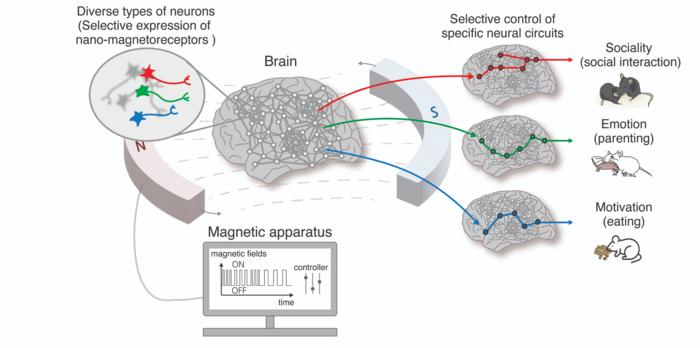
Researchers at the IBS have successfully developed a cutting-edge magnetogenetics technology called Nano-MIND, which enables wireless and remote control of specific brain regions to modulate complex brain functions such as emotions, social behaviors, and motivation in animals. This advanced technology leverages magnetic fields and magnetized nanoparticles to selectively activate targeted brain circuits. The key innovation lies in the selective expression of nano-magnetoreceptors in specific neuronal types and brain circuits and activating them with rotating magnetic fields at precise moments, allowing for spatiotemporal control of neural activity.
First, the Nano-MIND technology demonstrated its capability by selectively activating inhibitory GABA receptors in the medial preoptic area (MPOA), which is responsible for maternal behaviors. Activation of these neurons in non-maternal female mice significantly increased nurturing behaviors, such as bringing pups to their nest, similar to maternal mice.
Additionally, the technology was used to regulate feeding behaviors by targeting motivation circuits in the lateral hypothalamus. Activation of inhibitory neurons within these areas resulted in a 100% increase in appetite and feeding behaviors in mice. Conversely, activating excitatory neurons led to a more than 50% reduction in appetite and feeding behaviors.
These results show that nano-MIND technology can selectively activate desired brain circuits to bidirectionally modulate higher brain functions, paving the way for advancements in neuroscience and potential therapeutic applications.
Director CHEON Jinwoo of the Center for Nanomedicine stated, “This is the world’s first technology to freely control specific brain regions using magnetic fields. We expect it to be widely used in research to understand brain functions, sophisticated artificial neural networks, two-way BCI technologies, and new treatments for neurological disorders.”
This study was published in Nature Nanotechnology on July 2, 2023.
Journal
Nature Nanotechnology
Method of Research
Experimental study
Subject of Research
Animals
Article Title
In vivo magnetogenetics for cell-type-specific targeting and modulation of brain circuits
Article Publication Date
2-Jul-2024
Cite Scienmag News
Cassandra Pierce. (July 17, 2024). New technology to control the brain using magnetic fields developed. Scienmag. https://scienmag.com/new-technology-to-control-the-brain-using-magnetic-fields-developed/
Cassandra Pierce. "New technology to control the brain using magnetic fields developed." Scienmag, 17 July 2024, https://scienmag.com/new-technology-to-control-the-brain-using-magnetic-fields-developed/. Accessed 5 September 2026.
Cassandra Pierce. "New technology to control the brain using magnetic fields developed." Scienmag. July 17, 2024. https://scienmag.com/new-technology-to-control-the-brain-using-magnetic-fields-developed/

