

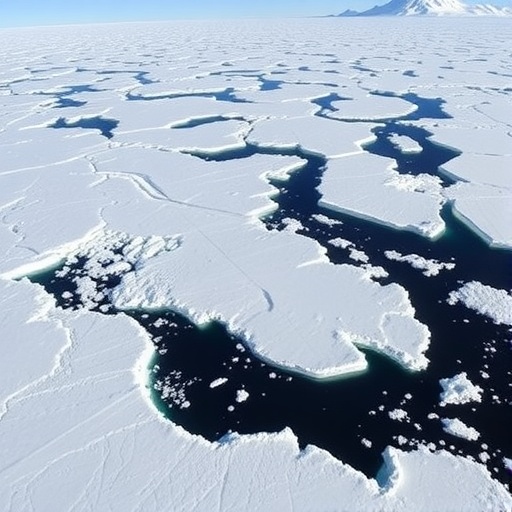
A startling paradox has long puzzled the scientific community: why did Antarctic sea ice extent increase steadily from the 1970s up until 2015 despite the overarching trend of global warming? The answer to this enigma, according to groundbreaking research from Stanford University, lies beneath the icy surface of the Southern Ocean. Using a wealth of data from autonomous robotic probes, the study reveals how subtle changes in oceanic heat and precipitation dynamics have orchestrated a dramatic and unprecedented shift in Antarctic sea ice, culminating in the abrupt decline seen after 2015.
For decades, scientists watched in awe as Antarctic sea ice expansively defied expectations, growing rather than shrinking in a warming world. This trend mystified researchers, who associated rising atmospheric and ocean temperatures with diminishing ice in polar regions. However, in a sudden reversal beginning in 2016, the Antarctic lost sea ice at record-breaking rates, plunging the region into what scientists are now calling a “low-ice era.” Until now, the causes of this sharp downturn had remained elusive, obscured by the complexity of the interaction between ocean, atmosphere, and ice.
The study, spearheaded by Earle Wilson, Assistant Professor of Earth System Science at Stanford’s Doerr School of Sustainability, has unveiled a critical mechanism driving these dramatic shifts. According to Wilson, the interplay between increased precipitation and intensified oceanic upwelling has been a key factor. Over prior decades, enhanced snowfall and rainfall deposited fresh water atop the ocean’s surface, creating a less dense, less saline “lid” that trapped warmer waters beneath. This stratification effectively insulated the ocean’s subsurface heat from escaping, fostering an environment conducive to sea ice expansion even against the tide of rising temperatures.
However, this delicate balance changed with the momentum of increasingly stormy weather conditions circling Antarctica—phenomena likely linked to human-driven climate change. Strengthened winds and heightened storm activity amplified the upwelling of warmer, deeper waters to the surface. Once this upwelled heat surged upward past the stratified lid, it rapidly melted sea ice, sparking the precipitous ice retreat seen from 2016 onward. Wilson describes this dynamic contest between precipitation-driven stratification and wind-driven upwelling as a seesaw, with precipitation maintaining its dominance for decades before upwelling ultimately tipping the scale.
This investigation leverages an extraordinary, yet often overlooked data trove collected by the global Argo float array. Over the past 25 years, these autonomous robotic floats have revolutionized oceanography by drifting below the ocean surface to record temperature, salinity, and other vital parameters. Notably, some floats operate beneath Antarctic seasonal ice, surfacing during the austral summer to transmit invaluable under-ice data that provide rare glimpses into these hidden environments. By compiling and analyzing two decades of this under-ice oceanographic dataset, Wilson and colleagues were able to pinpoint the subtle oceanic conditions that have governed sea ice variability across Antarctica.
One of the most striking revelations from this data was the early onset of upwelled warm water infiltration. The warm ocean layer, typically residing a few hundred meters below the surface at about two to three degrees Celsius, had begun surfacing years before the sea ice downturn became evident. This finding suggested that another modulating factor was delaying the ice melt, prompting a closer examination of the ocean’s salinity profiles. The researchers discovered that surging precipitation over the Southern Ocean had bolstered salinity stratification, hindering vertical heat transfer and temporarily insulating the sea ice from the subsurface heat anomaly.
This ocean layering phenomenon holds profound implications for how the Southern Ocean exchanges heat with the atmosphere and global climate system. The less saline, buoyant surface waters act as a barrier preventing warm, salty subsurface waters from mixing upward. Yet as storm intensities increased, the resultant winds and turbulence eroded this stratification, facilitating the ventilation of ocean heat to the surface, where its impact on sea ice was immediate and severe.
Intriguingly, this stratification and heat ventilation process does not manifest uniformly around Antarctica. The study highlights marked differences between the Atlantic-facing and Pacific-facing sectors of the Southern Ocean. While the Atlantic sector exhibits the stratified layering and warming-driven retreat pattern, the Pacific sector—spanning from the Antarctic Peninsula to the Ross Sea—experienced ocean cooling in its interior waters amid the ice loss phase. This contradictory behavior remains a tantalizing mystery, underscoring that multiple, spatially heterogeneous mechanisms influence Antarctic sea ice trends.
Wilson and his team anticipate that other processes, such as variations in sea ice drift and escalated turbulent mixing driven by more frequent storms, are at play particularly in the Pacific sector. These factors may induce oceanic and atmospheric interactions not captured solely by the Argo float data, pointing to the need for multifaceted approaches combining observations, models, and satellite data to unravel the full complexity of the system.
Beyond shedding light on Antarctic sea ice dynamics, this research carries profound ramifications for global climate understanding. The Southern Ocean is a linchpin within the Earth’s climate network, regulating ocean circulation patterns—often described as the planet’s conveyor belt—and sequestering large quantities of heat and carbon dioxide generated by anthropogenic emissions. Sea ice extent in this region influences ocean-atmosphere heat exchange, ocean salinity gradients, and marine ecosystems. Therefore, grasping the mechanisms governing its variability is essential for improving projections related to Antarctic ice sheet mass loss, sea level rise, and broader climate system feedbacks.
Furthermore, the ocean’s inherent long-term memory, retaining thermal and salinity anomalies for years to decades, allows it to drive multiyear climate variability that weather patterns alone cannot explain. This research lays a foundation for developing predictive tools that incorporate the ocean’s nuanced memory effects to better anticipate the trajectory of Antarctic sea ice in an era of rapid climate transformation.
As Wilson eloquently puts it, “We plan to continue monitoring the ocean data and work toward developing a theory that will help us anticipate changes in Antarctic sea ice extent in decades to come.” By integrating robust observational datasets with innovative modeling, the scientific community can move beyond mere description towards actionable predictive understanding. This study stands as a testament to the power of interdisciplinary research harnessing cutting-edge technology to decode vital components of our planet’s future.
The rich insights yielded by the Argo float dataset, supported by the National Science Foundation and the Washington Research Foundation, underscore the value of sustained ocean observation efforts. The collaboration between academic institutions, including the University of Washington, and extensive funding from philanthropic sources highlight the importance of coordinated investment in climate science infrastructure. As the climate crisis deepens, efforts like these will be indispensable for dissecting complex Earth system processes and informing policy decisions worldwide.
In sum, the remarkable expansion and abrupt retreat of Antarctic sea ice over recent decades are emblematic of the intricate, interconnected forces shaping our planet’s polar regions. This study elevates our understanding of how ocean heat ventilation, governed by precipitation-induced stratification and wind-driven upwelling, dictates the fate of the Southern Ocean’s icy mantle. As the scientific community continues to probe these mysteries, such revelations refine our awareness of global climate feedbacks and enhance the fidelity of future climate projections critical for humanity’s adaptive responses.
Subject of Research: Antarctic sea ice extent variability and ocean heat dynamics
Article Title: Recent extremes in Antarctic sea ice extent modulated by ocean heat ventilation
News Publication Date: March 23, 2026
Web References: https://www.pnas.org/doi/10.1073/pnas.253083212
References: Wilson, E. et al. Recent extremes in Antarctic sea ice extent modulated by ocean heat ventilation. Proceedings of the National Academy of Sciences, 2026.
Image Credits: [Not provided in the original source]
Keywords: Antarctic sea ice, Southern Ocean, ocean heat ventilation, salinity stratification, climate change, ocean upwelling, Argo floats, polar ocean dynamics, sea ice variability, ocean-atmosphere interactions


