

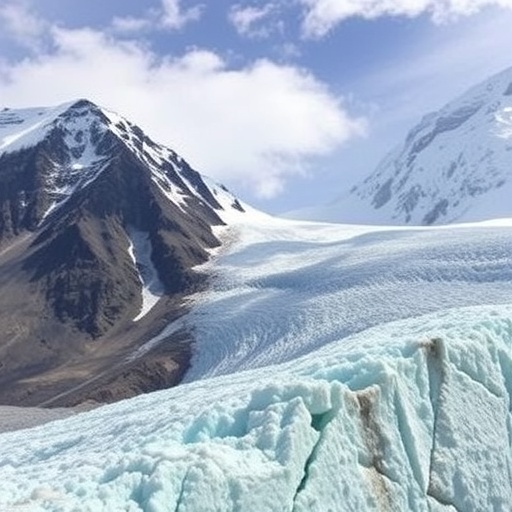
In recent years, the dynamics of glacier behavior have captured the attention of glaciologists and climate scientists alike, not only because of their role as indicators of climate change but also due to their complex physical processes and potential hazards. While the majority of glaciers worldwide are exhibiting retreat caused by global warming, a fascinating and perilous subset behaves differently. These are known as surging glaciers—a phenomenon whereby glaciers undergo abrupt, dramatic increases in flow velocity, sometimes advancing substantially over just a few years. This dynamic behavior is not only scientifically intriguing but also presents acute risks to human settlements and infrastructure in mountainous regions.
An extensive interdisciplinary study, spearheaded by researchers from the University of Portsmouth, has meticulously compiled and analyzed data on over 3,100 known surging glaciers globally. This study reveals that surging glaciers tend not to be randomly distributed. Instead, they congregate in strikingly dense clusters in specific geographical and climatic zones, notably the Arctic, High Mountain Asia, and the Andes. These regions provide the necessary physical and climatic conditions that facilitate the build-up and sudden release of vast ice masses through glacier surges.
Surge events radically alter glacier dynamics. Typically, glaciers move at relatively slow, stable rates dictated by ice deformation and basal sliding. However, during a surge, the velocity can increase by an order of magnitude or more, resulting in rapid ice mass delivery to glacier fronts. These surges can last several years and are often separated by quiescent intervals that can span decades, during which the glacier accumulates strain energy or mass in a manner akin to a charging battery. When released, this stored mass discharges abruptly, causing potentially catastrophic impacts in downstream areas.
The recent investigation not only maps surge-type glaciers with unprecedented detail but also delves into the climactic and geological variables dictating their locations and behaviors. Key findings indicate that although surge-type glaciers constitute just about 1% of all glaciers worldwide, they occupy nearly 20% of the global glacier surface area. This disproportion highlights their significance in glaciological mass balance research and hazard assessment.
One of the most critical insights from the study is the identification of 81 glaciers that pose exceptional risks due to their sizes, proximity to human populations, and histories of repeated surges. The Karakoram Mountains emerge as a hotspot for dangerous glacier surging, where surges threaten populous valleys and vital infrastructure. This finding is alarming for residents and planners alike, emphasizing the urgent necessity for effective monitoring and disaster mitigation strategies in high-mountain regions.
Glacier surges present an array of hazards that transcend simple ice movement. Among the most damaging is glacier advance, where ice overruns human developments, obliterating roads, farmland, and even habitations. Furthermore, surging glaciers can block rivers, creating temporary and often unstable ice dams. The subsequent catastrophic failure of these dams often results in glacial lake outburst floods—one of the most devastating natural disasters in mountainous terrain.
Meltwater dynamics during surges also contribute to hazard complexity. Sudden releases of water stored beneath glaciers can initiate floods with little warning. Additionally, surges provoke surface fracturing and widespread crevassing due to dramatic increases in ice velocity. Because glaciers often serve as transit routes between isolated settlements or are used for mountaineering and tourism, surging-induced crevasses create significant safety challenges, impeding transport and disrupting economic activities.
The study also surfaces the peril of sudden glacier detachments, which can send massive ice and rock avalanches downhill with devastating impacts. When glaciers surge seaward into marine environments, they discharge numerous icebergs rapidly, complicating navigation and posing risks to shipping lanes and marine tourism. Altogether, these multifaceted hazards call for comprehensive risk assessments and localized adaptation plans.
Compounding these concerns, climate change is fundamentally altering the frequency, intensity, and spatial distribution of glacier surges. The research highlights that warming is increasing the unpredictability of surges, often destabilizing long-established surge cycles. For example, anomalous weather events such as intense rainfall or unusually warm summers have been observed to trigger surges earlier than anticipated, disrupting hazard prediction models.
This evolving climatic influence leads to a regionally varied pattern. In some areas, surges have become more frequent in recent decades, while in others, they have diminished or ceased entirely, likely due to the glaciers losing sufficient mass to sustain surging behavior. Moreover, as glaciers in traditional surge regions shrink rapidly, the phenomenon may migrate to new areas, such as parts of the Canadian and Russian Arctic where increasing meltwater accelerates the potential for surges.
One of the striking hypotheses posited by the investigators is the possibility of surging glaciers emerging in regions where they have not been previously recorded, such as the Antarctic Peninsula. This prospect is scientifically profound, as it suggests that the rules governing glacier surge mechanics may be modified by ongoing climate perturbations in a manner not previously understood.
Experts emphasize that the increasing unpredictability of surges, driven by more frequent extreme weather events and ongoing warming, complicates efforts to safeguard vulnerable mountain communities. Improved surveillance incorporating satellite monitoring, augmented field observations, and sophisticated computational modeling must be prioritized to anticipate and mitigate associated risks effectively.
The findings of this work underscore a pressing need for enhanced interdisciplinary collaboration and investment in glacier sciences. As glaciologists and climate scientists deepen their understanding of surge dynamics, integrating the latest data into hazard management frameworks will be essential for protecting millions who live in or near surging glacier zones. The study serves as a clarion call to the global scientific community and policymakers alike: surging glaciers are both physical oddities and formidable natural threats with growing significance in a warming world.
Subject of Research: Glacier surging and surge-related hazards in the context of climate change
Article Title: Glacier surging and surge-related hazards in a changing climate
News Publication Date: 12-Feb-2026
Web References: http://dx.doi.org/10.1038/s43017-025-00757-9
Keywords: Glaciology, Glacier surging, Climate change, Glacier hazards, Mountain hazards, Ice dynamics


