


Ann Arbor, May 1, 2024 – During the past 40 years, the gap between rich and poor Americans has continued to widen in terms of health and mortality, as well as income.

Credit: Southern Community Cohort Study
Ann Arbor, May 1, 2024 – During the past 40 years, the gap between rich and poor Americans has continued to widen in terms of health and mortality, as well as income.
Now, in a first-of-its-kind study of an extremely low-income and predominantly Black population, researchers at Vanderbilt University Medical Center found that people who earned less than $15,000 a year died, on average, more than 10 years earlier than those whose annual income exceeded $50,000.
Addressing racial and income disparities in mortality requires a comprehensive approach. Ultimately, “efforts to improve income equality are crucial in reducing mortality and health disparities among low-income Americans,” the researchers reported recently in the American Journal of Preventive Medicine, published by Elsevier.
The paper’s corresponding author, Wei Zheng, MD, PhD, MPH, director of the Vanderbilt Epidemiology Center, noted, “Tobacco smoking is the leading cause of death in the US. However, we found that in this low-income population excess risk of death due to poverty is greater in magnitude than tobacco smoking.”
The study included 79,385 participants aged 40 to 79 in the ongoing Southern Community Cohort Study, the majority of whom were recruited at community health centers in 12 southeastern states between 2002 and 2009. Approximately two thirds of cohort members are Black.
More than half of the study participants reported an annual household income of less than $15,000, providing a unique opportunity to evaluate the impact of extreme poverty on mortality in a racially diverse low-income population.
Participants completed questionnaires that collected data about their health and lifestyle/behavioral factors associated with disease risk and death, including cigarette smoking, alcohol consumption, physical activity, and the quality of the foods they ate.
The study analyzed 19,749 deaths in this group that occurred during a period of about 18 years from the time participants joined the cohort.
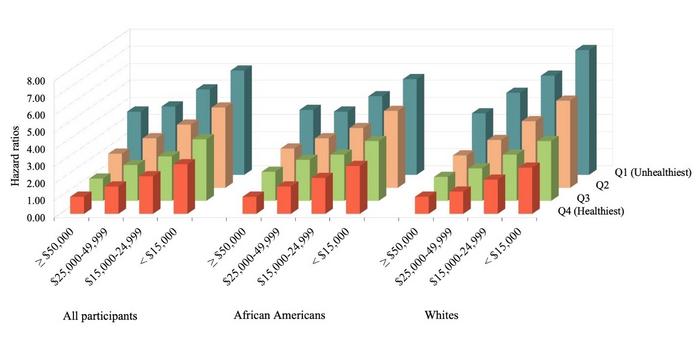
Individuals in the low-income group (less than $15,000 in annual income) who had the worst lifestyle score based on risk factors identified in the questionnaire, had a 6.1-fold increase in mortality, compared to those in the highest-income group (more than $50,000) who had the best lifestyle score.
Low-income participants with the best lifestyle scores had a lower cumulative mortality than those in the high-income group with the worst lifestyle scores, supporting the impact that behavioral and lifestyle factors have on health and lifespan.
Because low-income communities tend to have a limited availability of healthy food options and less access to healthcare or to safe, walkable environments that are conducive to regular physical exercise, encouraging healthy behaviors and lifestyles cannot fully mitigate the adverse effects of poverty on mortality, the researchers cautioned.
Among those in the high-income group, White participants had a lower cumulative mortality risk than Black participants. But the situation was reversed in the low-income group — Whites had a higher cumulative mortality than Blacks.
In the high-income group, the average age at death was 82.7 years for Whites and 81.2 years for Blacks. In the low-income group, the average age at death was 67.8 years for Whites and 70.9 years for Blacks.
Despite the healthier lifestyle practiced by some participants, the disparity in life expectancy between the two income groups ranged from about 10 years for Blacks to nearly 15 years for Whites.
The researchers concluded, “This estimate is alarming and calls for evaluation of policy and public health strategies to reduce mortality and health disparities in low-income Americans. Without interventions on this specific population to decouple low income and health, further widening and hardening SES (socioeconomic status) gaps might be seen in health.”
Journal
American Journal of Preventive Medicine
Method of Research
Data/statistical analysis
Subject of Research
People
Article Title
Impacts of Poverty and Lifestyles on Mortality: A Cohort Study in Predominantly Low-Income Americans,
Cite Scienmag News
Courtney Benton. (May 1, 2024). New study shows the dramatic impact of extreme poverty on mortality in a racially diverse low-income population. Scienmag. https://scienmag.com/new-study-shows-the-dramatic-impact-of-extreme-poverty-on-mortality-in-a-racially-diverse-low-income-population/
Courtney Benton. "New study shows the dramatic impact of extreme poverty on mortality in a racially diverse low-income population." Scienmag, 1 May 2024, https://scienmag.com/new-study-shows-the-dramatic-impact-of-extreme-poverty-on-mortality-in-a-racially-diverse-low-income-population/. Accessed 5 September 2026.
Courtney Benton. "New study shows the dramatic impact of extreme poverty on mortality in a racially diverse low-income population." Scienmag. May 1, 2024. https://scienmag.com/new-study-shows-the-dramatic-impact-of-extreme-poverty-on-mortality-in-a-racially-diverse-low-income-population/

