
Saturday, February 28, 2026
Science
No Result
View All Result
  • Login
  • HOME
  • SCIENCE NEWS
  • CONTACT US
  • HOME
  • SCIENCE NEWS
  • CONTACT US
No Result
View All Result
Scienmag
No Result
View All Result
Home Science News Bussines

New study shows the dramatic impact of extreme poverty on mortality in a racially diverse low-income population

May 1, 2024
in Bussines
Reading Time: 3 mins read
0
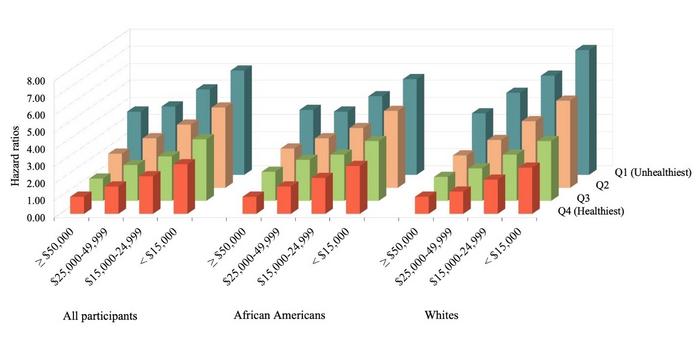
Joint associations of annual household income and the lifestyle score with all-cause mortality by race, the Southern Community Cohort Study
67
SHARES
605
VIEWS
Share on FacebookShare on Twitter
ADVERTISEMENT

Ann Arbor, May 1, 2024 – During the past 40 years, the gap between rich and poor Americans has continued to widen in terms of health and mortality, as well as income.

Joint associations of annual household income and the lifestyle score with all-cause mortality by race, the Southern Community Cohort Study

Credit: Southern Community Cohort Study

Ann Arbor, May 1, 2024 – During the past 40 years, the gap between rich and poor Americans has continued to widen in terms of health and mortality, as well as income.

Now, in a first-of-its-kind study of an extremely low-income and predominantly Black population, researchers at Vanderbilt University Medical Center found that people who earned less than $15,000 a year died, on average, more than 10 years earlier than those whose annual income exceeded $50,000.

Addressing racial and income disparities in mortality requires a comprehensive approach. Ultimately, “efforts to improve income equality are crucial in reducing mortality and health disparities among low-income Americans,” the researchers reported recently in the American Journal of Preventive Medicine, published by Elsevier.

The paper’s corresponding author, Wei Zheng, MD, PhD, MPH, director of the Vanderbilt Epidemiology Center, noted, “Tobacco smoking is the leading cause of death in the US. However, we found that in this low-income population excess risk of death due to poverty is greater in magnitude than tobacco smoking.”

The study included 79,385 participants aged 40 to 79 in the ongoing Southern Community Cohort Study, the majority of whom were recruited at community health centers in 12 southeastern states between 2002 and 2009. Approximately two thirds of cohort members are Black.

More than half of the study participants reported an annual household income of less than $15,000, providing a unique opportunity to evaluate the impact of extreme poverty on mortality in a racially diverse low-income population.

Participants completed questionnaires that collected data about their health and lifestyle/behavioral factors associated with disease risk and death, including cigarette smoking, alcohol consumption, physical activity, and the quality of the foods they ate.

The study analyzed 19,749 deaths in this group that occurred during a period of about 18 years from the time participants joined the cohort.

Individuals in the low-income group (less than $15,000 in annual income) who had the worst lifestyle score based on risk factors identified in the questionnaire, had a 6.1-fold increase in mortality, compared to those in the highest-income group (more than $50,000) who had the best lifestyle score.

Low-income participants with the best lifestyle scores had a lower cumulative mortality than those in the high-income group with the worst lifestyle scores, supporting the impact that behavioral and lifestyle factors have on health and lifespan.

Because low-income communities tend to have a limited availability of healthy food options and less access to healthcare or to safe, walkable environments that are conducive to regular physical exercise, encouraging healthy behaviors and lifestyles cannot fully mitigate the adverse effects of poverty on mortality, the researchers cautioned.

Among those in the high-income group, White participants had a lower cumulative mortality risk than Black participants. But the situation was reversed in the low-income group — Whites had a higher cumulative mortality than Blacks.

In the high-income group, the average age at death was 82.7 years for Whites and 81.2 years for Blacks. In the low-income group, the average age at death was 67.8 years for Whites and 70.9 years for Blacks.

Despite the healthier lifestyle practiced by some participants, the disparity in life expectancy between the two income groups ranged from about 10 years for Blacks to nearly 15 years for Whites.

The researchers concluded, “This estimate is alarming and calls for evaluation of policy and public health strategies to reduce mortality and health disparities in low-income Americans. Without interventions on this specific population to decouple low income and health, further widening and hardening SES (socioeconomic status) gaps might be seen in health.”


Journal

American Journal of Preventive Medicine

DOI

10.1016/j.amepre.2024.02.015

Method of Research

Data/statistical analysis

Subject of Research

People

Article Title

Impacts of Poverty and Lifestyles on Mortality: A Cohort Study in Predominantly Low-Income Americans,

Share27Tweet17
Previous Post

Social-media break has huge impact on young women’s body image: York U study

Next Post

New York State is vulnerable to increasing weather-driven power outages, with vulnerable people in the Bronx, Queens and other parts of New York City being disproportionately affected

Related Posts

blank
Bussines

Modeling Study Reveals Lower International Donor Funding Increases Household Economic Burden of Tuberculosis in Low- and Middle-Income Countries

February 27, 2026
blank
Bussines

New Study Uncovers Why Global IT Strategies Adapt Locally—and How Leaders Can Navigate the Shift

February 26, 2026
blank
Bussines

Telemedicine Visits Cost Five Times Less Than In-Person Appointments, Study Finds

February 26, 2026
blank
Bussines

As Healthcare Embraces Digitalization, Patients Struggle to Keep Up

February 25, 2026
blank
Bussines

New Study Reveals Smarter Shelf Strategies Could Increase Retail Profits and Slash Food Waste by Over 20%

February 25, 2026
blank
Bussines

Introducing Vote3D-AD: A Breakthrough Framework for Unsupervised Anomaly Detection in Point Clouds

February 25, 2026
Next Post
New York State is vulnerable to increasing weather-driven power outages, with vulnerable people in the Bronx, Queens and other parts of New York City being disproportionately affected

New York State is vulnerable to increasing weather-driven power outages, with vulnerable people in the Bronx, Queens and other parts of New York City being disproportionately affected

  • Mothers who receive childcare support from maternal grandparents show more parental warmth, finds NTU Singapore study

    Mothers who receive childcare support from maternal grandparents show more parental warmth, finds NTU Singapore study

    27618 shares
    Share 11044 Tweet 6902
  • University of Seville Breaks 120-Year-Old Mystery, Revises a Key Einstein Concept

    1022 shares
    Share 409 Tweet 256
  • Bee body mass, pathogens and local climate influence heat tolerance

    665 shares
    Share 266 Tweet 166
  • Researchers record first-ever images and data of a shark experiencing a boat strike

    532 shares
    Share 213 Tweet 133
  • Groundbreaking Clinical Trial Reveals Lubiprostone Enhances Kidney Function

    517 shares
    Share 207 Tweet 129
Science

Embark on a thrilling journey of discovery with Scienmag.com—your ultimate source for cutting-edge breakthroughs. Immerse yourself in a world where curiosity knows no limits and tomorrow’s possibilities become today’s reality!

RECENT NEWS

  • Physical Activity Slows Aging-Related Physical Decline
  • X-ray Activated Platinum Complex Boosts Cancer Immunotherapy
  • New Study Shows Belzutifan and Pembrolizumab Combo Extends Cancer-Free Survival in High-Risk Kidney Cancer Patients After Surgery
  • Botulinum Toxin Causes Masseter Atrophy via Autophagy Impairment

Categories

  • Agriculture
  • Anthropology
  • Archaeology
  • Athmospheric
  • Biology
  • Biotechnology
  • Blog
  • Bussines
  • Cancer
  • Chemistry
  • Climate
  • Earth Science
  • Editorial Policy
  • Marine
  • Mathematics
  • Medicine
  • Pediatry
  • Policy
  • Psychology & Psychiatry
  • Science Education
  • Social Science
  • Space
  • Technology and Engineering

Subscribe to Blog via Email

Enter your email address to subscribe to this blog and receive notifications of new posts by email.

Join 5,190 other subscribers

© 2025 Scienmag - Science Magazine

Welcome Back!

Login to your account below

Forgotten Password?

Retrieve your password

Please enter your username or email address to reset your password.

Log In
No Result
View All Result
  • HOME
  • SCIENCE NEWS
  • CONTACT US

© 2025 Scienmag - Science Magazine

Discover more from Science

Subscribe now to keep reading and get access to the full archive.

Continue reading