

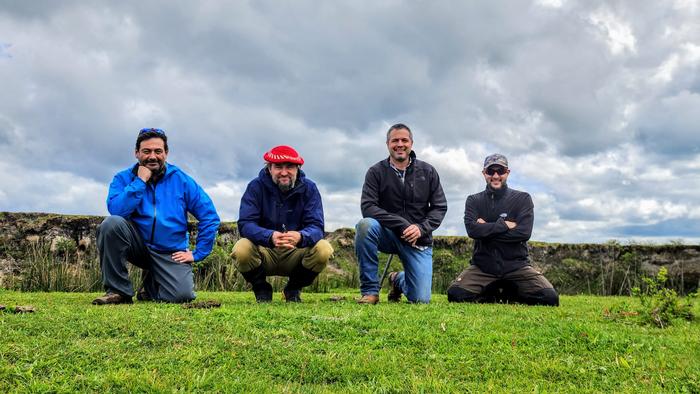
In a groundbreaking challenge to long-standing beliefs about the earliest human settlements in the Americas, new research spearheaded by University of Wyoming archaeologist Professor Todd Surovell revisits the enigmatic Monte Verde site in southern Chile. This iconic location, long touted as a cornerstone for understanding human migration into South America, is now dated to a much younger era than previously believed. Contrary to decades of accepted research placing human activity there at approximately 14,500 years ago, the latest study asserts the site’s occupation occurred between 4,200 and 8,200 years ago—a revelation with profound implications for archaeology and the peopling of the Americas.
Monte Verde gained immense prominence in the archaeological world after its acceptance 29 years ago transformed theories regarding the timing and routes of early human migration into the Americas. Previously, Monte Verde stood as pivotal evidence disproving the “Clovis-first” theory, which posited that the earliest Americans were Clovis point users moving southward from the Beringia land bridge around 13,000 to 14,200 years ago. The acceptance of a much older Monte Verde site opened the door to hypotheses asserting an earlier coastal migration pattern along the Pacific, challenging conventional wisdom about the ice-free corridor and migration timings.
Surovell, collaborating with Claudio Latorre and colleagues from Chile’s Pontificia Universidad Católica, Austria’s BOKU University, and the U.S. Geological Survey, embarked on an independent, meticulous analysis of Monte Verde’s stratigraphy and radiocarbon dating evidence. Their multi-year investigation applied stratigraphic integrity assessments, sedimentological analysis, and rigorous radiocarbon dating techniques on nine alluvial deposits along the Chinchihuapi Creek, proximal to the site. Their results compellingly suggest that prior datings, which supported the ancient age for human presence, were compromised by redeposited materials skewing the radiocarbon timeline.
Integral to their argument is the reevaluation of organic materials, particularly Ice Age wood intermingled within younger archaeological deposits, which had misled earlier radiocarbon estimates. The reassessment reveals these older wood samples were displaced by erosional and depositional processes along the creek, not directly associated with human activity layers. This important distinction clarifies why materials appearing to date back over 14,000 years do not correspond to the actual timeframe of human occupation, which is demonstrably more recent.
Compounding this stratigraphic reinterpretation is the recognition of 11,000-year-old volcanic ash embedded beneath the archaeological layers containing human evidence. If the site’s earliest human presence truly predated this volcanic event, the ash layer should lie above the occupation levels. Its absence above these layers disputes the former timeline and substantiates the revised, younger chronology that coincides with the mid-Holocene epoch.
With the revised dating framework, the surface context yielding Monte Verde artifacts did not even exist until after 8,600 years ago, contradicting fundamental premises that supported the older Monte Verde age. This temporal adjustment not only alters the direct archaeological narrative at Monte Verde but also requires a reexamination of broader migration models and timelines for human colonization across South America.
This study’s seismic implications ripple into the ongoing debates surrounding early human migration routes into the Americas. The coastal migration hypothesis, upheld largely due to Monte Verde’s previously accepted antiquity, loses a pivotal pillar. The prospect of initial human migration through the interior ice-free corridor of North America gains renewed credibility as a more viable first entry route, dating to just over 13,000 years ago. This realignment calls for a reassessment of numerous archaeological sites and migration theories dependent on the coastal corridor narrative.
Moreover, the research aligns with previous findings by Surovell and others which questioned early pre-Clovis dates at various archaeological sites throughout North and South America. These earlier studies highlighted issues with stratigraphic integrity and temporal mixing of artifacts, cautioning against uncritical acceptance of purported early human occupation claims. The new Monte Verde study substantiates this skepticism, emphasizing the necessity for rigorous, independent verification of iconic archaeological sites.
This reassessment does not deny the possibility of humans arriving in the Americas prior to 13,000 to 14,000 years ago entirely but stresses the lack of unambiguous, well-dated archaeological evidence supporting such claims south of the continental ice sheets. It underscores the scientific process’s evolving nature, where new methods and perspectives refine or overturn previous paradigms in light of fresh data and analysis.
Martín Batres of the University of Santiago, commenting on the study’s impact, emphasizes that the reevaluation “invites a critical reconsideration of the archaeological and paleoenvironmental records that have shaped our understanding of prehistoric human mobility and adaptation.” As ancient human migrations remain at the forefront of archaeological inquiry, this study underscores the importance of integrating geological, stratigraphic, and radiometric disciplines to unravel complex site formation histories accurately.
The Monte Verde site remains invaluable for its cultural and archaeological artifacts but its role as the earliest settlement in the Southern Hemisphere demands revision. By repositioning its timeline firmly within the mid-Holocene, researchers open new avenues for investigating later waves of migration, environmental adaptations, and technological developments influencing human dispersal throughout the continent.
Technologically, this study highlights advances in sedimentology, radiocarbon dating calibration, and geoarchaeological analysis that enable more precise temporal resolution. By disentangling natural depositional phenomena from human activity layers, the research showcases how archaeological narratives must incorporate environmental processes influencing artifact assemblages to avoid anachronistic conclusions.
The study, published in the premier scientific journal Science, invites archaeologists, anthropologists, and geologists to revisit and critically evaluate the chronology of early American sites. It challenges textbook orthodoxy and promotes a dynamic, data-driven understanding of humanity’s ancient past, affirming that the saga of the Americas’ first peoples is still unfolding with new discoveries and interpretations continuously reshaping historical landscapes.
Subject of Research: People
Article Title: A Mid-Holocene Age for Monte Verde Challenges the Timeline of Human Colonization of South America
News Publication Date: 19 March 2026
Web References: http://dx.doi.org/10.1126/science.adw9217
Image Credits: Todd Surovell
Keywords: Monte Verde, human migration, South America archaeology, Clovis culture, radiocarbon dating, stratigraphic analysis, mid-Holocene, early American settlements, coastal migration hypothesis, ice-free corridor, paleoindian archaeology, geoarchaeology


