

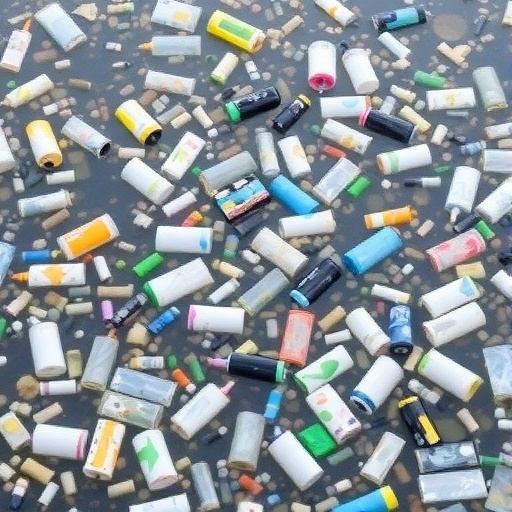
Plastic pollution has emerged as one of the most pressing environmental challenges facing the world today, largely driven by the ubiquitous use of plastic products in modern society. As these plastics accumulate in various ecosystems, their impact on marine life and human health has become increasingly apparent. Rivers, serving as the vascular networks connecting terrestrial environments to the ocean, act as major conduits for plastic debris transported from urban landscapes, agricultural regions, and forested areas. However, understanding the dynamics of how plastics, especially microplastics and mesoplastics, move through river systems during different hydrological scenarios remains incomplete, particularly under the extreme conditions of flooding.
Microplastics (particles smaller than 5 millimeters) and mesoplastics (ranging from 5 to 25 millimeters) originate largely from the fragmentation of larger plastic debris over time. These plastic particles infiltrate ecosystems beyond their point of origin and penetrate biological food webs, ultimately threatening biodiversity and potentially contaminating human food supplies. Accurate quantification of these plastics’ presence and flux in riverine environments is critical for formulating effective mitigation policies. Yet, while many studies have focused on measuring plastic concentrations during normal, low-flow periods in rivers, the contribution of flood events to plastic transport remains underexplored.
Recognizing this gap, Assistant Professor Mamoru Tanaka and Professor Yasuo Nihei from Tokyo University of Science embarked on a groundbreaking study to characterize and quantify microplastic and mesoplastic fluxes during flood events in multiple Japanese river systems. Unlike previous observational research, their study uniquely involved collecting river water samples during active flood episodes, allowing for a direct and time-resolved assessment of plastic concentration changes as the river discharge fluctuated. This approach provided unprecedented insight into the temporal dynamics of plastic pollution transport associated with extreme weather events.
The research encompassed field campaigns across four Japanese rivers distinguished by varied catchment characteristics, including urban development, agriculture, and forests, all with relatively high population densities. Over six significant rainfall events, ranging widely in precipitation intensity from about 9 to 118 millimeters, researchers collected surface water samples hourly for over a twelve-hour window. This sampling strategy ensured comprehensive coverage of the rising limb, peak, and recession of each flood hydrograph. Alongside microplastic and mesoplastic quantification, turbidity measurements were performed to offer auxiliary data on suspended sediment, a potential proxy for plastic particle transport.
Findings from this intensive field campaign were striking: microplastic and mesoplastic concentrations during flooding amplified by factors ranging from tenfold to over ten thousand times compared to low-flow baselines. This dramatic increase correlates with prior assumptions that floodwaters mobilize large reservoirs of plastic waste deposited on urban surfaces and rural landscapes, flushing them into rivers through sewer infrastructure, drainage systems, and surface runoff. Capturing this enhanced plastic load during high-flow conditions underscores the critical need to integrate flood event measurements into assessments of river-borne plastic pollution.
A core component of the study was the analysis of load–discharge (L–Q) relationships, a hydrological framework typically utilized for describing how sediment loads scale with river discharge. Applying this framework to plastic pollution reveals systematic relationships between the total mass of plastics transported and river discharge. The research demonstrated that, for the studied rivers, plastic fluxes could be reliably estimated through L–Q scaling laws, though the specific parameters differed between catchments. Surprisingly, no clear link was established between variations in L–Q behavior and catchment attributes such as land use or population density, indicating that flood-driven plastic transport may be governed by complex, site-specific factors.
Perhaps the most consequential revelation from this study lies in the temporal concentration of plastic emissions. The analysis showed that short-duration, high-discharge events, often accounting for less than two months of the year, can be responsible for the vast majority of annual plastic fluxes discharged into the ocean. In one example river, up to 90% of the yearly mesoplastic load occurred within just 43 days. This highly skewed distribution implies that ignoring flood periods in monitoring efforts could grossly underestimate riverine contributions to marine plastic contamination.
Furthermore, a strong correlation between suspended sediment concentrations, as gauged by turbidity, and microplastic and mesoplastic loads was detected. This relationship suggests that regular sediment monitoring programs could serve as cost-effective proxies for estimating plastic pollution, streamlining long-term monitoring without requiring labor-intensive direct plastic quantification. Such an approach could greatly enhance the ability of environmental agencies to track and manage plastic emissions on a regional and global scale.
The implications of these findings extend beyond the immediate scientific community, offering valuable knowledge for public education and policy formulation. The L–Q relationships described enable stakeholders to approximate plastic emission volumes under varying hydrological regimes by utilizing readily measurable river flow data. This empowers communities and decision-makers to visualize plastic pollution burdens numerically, fostering greater awareness and guiding targeted interventions.
Professor Yasuo Nihei emphasizes the significance of these results for environmental governance: “Our study not only quantifies the dramatic surges in plastic pollution during flooding but also provides a practical toolset for incorporating these dynamics into monitoring and management frameworks. Understanding the timing and magnitude of plastic transport is vital for developing policies that reduce plastic loads entering ocean systems.”
By spotlighting the role of flood events in mobilizing plastic debris, this research challenges conventional assessments of riverine plastic export that have predominantly focused on stable flow conditions. It prompts a paradigm shift towards integrating the episodic but intense influence of extreme weather conditions driven by increasingly variable climate patterns. That integration is essential to reconcile global plastic emission estimates with observed pollution levels in marine environments.
In conclusion, this landmark observational study from Tokyo University of Science advances the frontiers of knowledge on the hydrological controls of plastic pollution transport. It elucidates the mechanisms and temporal scales at which rivers discharge microplastics and mesoplastics, underpinning more accurate global plastic budgets and more effective environmental strategies. As floods escalate with climate change, accounting for their outsized impact on plastic mobilization will be indispensable for safeguarding aquatic ecosystems and human health worldwide.
Subject of Research:
Not applicable
Article Title:
How flooding rivers deliver plastic to the ocean: A case study of microplastic and mesoplastic load–discharge relationships
News Publication Date:
1-Mar-2026
References:
DOI: 10.1016/j.watres.2025.125175
Image Credits:
Assistant Professor Mamoru Tanaka from Tokyo University of Science, Japan
Keywords:
Pollution, Floods, Water quality, Climate change, Rivers, Water pollution, Oceans, Ecology, Plastics


