


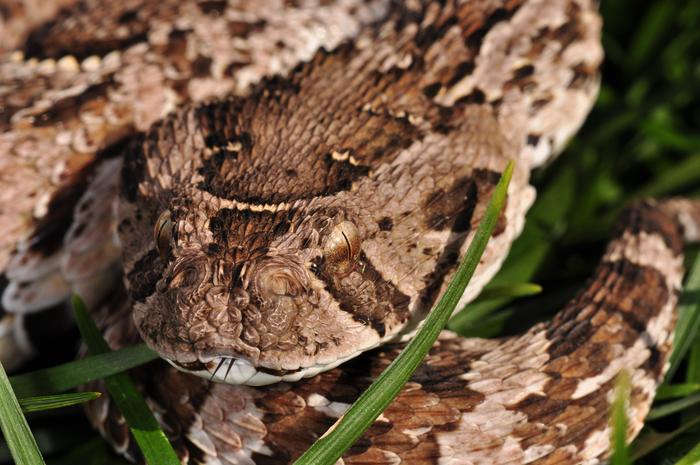
In the realm of sustainable agriculture, the use of natural predators to manage pest populations is increasingly celebrated for reducing reliance on chemical interventions. New research emerging from the University of the Witwatersrand in Johannesburg, South Africa, has spotlighted an unlikely yet formidable candidate in this ecological toolkit: the puff adder (Bitis arietans). This widespread African venomous snake, traditionally viewed with apprehension and often persecuted, may hold the key to revolutionizing rodent pest management across diverse farming landscapes.
Rodent outbreaks present a perennially daunting challenge to African agriculture, especially during periods of high rainfall when rodent populations explode, causing millions of dollars in crop damage annually. Conventional strategies to mitigate these outbreaks heavily depend on costly chemical rodenticides and trapping efforts that carry ecological risks and variable effectiveness. However, the study led by Professor Graham Alexander elucidates how puff adders naturally regulate these rodent surges with remarkable efficiency and ecological finesse, demonstrating a predator-prey dynamic that could be harnessed to safeguard food security sustainably.
Employing an innovative metric termed the “factorial scope of ingestion,” this research quantifies the remarkable capacity of puff adders to elevate their feeding rates well above standard maintenance requirements. Fascinatingly, puff adders can consume rodent prey at a rate exceeding twelve times their basal metabolic needs during periods of prey abundance. This degree of trophic flexibility far surpasses that observed in many traditional mammalian rodent predators, such as weasels and lynx, positioning puff adders as uniquely capable biocontrol agents in African agroecosystems.
Physiologically, puff adders exhibit extraordinary adaptations that enable this predatory efficiency. Their ability to ingest multiple rodents—sometimes up to ten—in a single venom-assisted feeding session, followed by readiness to resume hunting within a week, ensures a highly dynamic response to fluctuating prey populations. Moreover, their metabolic resilience allows them to endure prolonged fasting periods of up to two years when prey becomes scarce, effectively functioning as ‘on-call’ biological controllers that can swiftly capitalize on rodent population rebounds without the need for immediate prey availability.
This ecological resilience and predatory adaptability make puff adders indispensable agents in dampening rodent population oscillations before they escalate to plague proportions. By dynamically adjusting their hunting intensity in response to prey density cues, they minimize the likelihood of unchecked rodent booms that devastate subsistence and commercial crops alike. Such a system offers a compelling alternative to labor- and resource-intensive pest management, aligning agroecological approaches with broader biodiversity conservation goals.
The implications of this predator-prey interaction extend beyond mere pest control. The study underscores that the natural abundance and wide geographical distribution of puff adders across African habitats multiply their collective impact on rodent suppression. While an individual puff adder’s consumption volume at any one time may be less than that of a fox or mongoose, their sheer population density imparts a formidable aggregate predatory pressure. This distributed predation network enhances ecosystem stability and agricultural resilience simultaneously.
From a biochemical standpoint, the venom composition and strike efficacy of puff adders play critical functional roles in their predatory success. The neurotoxic and cytotoxic properties of their venom facilitate rapid immobilization of small mammalian prey, minimizing energy expenditure during hunting and reducing escape probabilities. This venom efficiency, combined with the snake’s cryptic ambush predatory behavior, positions puff adders as optimal natural candidates for targeted rodent control strategies that leverage evolutionary honed traits.
Furthermore, the study calls into question the pervasive negative perceptions and often lethal human responses toward snakes in agricultural areas. By reframing the puff adder not as an undesirable pest but as a vital component in ecosystem service delivery, conservationist and agricultural stakeholders are urged to integrate snake population management into pest control paradigms. Such integration promises to yield synergistic benefits, advancing both crop protection and snake conservation objectives.
From a methodological perspective, the application of the ‘factorial scope of ingestion’ metric offers a novel quantitative framework for assessing predator impact in ecological pest management. This approach moves beyond simplistic prey consumption metrics to incorporate predator physiological plasticity and population dynamics, providing a robust basis for predictive modeling of predator-prey interactions under varying environmental conditions. The resulting data empowers informed decision-making regarding species protection priorities and ecosystem management interventions.
Applying this knowledge, agricultural policy and extension services across the African continent stand to benefit from revised guidelines that promote habitat conservation for puff adders and other native snake species. Preserving refugia and reducing the use of rodenticides that indiscriminately harm non-target fauna will be paramount in cultivating balanced ecosystems where puff adders can thrive. This, in turn, supports farmers in achieving sustainable yields with reduced chemical inputs and enhanced ecological integrity.
The ecological narrative woven by this research exemplifies a paradigm shift in agricultural pest management strategy, one rooted deeply in leveraging natural biological relationships rather than artificial control mechanisms. It further exemplifies the multifaceted role predators play in ecosystem regulation, offering insights applicable not only within African agriculture but potentially in diverse global agroecosystems facing rodent pest pressures.
In conclusion, the findings detailed by Professor Graham Alexander and his team present a compelling case for integrating puff adders into holistic, sustainable pest control frameworks. Recognizing these snakes as essential partners in agricultural success necessitates a reexamination of entrenched biases and implementation of conservation-friendly policies. By doing so, farmers and ecologists alike can foster resilient food production systems that harmonize with Africa’s rich biodiversity and evolving environmental challenges.
—
News Publication Date: [Not specified in the source content]
Web References: [Not specified in the source content]
References: Published in Scientific Reports; specific citation details not provided.
Cite Scienmag News
Margaret Porter. (May 20, 2025). New Study Highlights Puff Adders as Key to Conservation and Rodent Management. Scienmag. https://scienmag.com/new-study-highlights-puff-adders-as-key-to-conservation-and-rodent-management/
Margaret Porter. "New Study Highlights Puff Adders as Key to Conservation and Rodent Management." Scienmag, 20 May 2025, https://scienmag.com/new-study-highlights-puff-adders-as-key-to-conservation-and-rodent-management/. Accessed 4 September 2026.
Margaret Porter. "New Study Highlights Puff Adders as Key to Conservation and Rodent Management." Scienmag. May 20, 2025. https://scienmag.com/new-study-highlights-puff-adders-as-key-to-conservation-and-rodent-management/


