

Saturday, May 2, 2026
Science
No Result
View All Result
  • Login
  • HOME
  • SCIENCE NEWS
  • CONTACT US
  • HOME
  • SCIENCE NEWS
  • CONTACT US
No Result
View All Result
Scienmag
No Result
View All Result
Home Science News Technology and Engineering

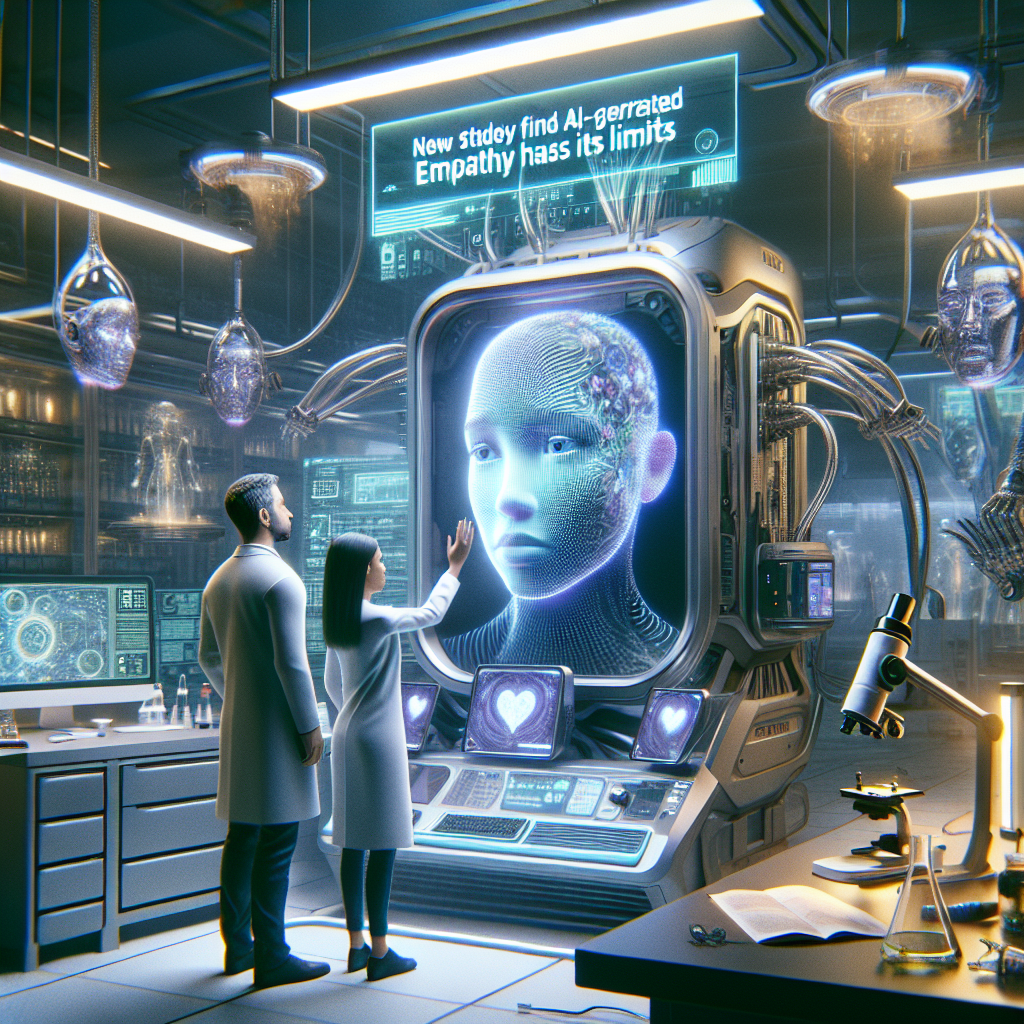
New study finds AI-generated empathy has its limits

May 8, 2024
in Technology and Engineering
Reading Time: 2 mins read
0
New study finds AI-generated empathy has its limits
66
SHARES
598
VIEWS
Share on FacebookShare on Twitter
ADVERTISEMENT

ITHACA, N.Y. – Conversational agents (CAs) such as Alexa and Siri are designed to answer questions, offer suggestions – and even display empathy. However, new research finds they do poorly compared to humans when interpreting and exploring a user’s experience.

ITHACA, N.Y. – Conversational agents (CAs) such as Alexa and Siri are designed to answer questions, offer suggestions – and even display empathy. However, new research finds they do poorly compared to humans when interpreting and exploring a user’s experience.

CAs are powered by large language models (LLMs) that ingest massive amounts of human-produced data, and thus can be prone to the same biases as the humans from which the information comes.

Researchers from Cornell University, Olin College and Stanford University tested this theory by prompting CAs to display empathy while conversing with or about 65 distinct human identities.

The team found that CAs make value judgments about certain identities – such as gay and Muslim – and can be encouraging of identities related to harmful ideologies, including Nazism.

“I think automated empathy could have tremendous impact and huge potential for positive things – for example, in education or the health care sector,” said lead author Andrea Cuadra, now a postdoctoral researcher at Stanford.

“It’s extremely unlikely that it (automated empathy) won’t happen,” she said, “so it’s important that as it’s happening, we have critical perspectives so that we can be more intentional about mitigating the potential harms.”

Cuadra will present “The Illusion of Empathy? Notes on Displays of Emotion in Human-Computer Interaction” at CHI ’24, the Association of Computing Machinery conference on Human Factors in Computing Systems, May 11-18 in Honolulu. Research co-authors at Cornell University included Nicola Dell, associate professor, Deborah Estrin, professor of computer science and Malte Jung, associate professor of information science.

Researchers found that, in general, LLMs received high marks for emotional reactions, but scored low for interpretations and explorations. In other words, LLMs are able to respond to a query based on their training but are unable to dig deeper.

Dell, Estrin and Jung said there were inspired to think about this work as Cuadra was studying the use of earlier-generation CAs by older adults.

“She witnessed intriguing uses of the technology for transactional purposes such as frailty health assessments, as well as for open-ended reminiscence experiences,” Estrin said. “Along the way, she observed clear instances of the tension between compelling and disturbing ‘empathy.’”

Funding for this research came from the National Science Foundation; a Cornell Tech Digital Life Initiative Doctoral Fellowship; a Stanford PRISM Baker Postdoctoral Fellowship; and the Stanford Institute for Human-Centered Artificial Intelligence.

For additional information, see this Cornell Chronicle story.

-30-


DOI

10.1145/3613904.3642336

Article Title

The Illusion of Empathy? Notes on Displays of Emotion in Human-Computer Interaction

Share26Tweet17
Previous Post

ECOG-ACRIN adds another trial to the ComboMATCH precision oncology study platform

Next Post

Homes heated by human sewage could be a reality thanks to Aston University

Related Posts

Early Detection of Keratoconus Enhanced by Light Polarization and AI — Technology and Engineering
Technology and Engineering

Early Detection of Keratoconus Enhanced by Light Polarization and AI

May 2, 2026
SNU Researchers Create Battery-Free, Skin-Conforming Wearable Technology — Technology and Engineering
Technology and Engineering

SNU Researchers Create Battery-Free, Skin-Conforming Wearable Technology

May 1, 2026
Strategies to Prevent Supply Chain Disruptions Amid the Rapid Growth of Drone and Robot Manufacturing — Technology and Engineering
Technology and Engineering

Strategies to Prevent Supply Chain Disruptions Amid the Rapid Growth of Drone and Robot Manufacturing

May 1, 2026
Dan M. Frangopol Wins Third ASCE Wellington Prize for Pioneering Infrastructure Resilience Research — Technology and Engineering
Technology and Engineering

Dan M. Frangopol Wins Third ASCE Wellington Prize for Pioneering Infrastructure Resilience Research

May 1, 2026
Allied Health Impact on Preterm Infant Nutrition — Technology and Engineering
Technology and Engineering

Allied Health Impact on Preterm Infant Nutrition

May 1, 2026
Cu-Ion Crosslinked Membranes Boost High-Temp Fuel Cells — Technology and Engineering
Technology and Engineering

Cu-Ion Crosslinked Membranes Boost High-Temp Fuel Cells

May 1, 2026
Next Post
Dr Jude Onwudili

Homes heated by human sewage could be a reality thanks to Aston University

  • Mothers who receive childcare support from maternal grandparents show more parental warmth, finds NTU Singapore study

    Mothers who receive childcare support from maternal grandparents show more parental warmth, finds NTU Singapore study

    27639 shares
    Share 11052 Tweet 6908
  • University of Seville Breaks 120-Year-Old Mystery, Revises a Key Einstein Concept

    1042 shares
    Share 417 Tweet 261
  • Bee body mass, pathogens and local climate influence heat tolerance

    677 shares
    Share 271 Tweet 169
  • Researchers record first-ever images and data of a shark experiencing a boat strike

    540 shares
    Share 216 Tweet 135
  • Groundbreaking Clinical Trial Reveals Lubiprostone Enhances Kidney Function

    527 shares
    Share 211 Tweet 132
Science

Embark on a thrilling journey of discovery with Scienmag.com—your ultimate source for cutting-edge breakthroughs. Immerse yourself in a world where curiosity knows no limits and tomorrow’s possibilities become today’s reality!

RECENT NEWS

  • Family Health Needs of Disabled Elders Explored
  • Mcu Controls Bone Growth Through Mitochondrial Calcium
  • Physical Disorders, ADLs, Cognition, Depression in Nursing Homes
  • Precise Spatiotemporal Cardiac Repair and Regeneration

Categories

  • Agriculture
  • Anthropology
  • Archaeology
  • Athmospheric
  • Biology
  • Biotechnology
  • Blog
  • Bussines
  • Cancer
  • Chemistry
  • Climate
  • Earth Science
  • Editorial Policy
  • Marine
  • Mathematics
  • Medicine
  • Pediatry
  • Policy
  • Psychology & Psychiatry
  • Science Education
  • Social Science
  • Space
  • Technology and Engineering

Subscribe to Blog via Email

Success! An email was just sent to confirm your subscription. Please find the email now and click 'Confirm Follow' to start subscribing.

Join 5,146 other subscribers

© 2025 Scienmag - Science Magazine

Welcome Back!

Login to your account below

Forgotten Password?

Retrieve your password

Please enter your username or email address to reset your password.

Log In
No Result
View All Result
  • HOME
  • SCIENCE NEWS
  • CONTACT US

© 2025 Scienmag - Science Magazine
