


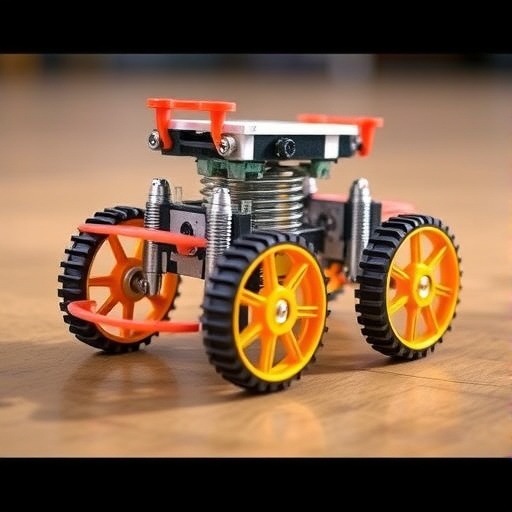
Wheels are superb at carrying robots across smooth ground, but the moment the terrain turns vertical, most wheeled machines grind to a halt. A curb, a ledge, a fallen pipe, or a step in an industrial facility can strand a robot that would otherwise be perfect for inspection or exploration work. A research team led by Jing Tian and Zhicheng He of Hunan University’s State Key Laboratory of Advanced Design and Manufacturing for Vehicle Body, working with Yijie Chen of the China North Vehicle Research Institute and Eric Li of Teesside University, has now addressed this bottleneck at its root: not in motors, batteries, or control software, but in the fundamental architecture of the jumping mechanism itself. Their study, published in the International Journal of Intelligent Robotics and Applications, introduces a computationally driven design framework that produces a six-bar linkage capable of making wheeled robots jump dramatically higher while drawing less torque from their motors than comparable existing designs.
The core problem the researchers tackled is a familiar one in robotics laboratories: jumping mechanisms have historically been designed through empirical trial and error. An engineer sketches a linkage, builds it, tests it, discovers the energy storage is unstable or the jump height is disappointing, and starts again. This iterative paradigm is slow, and it rarely converges on the best possible configuration. Worse, it tends to decouple two goals that are deeply intertwined: the precision of the foot trajectory during takeoff and the density with which elastic elements can store energy before release. A mechanism whose foot wanders off its intended path during the energy storage phase wastes energy, destabilizes the robot, and can even tip the machine over before the jump begins. The Hunan-led team argued that configuration design, the choice of how many links a mechanism has and how they are connected, is the fundamental determinant of jumping performance, and that it deserves a rigorous optimization treatment rather than intuition.
Their solution rests on a modeling technique known as the Spring-Connected Rigid Block Model, or SBM. In this representation, a linkage mechanism is abstracted as a collection of rigid blocks connected by zero-length springs. The positions, shapes, and angular orientations of the blocks define the mechanism’s geometry, while the stiffnesses of the connecting springs encode its topology, meaning the pattern of joints and links. By treating spring stiffnesses as design variables that can be driven toward zero or toward finite values, the model allows a computer to gradually transform one mechanism topology into another during optimization. In effect, the algorithm can discover linkage architectures that a human designer might never sketch on a whiteboard. The SBM approach has previously been applied to synthesizing planar linkages with revolute joints, vehicle suspensions, transformable wheels, and steering linkages, but the new work extends it into the demanding domain of jumping robot actuation, where dynamic energy storage and trajectory fidelity must be handled simultaneously.
The framework the team built integrates three optimization objectives into a single design pipeline. The first is rapid topological optimization of the mechanism, allowing the algorithm to search across linkage configurations efficiently. The second is trajectory accuracy optimization, which minimizes the deviation between the actual path traced by the mechanism’s foot and an ideal takeoff trajectory. The third, and arguably the most novel, is energy storage density optimization, which maximizes the elastic energy that can be accumulated in the mechanism’s storage springs for a given package size and mass. The researchers derived analytical sensitivity expressions for each of these objectives and their constraints, using the chain rule to propagate derivatives through the block positions, spring stiffnesses, and transformation matrices at every time step. These sensitivities feed gradient-based optimizers, including the method of moving asymptotes, enabling the coupled problem to converge far faster than black-box approaches would allow.
Running this framework produced a novel six-bar jumping mechanism, a configuration with one additional bar beyond the classic four-bar linkages used in many existing jumping robots, including the well-known Ascento two-wheeled jumping robot developed at ETH Zurich. The extra degrees of freedom in the linkage give the optimizer room to shape the foot trajectory with much finer control, and the results were striking. In simulations, when compared against the Ascento four-bar robot at the same mass, the new six-bar mechanism increased maximum jumping height by 21.5 percent while reducing the peak motor torque required by 12.5 percent. Those two numbers together represent something of a double dividend in robotics: more performance from the same motors and battery, or equivalently, the same performance from a smaller, lighter actuation package. In a field where every gram matters for flight time, payload, and stability, this kind of simultaneous improvement is rare.
The physics behind the improvement lies in how the linkage distributes work between the motor and the elastic elements during the energy storage phase. As the motor drives the mechanism, the six-bar geometry forces the storage springs to compress along a path that accumulates elastic potential energy at high density, while the foot follows a nearly vertical, highly repeatable trajectory. When the stored energy is released, it is converted into kinetic energy directed straight upward, with minimal lateral component that would otherwise destabilize the robot. Because the motor does not have to supply the full jump energy instantaneously, its peak torque demand drops. The trajectory accuracy constraint, meanwhile, ensures that during the slow compression phase the foot does not slide or deviate, which is what gives the robot the stability that has plagued empirically designed mechanisms, whose imprecise trajectories often produce wobbling, energy-wasting crouches before the jump.
Simulation alone was not enough for the team. They carried the design all the way through a complete system: they built a full wheeled jumping robot around the new mechanism and constructed a physical experimental platform to validate it. Testing focused on the telescopic leg operating condition, in which the robot’s legs extend and retract as the mechanism cycles through its energy storage and release phases. The experimental measurements of the foot end’s actual trajectory matched the theoretical calculations closely, confirming that the optimization pipeline’s predictions survive contact with the real world, with its friction, backlash, and manufacturing tolerances. The close agreement between theory and experiment also served as direct evidence of the robot’s stability during the energy storage process, which the researchers identify as the phase most sensitive to configuration design. Stability during this slow, loaded phase determines whether the jump that follows is clean and vertical or erratic and wasteful.
The implications extend well beyond one laboratory prototype. Wheeled jumping robots occupy a strategic niche in mobile robotics, combining the efficiency of wheels for long traverses with the vertical mobility of legs for obstacle negotiation. Applications in industrial inspection, where robots must navigate cluttered plant floors, stair landings, and pipe racks, and in field exploration, where uneven natural terrain defeats purely wheeled platforms, are frequently cited as prime use cases. Current designs, including wheeled bipedal robots and wheel-leg hybrids, typically rely on underactuated motion planning and sophisticated balance control to manage jumps, but their jumping hardware itself remains constrained by conservative linkage architectures. By demonstrating that the mechanism’s configuration can be optimized systematically, the new framework offers what the authors describe as a transformative design paradigm: instead of accepting a conventional linkage and compensating with control software, designers can now compute a linkage tailored precisely to the jump trajectory and energy budget their mission requires.
The methodology is also notable for its generality. Because the SBM framework treats topology, trajectory, and energy storage within one unified sensitivity analysis, it can in principle be adapted to other classes of mechanism synthesis problems. The authors’ own reference list traces an active research lineage, from early SBM-based automatic synthesis of planar linkages, through topology optimization of suspensions and exoskeleton mechanisms, to recent work on spring-linkage integration for jumping robots. The new study’s contribution is to close the loop between these threads for vertical obstacle negotiation, showing that the optimization of energy storage density need not come at the expense of trajectory precision, and vice versa. The sensitivity analyses published in the paper’s appendix, covering configuration, trajectory, and energy storage objectives in full mathematical detail, provide a practical toolkit for other groups to reproduce and extend the approach.
Funding for the work came from the Guangxi Science and Technology Program, with additional support from the China North Vehicle Research Institute and Teesside University. For the robotics community, the headline result is easy to state: a six-bar linkage, discovered rather than sketched, that jumps 21.5 percent higher and torques its motors 12.5 percent more gently than a benchmark four-bar design of identical mass, verified on physical hardware. For the wider public watching robots creep into warehouses, construction sites, and disaster zones, the study is a reminder that the next leap in robot mobility may come not from smarter algorithms or bigger batteries, but from the deceptively old-fashioned mathematics of bars, joints, and springs, reimagined through modern optimization and let loose to find configurations no human would have drawn.
Cite Scienmag News
Denise Maddox. (September 7, 2026). New spring-based jumping mechanism designed for wheeled jumping robots. Scienmag. https://scienmag.com/new-spring-based-jumping-mechanism-designed-for-wheeled-jumping-robots/
Denise Maddox. "New spring-based jumping mechanism designed for wheeled jumping robots." Scienmag, 7 September 2026, https://scienmag.com/new-spring-based-jumping-mechanism-designed-for-wheeled-jumping-robots/. Accessed 7 September 2026.
Denise Maddox. "New spring-based jumping mechanism designed for wheeled jumping robots." Scienmag. September 7, 2026. https://scienmag.com/new-spring-based-jumping-mechanism-designed-for-wheeled-jumping-robots/


