


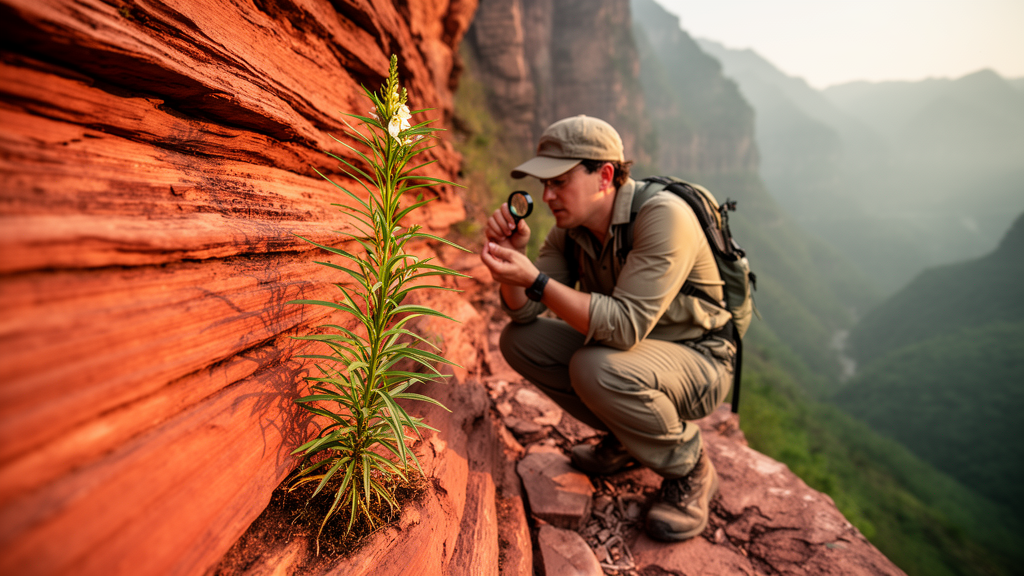
A delicate herb with creeping stems barely longer than a paperclip has turned out to be a species new to science, and botanists nearly missed it because it looks so much like several of its relatives. In a study published in the journal PhytoKeys, researchers describe Ophiorrhiza xishuiensis, a perennial herb in the coffee family, Rubiaceae, that grows on the red sandstone cliffs of the Danxia landform where Guizhou Province, Sichuan Province, and Chongqing City meet in southwest China. The plant is small, shy, and easy to overlook, but its discovery adds a new branch to one of Asia’s most species-rich flowering plant genera and highlights how much undiscovered life may still cling to the steep, moist cliffs of this famous landscape.
The genus Ophiorrhiza is a large group of tropical and subtropical Asian herbs best known to many readers as the source of camptothecin, an alkaloid that has been developed into important anticancer drugs. The species mainly occur in tropical and subtropical Asia and extend to Australia, New Guinea, and the Pacific islands. In China, the genus was comprehensively treated by botanist H.S. Lo in 1999, who recognized 72 species, and later by Chen and Taylor in 2011, who identified 70 species, 49 of them endemic to the country. In 2019, molecular evidence led researchers to fold two previously recognized genera, Keenania and Spiradiclis, into Ophiorrhiza, expanding its boundaries. As of February 2026, the genus includes 384 accepted species worldwide, 140 of them native to China. With so many lookalike species packed into overlapping ranges, telling one Ophiorrhiza from another demands close attention to tiny floral and vegetative details.
The story of the new species began in June 2024, when botanist Xuan-Ze He was conducting a field survey in Guizhou Xishui National Nature Reserve. Among the damp, shady rocks he spotted some small-sized plants of Ophiorrhiza that caught his eye. He brought living specimens back to Guizhou Botanical Garden and cultivated them. In March 2025, the cultivated plants bloomed, and their flowers revealed a crucial feature: well-developed bracteoles, the small leaf-like structures at the base of the flower clusters. The research team then returned to the wild. On 13 March 2025, they found flowering plants in Xishui County that matched the cultivated specimens exactly, and on 14 March 2025 they discovered a second population in Chishui City, Guizhou Province. Specimen and photographic records soon showed that the plants also occur in Xuyong County, Gulin County, Changning County, Weiyuan County, and Xuzhou District in Sichuan Province, and in Jiangjin District in Chongqing City.
What makes Ophiorrhiza xishuiensis distinctive is a combination of characters rather than any single dramatic trait. The plants are perennial herbs, erect, 10 to 20 centimeters tall, with glabrous, terete stems bearing 3 to 11 nodes. Most nodes do not root, but the species produces a creeping rooting stem 1 to 7 centimeters long, and when a petiole is cut, a very small amount of white sap appears. Most leaves are arranged in markedly unequal pairs, meaning each node carries one large leaf and one much smaller one, a feature the researchers emphasize as unusual among its relatives. The larger leaf blades measure 6 to 17 by 1.8 to 5 centimeters, while the smaller ones are only 1.5 to 5 by 0.5 to 1.5 centimeters, and the blade bases are somewhat inequilateral. The inflorescence is congested-cymose, a tightly packed flower cluster carrying 6 to 36 flowers per cyme on a drooping peduncle that later becomes erect, and the persistent bracteoles are ovate to oblong and 4.7 to 12 millimeters long.
The flowers themselves are distylous, meaning the species produces two floral forms, a classic breeding system in Rubiaceae. In long-styled flowers, the white or pale purplish red corolla has a tube 9 to 16 millimeters long, the stamens are inserted near the middle of the tube with tiny filaments 0.3 to 0.4 millimeters long, and the glabrous style runs 9 to 12.6 millimeters with the stigma positioned at the level of the throat or slightly exserted. In short-styled flowers, the stamens sit in the throat with filaments 1 to 1.2 millimeters long, and the style, 4.5 to 7.5 millimeters long, reaches above the middle of the tube. That last detail, the style reaching above rather than below the middle of the tube in short-styled flowers, proved to be one of the sharpest diagnostic characters separating the new species from its closest relatives. Flowering occurs from February to March, and fruiting from April to July, with capsules that are inverted triangle or submitriform in shape and numerous angled seeds.
To confirm the species was genuinely new, the team carried out a careful morphological investigation. They studied a population of approximately 300 mature individuals in Xishui County and another of approximately 15 long-styled individuals in Chishui City, cultivated roughly 30 living plants from Xishui at the botanical garden, and observed key characters such as stem, peduncle, bracteole, and calyx lobe lengths, leaf blade shape, and flower measurements in approximately 100 mature individuals. They measured about 20 short-styled flowers and 25 long-styled flowers under an Olympus SZ61 stereomicroscope. The researchers then compared the new taxon with 27 morphologically similar species, drawing on images of specimens and live plants from virtual herbaria and databases including iPlant, CVH, CUBG, Kew’s herbarium catalogue, JSTOR Plants, Harvard’s herbarium, the Natural History Museum London, and eFloraofIndia. Twelve species of Ophiorrhiza were grown side by side at Guizhou Botanical Garden, allowing direct comparison of living plants.
The closest lookalikes are Ophiorrhiza japonica, O. guizhouensis, and O. chinensis, which share similar stipule, calyx lobe, and corolla tube lengths, similar corolla shape, and overlapping distributions and altitudes. Yet the differences are consistent once you know where to look. The new species differs from O. japonica and O. guizhouensis by its 1 to 7 centimeter rooting stems, compared with 10 to 30 centimeters or longer in the others, by its markedly unequal leaf pairs, by the style position in short-styled flowers, and by its glabrous rather than pubescent style in long-styled flowers. It is distinct from O. chinensis by its congested-cymose rather than paniculiform to cymose inflorescences, its well-developed and persistent rather than absent or caducous bracteoles, and its glabrous style. Further comparisons separate it from O. umbricola, O. grandibracteolata, O. liuyanii, and O. cantonensis by combinations of stem indumentum, peduncle length, bracteole shape, and corolla lobe orientation. The paper provides both a detailed comparison table and an identification key to help future botanists avoid the confusion that has plagued this group.
That confusion is not hypothetical. The researchers found that the new species had already been collected or photographed by others in Sichuan and Chongqing and repeatedly misidentified as O. japonica, O. umbricola, O. cantonensis, or O. chinensis. Some of the misidentified specimens date back decades, including collections from Changning County in 1977 and Xuzhou District in 1977, meaning the species has been sitting in herbaria under the wrong name for nearly fifty years. The team also noticed overlooked characters that may prove taxonomically valuable across the genus. When cutting the petiole, O. xishuiensis exudes a very small amount of white sap, while O. japonica produces a very small amount of transparent, water-like sap. Both species carry a single globose, yellow colleter, a secretory glandular structure, on each side of the inner base of the bracteoles, but the new species sometimes shows red sparse colleters on the surfaces and margin of the bracteoles, while O. japonica has yellow ones. The researchers call for further research on the presence, absence, and position of colleters throughout the genus to better understand their taxonomic value.
The species is named after its type locality, Xishui County, and carries the Chinese vernacular name Xí Shuǐ Shé Gēn Cǎo. It grows in the Danxia landform, a striking red-bed landscape characterized by steep cliffs formed from red sandstone and conglomerate, where the plant thrives on moist, shady cliffs and sandy conglomerate surfaces. Because Ophiorrhiza species typically prefer to grow near streams or in damp areas, these cliff habitats suit the genus well. The species has now been confirmed in several counties and districts across Guizhou, Sichuan, and Chongqing, and the authors consider it highly probable that additional populations exist in the region. Until further investigation is carried out, they classify the species as Data Deficient under IUCN standards, a reminder that even a plant found across three provincial-level jurisdictions can remain poorly known. The holotype is stored in the herbarium of Chongqing Normal University, and the discovery stands as a vivid example of how modern field surveys, living collections, and digital herbaria can together uncover species that have been hiding in plain sight on the red cliffs of China.
Subject of Research: Ophiorrhiza xishuiensis (Rubiaceae), a new species endemic to Guizhou, Sichuan, and Chongqing, China
Article Title: Ophiorrhiza xishuiensis ( Rubiaceae ), a new species endemic to Guizhou, Sichuan, and Chongqing, China
Article References: He, X.-Z., Dai, Z.-X., Xu, J., Yang, J.-W., & Tang, S.-H. (2026). Ophiorrhiza xishuiensis (Rubiaceae), a new species endemic to Guizhou, Sichuan, and Chongqing, China. PhytoKeys, 275, 163-176. https://doi.org/10.3897/phytokeys.275.189435
Image Credits: AI Generated
DOI: 10.3897/phytokeys.275.189435
Keywords: Ophiorrhiza, xishuiensis, Rubiaceae, species, endemic, Guizhou, Sichuan, Chongqing, China, scientific research
Cite Scienmag News
Margaret Porter. (October 19, 2026). New snake root herb hidden on red cliffs of southwest China. Scienmag. https://scienmag.com/new-snake-root-herb-hidden-on-red-cliffs-of-southwest-china/
Margaret Porter. "New snake root herb hidden on red cliffs of southwest China." Scienmag, 19 October 2026, https://scienmag.com/new-snake-root-herb-hidden-on-red-cliffs-of-southwest-china/. Accessed 19 October 2026.
Margaret Porter. "New snake root herb hidden on red cliffs of southwest China." Scienmag. October 19, 2026. https://scienmag.com/new-snake-root-herb-hidden-on-red-cliffs-of-southwest-china/


