


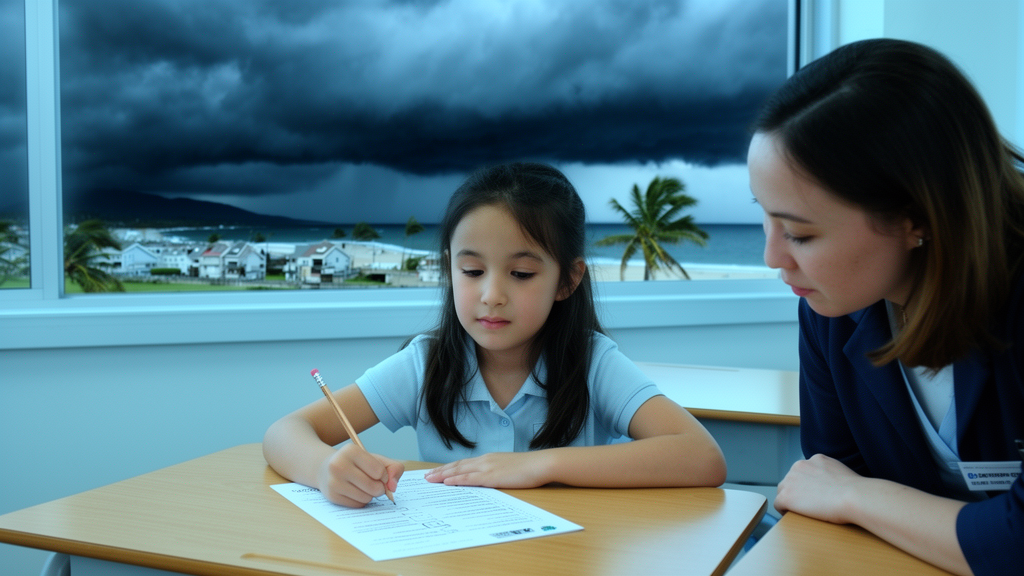
When a typhoon bears down on a coastal city, most disaster planning focuses on sandbags, evacuation routes, and emergency supplies. But psychologists have long argued that another kind of preparation matters just as much: the ability to anticipate and manage one’s own emotional and cognitive responses to an approaching threat. A research team in Japan has now built the first validated measurement tool designed specifically to capture this psychological preparedness in children, and has paired it with a classroom program that aims to teach it. The work, published in BMC Psychology, addresses a stubborn gap in disaster risk reduction education, which has traditionally leaned on fear-based messaging that can leave young students overwhelmed rather than empowered.
Psychological preparedness is a concept that has gained traction among disaster researchers over the past two decades. It refers to a person’s capacity to foresee the emotional turmoil a disaster might trigger, to plan coping strategies in advance, and to regulate fear, anxiety, and confusion well enough to act deliberately when a real threat emerges. Adults can be assessed with existing instruments, but no validated scale existed for children in middle childhood, roughly the ages of nine to twelve, even though this is precisely the period when schools deliver most disaster education. Without a way to measure the construct, educators could not tell whether their programs were actually building psychological readiness or simply scaring students.
The research team, led by Takahiro Kubo of Yokohama National University with colleagues from Nagoya University, Kyoto University, and Ochanomizu University, tackled the problem in two linked studies. In the first, they drafted 24 candidate items for what they call the Child Version of the Psychological Preparedness for Disaster Threat Scale, or C-PPDTS. The items were written for a specific hazard context: typhoons, the hydrometeorological events that most reliably menace Japan each year. Rather than asking children whether they know evacuation procedures, the items probe whether they can anticipate their own reactions, imagine coping responses, and mentally rehearse staying functional under threat.
To test the draft scale, the researchers administered it to 398 elementary school students in grades four through six. The statistical work followed the standard playbook of modern psychometrics, but with careful attention to what the data would support. Parallel analysis was used to estimate how many underlying dimensions the responses actually reflected, a technique that compares observed eigenvalues against those generated by random data to avoid overfactoring. Exploratory factor analysis then let the structure emerge from the data, and confirmatory factor analysis pitted competing models against each other to see which fit best.
The results were strikingly clean. After one redundant item was removed, the remaining 23 items formed an essentially unidimensional scale, meaning that psychological preparedness in children behaves as a single coherent capacity rather than a bundle of separate skills. The one-factor model showed good fit to the data, with a Comparative Fit Index of 0.970, well above the conventional 0.95 threshold, and a Root Mean Square Error of Approximation of 0.066, within the acceptable range. Internal consistency was exceptionally high, with Cronbach’s alpha at 0.96 and McDonald’s omega at 0.97, indicating that the items hang together tightly and reliably.
The team also checked whether the scale behaved the way theory says it should. In a known-groups validity test, children who reported discussing disaster response with their families scored significantly higher on the C-PPDTS than those who did not, with an effect size of d equal to 0.72, a substantial difference by psychological standards. This makes intuitive sense: family conversations about disasters are exactly the kind of anticipatory coping activity that psychological preparedness is supposed to capture. The finding suggests the scale is not merely measuring general anxiety or test-taking tendencies but is tracking something meaningfully connected to real preparedness behavior.
The second study put the scale to work as an outcome measure. Sixty-seven fourth-grade students took part in a 90-minute classroom intervention that combined two elements the researchers argue are rarely paired. The first was a video-based typhoon simulation called Ametore, which immerses students in a simulated approaching storm and lets them experience the escalating threat in a controlled setting. The second was cognitive-behavioral psychoeducation, which teaches concrete coping strategies drawn from established principles of how people regulate fear and manage anxious arousal. The design deliberately moves beyond fear appeals alone, which earlier research suggests can induce overwhelming anxiety in children without giving them tools to manage it.
Using a single-group pre-post design, the researchers measured C-PPDTS scores before and after the session. Scores rose significantly, with an effect size of d equal to 0.42, a modest but meaningful gain for a single 90-minute lesson. Just as informative were the emotional ratings students provided during the simulation itself. The pattern showed a decline in emotional response toward the peak of the simulated threat, followed by recovery afterward, a trajectory consistent with the intended mechanism of the program: children learn to anticipate and manage their reactions as the threat intensifies rather than being flooded by it. Program comprehension ratings were also high, suggesting the material landed with its young audience.
The authors are careful about the limits of what they can claim. Because the second study lacked a control group, the observed improvement cannot be attributed to the intervention itself; practice effects, demand characteristics, or simple maturation could contribute. The researchers state plainly that confirmation in controlled trials is needed before the program can be recommended at scale. Still, the combination of a validated measurement tool and a theoretically grounded classroom format gives the field something it has lacked: a way to quantify psychological preparedness in children and to test, rigorously, whether disaster education can build it.
The implications reach beyond Japan’s typhoon belt. As climate change intensifies hydrometeorological hazards worldwide, schools everywhere are being asked to prepare children for events that once seemed rare. The C-PPDTS offers a template for measuring whether that preparation works at the level of the child’s mind, not just their knowledge of evacuation maps. And the finding that family discussion of disaster response correlates with higher preparedness hints at a low-cost lever: simply talking about threats at home, in age-appropriate and coping-focused terms, may seed the psychological readiness that formal education then amplifies. For a field long dominated by infrastructure and logistics, the message is quietly radical: readiness begins in the mind, and now it can be measured.
Subject of Research: Development and preliminary validation of a psychological preparedness scale for elementary school students and evaluation of a disaster education program
Article Title: Development of a psychological preparedness scale for elementary school students (C-PPDTS) and a preliminary evaluation of a disaster education program
Article References: Kubo, T., Takenouchi, K., Takamoto, M., Suzuki, M., Nakahara, K., & Sadamitsu, C. (2026). Development of a psychological preparedness scale for elementary school students (C-PPDTS) and a preliminary evaluation of a disaster education program. BMC Psychology. https://doi.org/10.1186/s40359-026-05629-5
Image Credits: AI Generated
DOI: 10.1186/s40359-026-05629-5
Keywords: psychological preparedness, disaster risk reduction, elementary school students, scale development, psychometrics, typhoon, disaster education, cognitive-behavioral psychoeducation, Japan, child psychology, fear appeals, hydrometeorological hazards
Cite Scienmag News
Glenn Wilkins. (October 18, 2026). New Scale Measures How Prepared Children Feel Psychologically for Typhoons. Scienmag. https://scienmag.com/new-scale-measures-how-prepared-children-feel-psychologically-for-typhoons/
Glenn Wilkins. "New Scale Measures How Prepared Children Feel Psychologically for Typhoons." Scienmag, 18 October 2026, https://scienmag.com/new-scale-measures-how-prepared-children-feel-psychologically-for-typhoons/. Accessed 18 October 2026.
Glenn Wilkins. "New Scale Measures How Prepared Children Feel Psychologically for Typhoons." Scienmag. October 18, 2026. https://scienmag.com/new-scale-measures-how-prepared-children-feel-psychologically-for-typhoons/


