


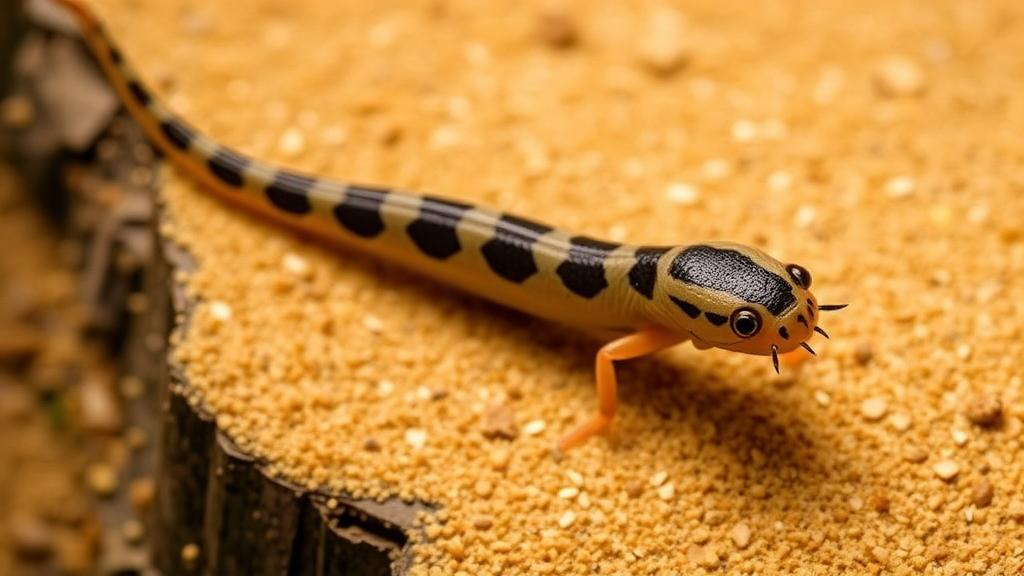
A tiny, sand-loving fish from the rivers of central Myanmar has just been formally introduced to science, and it is carrying a much bigger message than its 30-millimetre body suggests. Researchers surveying the Chindwin–Irrawaddy River basin between 2016 and 2024 collected a series of small nemacheilid loaches that, after years of morphological scrutiny and DNA sequencing, turned out to represent a species entirely new to science. The fish has been named Mustura arenaria, with the species epithet drawn from the Latin word for sand, a nod to its fondness for fine sandy stream bottoms. The description, published in the journal Zoosystematics and Evolution, also delivers a taxonomic shake-up: the genus Mustura, it turns out, is not what it appeared to be.
The holotype, an adult male measuring 29.3 millimetres in standard length, was collected on 22 December 2016 in Yaw Stream, a tributary of the Yebya River near Pakokku City in Myanmar’s Magway Region. Over the following years, the team gathered additional specimens from several widely separated localities, including Myan Aww Stream inside Alaungdaw Kathapa National Park, the Salin Stream near Sinbyugyun, the lower Yemar River near Monywa, Nam Sa Pi Stream at Htamanthi, and even a stream flowing into Indawgyi Lake in Kachin State in the far north. That broad spread across the Chindwin–Irrawaddy drainage suggests the species may eventually be found throughout the tributaries of central Myanmar, particularly in the dry zones of the Sagaing, Mandalay, and Magway regions.
What makes Mustura arenaria recognisable is a distinctive combination of features rather than any single dramatic trait. The body carries 7 to 15 vertically elongated dark blotches along the flank, alternating with 9 to 17 dorsal saddles, and crucially the blotches are distinctly narrower than the pale spaces between them. Males and females differ in the shape of these markings, with the blotches more rounded in males and more elongated in females. The species also shows 8½ branched dorsal-fin rays, a forked tail with 8+8 branched caudal-fin rays, a complete lateral line, an axillary pelvic lobe, and a small notch in the upper lip. Two dark stripes running from the tip of the snout toward the front of the eyes, together with a pair of faint blotches between the nostrils, form an X-shaped pattern on the head, while a pair of blotches around the fontanelle creates a triangular mark extending to the nape.
Sexual dimorphism adds another layer of identification. Males possess a longer suborbital flap, a fleshy structure on the cheek studded with small tubercles, and their first branched pectoral-fin ray is broadened and angled slightly upward, with the branches pressed together and lacking a membrane except near the tip. Females show only a small flap, a groove, or nothing at all in that position. Males also carry more developed tubercles on the snout and head. These traits align the new species with the diagnostic profile of Mustura as defined by Swiss ichthyologist Maurice Kottelat when he established the genus in 2018, designating Mustura celata as its type species.
To test whether the morphology told the true evolutionary story, the researchers turned to genetics. They extracted DNA from fin tissue and sequenced two markers: the mitochondrial cytochrome b gene, a workhorse of fish phylogenetics, and the nuclear recombination-activating gene RAG1. The dataset ultimately included 57 Cyt b and 54 RAG1 sequences, with three species from other genera serving as outgroups. After alignment with MAFFT and trimming with Gblocks, the team built phylogenetic trees using both maximum likelihood methods in IQ-TREE, with 10,000 ultrafast bootstrap replicates, and Bayesian inference in MrBayes, running four Markov chain Monte Carlo chains for 10 million generations. An incongruence length difference test confirmed that the two genes did not significantly conflict, with a p-value of 0.335, allowing a combined analysis.
The genetic results were unambiguous about the new species itself. Mustura arenaria formed a well-supported, monophyletic lineage, and its pairwise Kimura two-parameter genetic distance from congeners, based on Cyt b, ranged from 13.49 to 16.16 percent, a deep divergence by any standard for closely related fish species. Within the species, sampled individuals differed by only 1.19 percent on average. For comparison, the smallest interspecific distance recorded in the study, 9.46 percent between Mustura sp. UF192977 and M. yangi, was still far above the new species’ internal variation, reinforcing its status as an independently evolving lineage.
But the wider picture was far messier. Across all analyses, Mustura as currently defined came out polyphyletic, meaning its member species do not all share a single recent common ancestor exclusive of other genera. The type species M. celata clustered with M. maepaiensis, M. arenaria, M. yangi, and two unassigned taxa, forming a clade that is sister to the genus Neonoemacheilus. The remaining species scattered into Schistura, Physoschistura, and other lineages. In other words, the genus is a morphological convenience rather than an evolutionary reality, a conclusion that echoes several recent phylogenetic studies of nemacheilid loaches.
The study also settled a long-running identity question for one particular fish. Mustura shanensis, first described in 1929 as Nemacheilus shanensis, has bounced between genera for decades, variously placed in Physoschistura, tentatively assigned to the Schistura rupecula group, and moved to Mustura on the basis of colour pattern and caudal-fin shape. Fresh examination of specimens from Inle Lake in Myanmar’s Shan State revealed that it lacks the sexual dimorphism typical of Mustura, has an air bladder divided into separate halves with a distinct oval posterior chamber, and possesses a lower lip broadly interrupted without the triangular cushion-like pads characteristic of true Mustura. Molecular data placed it firmly as a sister lineage to Schistura species, with maximal support values, and the authors formally transferred it to that genus as Schistura shanensis.
The deeper implication is that convergent evolution may be muddying loach classification across South and Southeast Asia. Species grouped in Mustura and related genera such as Pteronemacheilus, Physoschistura, and Petruichthys share features like mouth structure and male pectoral-fin modifications, yet the DNA indicates clear genetic divergence among these groups. Some of the characters long used to define genera may be less reliable than assumed. The authors note that air bladder variation has been linked to water velocity in the fish’s environment, and that preservation methods can make the small posterior chamber difficult to identify, while the rigid pectoral-fin rays of males appear only probabilistically across populations. Such traits may matter at the species level but must be applied cautiously when drawing genus boundaries.
For now, Mustura arenaria takes its place among the flowing, sandy-bottomed streams of the Irrawaddy basin, living in small aggregations alongside eels, loaches, and carps including Anguilla bengalensis, Pangio signicauda, Schistura callidora, and several species of Glyptothorax. Its description brings the count of recognised Mustura species, broadly defined, to 23, but the authors are clear that the number is a moving target. Several species provisionally assigned to the genus, including M. bella, M. geisleri, M. isostigma, and M. shuangjiangensis, appear genetically closer to other lineages, and one has already been moved to a newly erected genus. A comprehensive revision of Mustura and its relatives, combining broader molecular sampling with systematic morphological comparison, is now clearly needed. In the sandy shallows of Myanmar, a small fish has made a large case that the loach family tree still needs redrawing.
Subject of Research: Description of a new nemacheilid loach species from Myanmar and taxonomic revision of the genus Mustura
Article Title: Mustura arenaria , a new species of genus Mustura ( Cypriniformes , Nemacheilidae ) from Myanmar, with taxonomic notes on Mustura shanensis
Article References: Lyu, J.-B., Lin, F., Oo, T. N., & Chen, X.-Y. (2026). Mustura arenaria, a new species of genus Mustura (Cypriniformes, Nemacheilidae) from Myanmar, with taxonomic notes on Mustura shanensis. Zoosystematics and Evolution, 102(1), 107-117. https://doi.org/10.3897/zse.102.170882
Image Credits: AI Generated
Keywords: Mustura arenaria, new species, Nemacheilidae, Myanmar, Irrawaddy basin, loach taxonomy, phylogenetics, cytochrome b, RAG1, Schistura shanensis, polyphyly, integrative taxonomy
Cite Scienmag News
Margaret Porter. (October 19, 2026). New Sand-Dwelling Loach from Myanmar Exposes Cracks in Loach Family Tree. Scienmag. https://scienmag.com/new-sand-dwelling-loach-from-myanmar-exposes-cracks-in-loach-family-tree/
Margaret Porter. "New Sand-Dwelling Loach from Myanmar Exposes Cracks in Loach Family Tree." Scienmag, 19 October 2026, https://scienmag.com/new-sand-dwelling-loach-from-myanmar-exposes-cracks-in-loach-family-tree/. Accessed 19 October 2026.
Margaret Porter. "New Sand-Dwelling Loach from Myanmar Exposes Cracks in Loach Family Tree." Scienmag. October 19, 2026. https://scienmag.com/new-sand-dwelling-loach-from-myanmar-exposes-cracks-in-loach-family-tree/


