

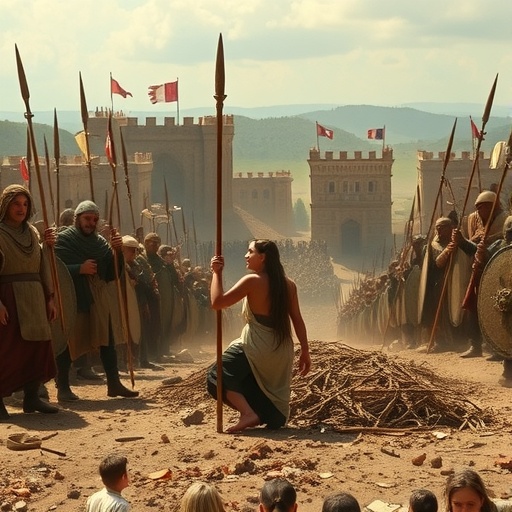
New archaeological research has uncovered startling evidence of targeted violence against women and children in one of Europe’s most significant prehistoric mass killings. The discovery originates from the Gomolava burial sites in northern Serbia, where remains of over seventy-seven individuals were found, predominantly women and children. Dated to approximately 2,800 years ago, this mass grave reveals a brutal episode of violence characterized by various forms of inflicted trauma indicative of systematic and planned aggression rather than a random or spontaneous attack.
The examination of the Gomolava burial site unveiled that the victims suffered lethal injuries caused by bludgeoning and stabbing, signifying deliberate acts of violence. This level of brutality, combined with the demographic profile of the deceased, suggests a selective targeting of vulnerable community members. Such precision in victim selection markedly diverges from the typical patterns observed in prehistoric mass graves, which often contain family groups or whole village populations.
One of the most astonishing findings emerging from the genetic analysis was the lack of close kinship ties among the victims. Contrary to expectations that the grave might represent a massacred family or village group, genetic data demonstrated that most individuals were unrelated, not sharing even distant ancestry within several generations. This finding challenges longstanding assumptions about the social structure and conflict dynamics of Iron Age communities in the Carpathian Basin, necessitating a reevaluation of how prehistoric violence was perpetrated and rationalized.
Further investigations revealed a striking bias toward female individuals among both adults and children, with approximately 87% of the adults and many of the younger victims being female. The only infant recovered from the grave was male. This pronounced gender disparity implies that the massacre was not merely opportunistic but orchestrated to convey a strategic message, possibly aimed at destabilizing the social fabric of rival groups by eliminating women and young girls, who embodied reproduction and lineage continuity.
The researchers interpret this selective victimization as a symbolic act of power assertion, designed to intimidate or warn opposing communities about their dominance and territorial control. The manner in which female children and adolescents were targeted underscores the perpetrators’ intent to disrupt community regeneration and long-term survival. This perspective expands our understanding of prehistoric conflict beyond simple warfare or resource competition to include broader social and psychological warfare mechanisms.
Distinct from other mass burials documented from the era, Gomolava presents unique burial practices that hint at a significant ritual component accompanying the aftermath of the massacre. The bodies were interred with personal adornments, including bronze jewelry and ceramics, signifying a level of respect or acknowledgment despite the violent context of their deaths. Additionally, the inclusion of animal remains, such as a butchered calf, alongside broken grain-grinding stones and burnt seeds atop the grave, points to elaborate mortuary rites likely imbued with symbolic meaning relating to sustenance and fertility.
This careful arrangement and the evident provision of offerings suggest that the burial was a consciously constructed ceremonial event rather than a pragmatic disposal of bodies. Such ritualized treatment following violence reflects complex social responses to trauma, potentially serving to restore dignity to the victims or to invoke ancestral protections. The duality of brutality in life and reverence in death exemplifies the multifaceted nature of Iron Age society’s engagement with conflict and commemoration.
Isotopic analyses conducted on the dental and skeletal remains unveiled significant dietary diversity among the individuals, indicating varied childhood environments and feeding practices. These data corroborate the hypothesis that the women and children originated from different settlements rather than a single community, further supporting the idea that they were likely abducted or forcibly displaced prior to their deaths. This displacement implies complex intergroup interactions involving capture, forced migration, or slavery as facets of prehistoric conflict.
The archaeological context situates the mass killing against a backdrop of socio-political instability characterized by the emergence and expansion of enclosed settlements and reoccupation of older Bronze Age fortified structures across the Carpathian Basin. Competition for control over land and resources amid these transformative processes would likely have intensified intergroup hostilities, potentially leading to violent confrontations such as the one evidenced at Gomolava. The construction of mega-forts and territorial boundary disputes delineate a period of volatile power negotiations.
The research team proposes that these violent acts played a role in shaping the regional balance of power during this critical Early Iron Age transition. The scorched-earth tactics and gruesome targeting of women and children served not merely as acts of survival but as strategic measures to undermine rival communities socially and biologically. This study, therefore, provides unprecedented insight into the strategic deployment of gendered and age-targeted violence as a means of political control in prehistoric Europe.
These findings advance the scholarly understanding of Iron Age warfare by illustrating the meticulous planning and social calculation involved in mass violence events. They challenge simplistic narratives focused solely on male warriors and open new avenues for interpreting the roles and vulnerabilities of women and children within prehistoric conflict frameworks. It also underscores the significance of interdisciplinary approaches—combining archaeology, genetics, and isotopic chemistry—in reconstructing complex ancient social phenomena.
The Gomolava mass grave thus stands as a testament to the dark and turbulent chapter of European prehistory, revealing how violence was not random but systematically engineered to sustain and reinforce power hierarchies during the formative phases of Iron Age society. The respectful treatment of the dead following such brutality further reflects the intricate coexistence of violence, ritual, and memory that likely shaped social cohesion and identity long after the victims’ lives ended.
This groundbreaking study was conducted by an international consortium of researchers from University College Dublin, the University of Edinburgh, the University of Copenhagen, and the Museum of Vojvodina, supported by the European Research Council grant “The Fall of 1200 BC.” Their comprehensive multidisciplinary analysis offers a new lens through which to view prehistoric mass violence, revealing the profound social ramifications embedded within this extraordinary archaeological site.
Subject of Research:
Article Title: A large mass grave from the Early Iron Age indicates selective violence towards women and children in the Carpathian Basin
News Publication Date: 23-Feb-2026
Web References: http://dx.doi.org/10.1038/s41562-025-02399-9
References: Nature Human Behaviour, DOI: 10.1038/s41562-025-02399-9
Image Credits: Linda Fibiger et al
Keywords: Social sciences


