
Saturday, March 21, 2026
Science
No Result
View All Result
  • Login
  • HOME
  • SCIENCE NEWS
  • CONTACT US
  • HOME
  • SCIENCE NEWS
  • CONTACT US
No Result
View All Result
Scienmag
No Result
View All Result
Home Science News Technology and Engineering

New research tools reveal the dynamics behind breaking a sweat

June 26, 2024
in Technology and Engineering
Reading Time: 3 mins read
0
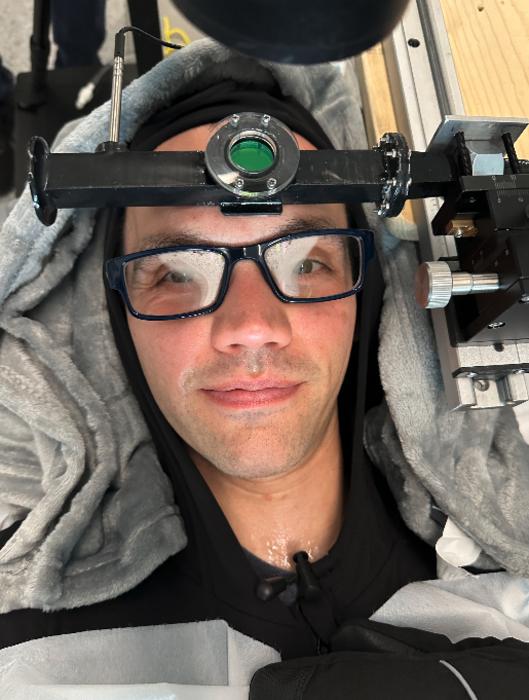
Exploring the dynamics of sweating
67
SHARES
605
VIEWS
Share on FacebookShare on Twitter
ADVERTISEMENT

Excessive heat across the United States is making this summer a season of sweat. Perspiration and its evaporation are crucial to keeping us cool when things get hot. But our understanding of how sweat evaporates is limited to the profuse phases of the process, when our bodies are coated in a sticky film or even pools of perspiration. Relatively is little is known about the dynamics behind initial phases of sweating, when tiny droplets are emitted by individual sweat glands and then quickly evaporate.

Exploring the dynamics of sweating

Credit: Konrad Rykaczewski / Arizona State University

Excessive heat across the United States is making this summer a season of sweat. Perspiration and its evaporation are crucial to keeping us cool when things get hot. But our understanding of how sweat evaporates is limited to the profuse phases of the process, when our bodies are coated in a sticky film or even pools of perspiration. Relatively is little is known about the dynamics behind initial phases of sweating, when tiny droplets are emitted by individual sweat glands and then quickly evaporate.

“There are mechanical engineering researchers around the world, myself included, who are devoted to understanding the different parameters of droplet behavior on almost every industrial substrate in electric power production, food processing, inkjet printing and more,” says Konrad Rykaczewski, an associate professor at Arizona State University. “So, I was amazed that no one has looked closely at sweat on skin.”

Seeking to fill this gap in knowledge, Rykaczewski and his colleagues have developed new research tools—including a wind tunnel-shaped, ventilated capsule with an infrared window enabling high-magnification video imagery of pulsating sweat droplet formation and evaporation on the foreheads of human subjects at a scale down to 20 microns, less than the width of a single strand of hair.

Early experiments with the equipment have revealed that the mass transfer coefficient—a measure of how much evaporation increases as more skin area is covered by sweat—and therefore the cooling power of initial phase or droplet sweating can be three times that of later phase film or pooled sweating. It also appears that much of that evaporative efficacy happens at the level of individual sweat ducts near or under the outer layer of skin.

“This has very interesting implications for textile design and apparel for hot climates,” says Rykaczewski. “And as we face a future of more extreme heat, we want all the resources possible to deal with it.”

Results from the team’s work have just been published as a paper in the journal iScience.

Rykaczewski appreciates the work of those partnering on this interdisciplinary team, including Professor Stavros Kavouras from ASU’s College of Health Solutions, Assistant Professor Gokul Pathikonda and Associate Professor Heather Emady from ASU’s Ira A. Fulton Schools of Engineering, postdoctoral researchers Ankush Jaiswal, Kambiz Sadeghi and Ankit Joshi; as well as graduate students Cibin T. Jose, Ramesh Rajesh, and Vinay Nanani.


Journal

iScience

DOI

10.1016/j.isci.2024.110304

Method of Research

Experimental study

Subject of Research

People

Article Title

Simultaneous imaging of multi-pore sweat dynamics and evaporation rate measurement using wind tunnel ventilated capsule with infrared window

Article Publication Date

17-Jun-2024

COI Statement

The authors declare no competing interests.

Share27Tweet17
Previous Post

Bone stem cells with IFITM5 mutation get caught in a loop leading to osteogenesis imperfecta type V

Next Post

Study shows how liver damage from stress and aging might be reversible

Related Posts

blank
Technology and Engineering

Dynamic Spectrum Sharing for Cognitive Radio Users

March 21, 2026
blank
Technology and Engineering

AI-Powered Tool Enhances Stroke Care and Patient Outcomes

March 20, 2026
blank
Technology and Engineering

New Research Uncovers How the Spleen-to-Lung Neutrophil Pathway Drives Antiviral Defense

March 20, 2026
blank
Technology and Engineering

Cutting-Edge AI Models Promise Major Energy Savings and Breakthrough Performance Enhancements

March 20, 2026
blank
Technology and Engineering

Innovative Biochar Technology Enhances Antibiotic Removal from Water with Low-Energy Ultrasound

March 20, 2026
blank
Technology and Engineering

Breakthrough Discoveries in Biochar Enhance Phosphorus Capture and Safeguard Water Systems

March 20, 2026
Next Post
Study shows how liver damage from stress and aging might be reversible

Study shows how liver damage from stress and aging might be reversible

  • Mothers who receive childcare support from maternal grandparents show more parental warmth, finds NTU Singapore study

    Mothers who receive childcare support from maternal grandparents show more parental warmth, finds NTU Singapore study

    27626 shares
    Share 11047 Tweet 6904
  • University of Seville Breaks 120-Year-Old Mystery, Revises a Key Einstein Concept

    1029 shares
    Share 412 Tweet 257
  • Bee body mass, pathogens and local climate influence heat tolerance

    671 shares
    Share 268 Tweet 168
  • Researchers record first-ever images and data of a shark experiencing a boat strike

    535 shares
    Share 214 Tweet 134
  • Groundbreaking Clinical Trial Reveals Lubiprostone Enhances Kidney Function

    520 shares
    Share 208 Tweet 130
Science

Embark on a thrilling journey of discovery with Scienmag.com—your ultimate source for cutting-edge breakthroughs. Immerse yourself in a world where curiosity knows no limits and tomorrow’s possibilities become today’s reality!

RECENT NEWS

  • Caroline Plateau Boosts Hydration in Mariana Trench
  • Older Patients’ Medication Challenges at Hospital Discharge
  • GPER1 Curbs Skin Inflammation by Halting Keratinocytes
  • Powerful Earthquakes Strike French-Italian Riviera

Categories

  • Agriculture
  • Anthropology
  • Archaeology
  • Athmospheric
  • Biology
  • Biotechnology
  • Blog
  • Bussines
  • Cancer
  • Chemistry
  • Climate
  • Earth Science
  • Editorial Policy
  • Marine
  • Mathematics
  • Medicine
  • Pediatry
  • Policy
  • Psychology & Psychiatry
  • Science Education
  • Social Science
  • Space
  • Technology and Engineering

Subscribe to Blog via Email

Success! An email was just sent to confirm your subscription. Please find the email now and click 'Confirm Follow' to start subscribing.

Join 5,191 other subscribers

© 2025 Scienmag - Science Magazine

Welcome Back!

Login to your account below

Forgotten Password?

Retrieve your password

Please enter your username or email address to reset your password.

Log In
No Result
View All Result
  • HOME
  • SCIENCE NEWS
  • CONTACT US

© 2025 Scienmag - Science Magazine