

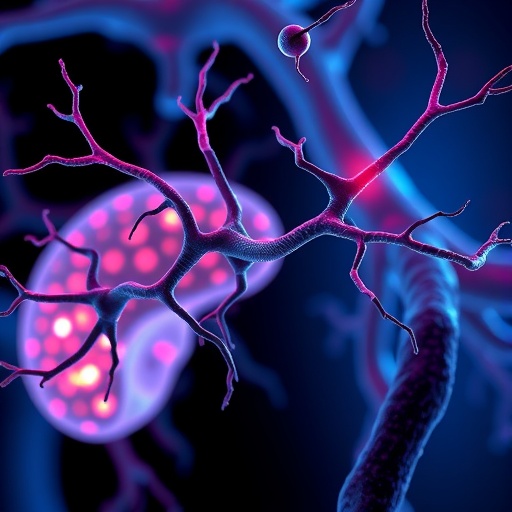
In a groundbreaking study emerging from Oregon Health & Science University (OHSU), researchers have unveiled a previously underappreciated dimension in the biology of pancreatic cancer: the dynamic and influential role of sympathetic nerves within the tumor microenvironment. This discovery provides compelling evidence that the nervous system is not merely a passive observer but an active participant influencing tumor growth and progression, specifically through interactions between sympathetic nerves and cancer-associated fibroblasts.
Pancreatic cancer, notorious for its dismal prognosis and resistance to conventional treatments, has long been studied primarily with a focus on cancer cells and commonly recognized components of the tumor microenvironment such as immune cells, vasculature, and fibroblasts. However, the nervous system’s involvement has remained largely enigmatic. The new study brings sympathetic nerves—components of the autonomic nervous system responsible for the body’s “fight or flight” response—into sharp scientific focus, showing that these nerves physically infiltrate pancreatic tumors and engage in biochemical crosstalk with cancer cells and supportive stromal fibroblasts.
The sympathetic nervous system exerts its influence through the release of neurotransmitters like norepinephrine, which bind to receptors on both cancer cells and fibroblasts. This signaling cascade appears to foster a tumor-promoting milieu by influencing multiple cellular pathways that enhance tumor cell proliferation, survival, and extracellular matrix remodeling. The latter process is critical as activated fibroblasts modify the structural architecture around the tumor, facilitating invasive and metastatic behavior.
A key technical challenge addressed by the research team was the difficulty in detecting the nerve fibers within the tumor due to their small and fragmented nature and the predominant location of nerve cell bodies outside the tumor mass. To circumvent these limitations, researchers devised novel molecular marker panels capable of identifying sympathetic nerves and established genetically engineered mouse models with selective ablation of sympathetic innervation in the pancreas. This innovative approach uncovered that nerve removal resulted in tumor size reduction; strikingly, this effect was observed exclusively in female mice, underscoring a sex-dependent influence on tumor progression.
The sex specificity suggested by the study introduces a fascinating layer of complexity implicating sex hormones as modulators of neural-tumor interactions. Estrogen and other hormones may influence the expression of receptors or signaling pathways in nerves or fibroblasts, transforming how sympathetic signals impact the cancer ecosystem. This revelation opens new investigative pathways into hormonal modulation as a therapeutic angle and stresses the importance of considering sex as a biological variable in cancer research.
Beyond the experimental work, correlational analyses in human pancreatic cancer patients revealed that genes associated with sympathetic nerve activity correlate with poorer survival outcomes. This finding fortifies the translational relevance of the study and highlights the sympathetic nervous system as a clinical biomarker candidate and a potential target for therapy.
Current cancer therapeutics have predominantly ignored the nervous system as a direct target, but this research advocates for a paradigm shift. There is burgeoning interest in repurposing existing pharmacological agents—such as beta-adrenergic blockers, commonly used for cardiovascular diseases—to attenuate the neurogenic signals that drive tumor progression. Moreover, the recent advent of neural stimulation devices for neurological and psychiatric disorders raises the intriguing possibility of neuromodulation as a complementary strategy in oncology.
The study, published in JCI Insight, exemplifies the burgeoning interdisciplinary field of cancer neuroscience. Its core message is profound: tumors reside in an intricate ecosystem where multiple body systems communicate and influence oncogenesis. The dialogue between nerves and fibroblasts within pancreatic tumors highlights the need to approach cancer treatment not only on the cellular or molecular level but also from a system biology perspective that integrates neural, hormonal, and immune inputs.
Investigators at OHSU are now extending these findings to explore the mechanisms by which nerve injury and matrix remodeling orchestrated by fibroblasts contribute to tumor aggressiveness. Understanding the detailed signaling pathways and receptor interactions in this neural-stromal crosstalk holds promise for identifying novel molecular targets.
This novel conceptual framework challenges the entrenched dogma in oncology and opens avenues for the design of innovative therapeutics. By regulating nerve-cancer cell interactions and disrupting pathological communication channels, there is hope to impede pancreatic tumor growth more effectively.
In summary, this pioneering research not only broadens our understanding of the tumor microenvironment but also reveals how the nervous system’s role can be pivotal in malignant progression. It signals the need for concerted multidisciplinary efforts to translate these insights into clinically viable interventions that can ultimately improve survival outcomes in one of the deadliest forms of cancer.
Subject of Research: Sympathetic nerve involvement in pancreatic cancer tumor microenvironment
Article Title: Sympathetic nerve–fibroblast crosstalk drives nerve injury, fibroblast activation, and matrix remodeling in pancreatic cancer
Web References: https://insight.jci.org/articles/view/192814
References: Published in the journal JCI Insight, DOI: 10.1172/jci.insight.192814
Keywords: Pancreatic cancer, sympathetic nerves, cancer-associated fibroblasts, tumor microenvironment, neural-tumor crosstalk, nerve ablation, sex differences in cancer, beta blockers, nerve injury, matrix remodeling, tumor progression, cancer neuroscience


