

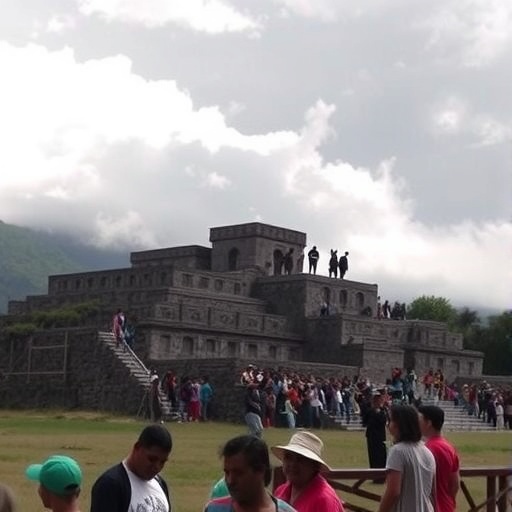
In a groundbreaking reassessment of one of South America’s most iconic archaeological sites, new research suggests that Monte Verde—long regarded as a cornerstone for understanding the early peopling of the continent—may be significantly younger than previously believed. This revelation, spearheaded by Todd Surovell and colleagues, challenges decades-old assumptions that positioned Monte Verde as a preeminent pre-Clovis site dating back approximately 14,500 years. Instead, their independent investigation indicates that the site’s primary archaeological deposits correspond to the mid-Holocene period, roughly between 8,000 and 4,000 years ago, fundamentally reshaping debates surrounding the timing of human colonization in South America.
Monte Verde, located in southern Chile, has occupied a central role in discussions about the earliest human presence in the Americas since its discovery in the 1970s. Excavations at Monte Verde II—one of the site’s most extensively studied components—yielded an array of well-preserved organic artifacts such as wooden tools, cordage, and bones from extinct Pleistocene megafauna. Radiocarbon dates previously reported suggested human occupation around 14,500 years ago, predating the Clovis culture by nearly 1,500 years and providing critical evidence against the Clovis-first model that dominated archaeological thinking for much of the 20th century.
Despite its importance, the chronology of Monte Verde has long been a subject of scrutiny and debate. Skeptics questioned whether the associations between artifacts, stratigraphy, and radiocarbon dates were genuine or whether some materials had been re-deposited from older contexts, potentially skewing age estimates. The complexity of the site’s floodplain sediments and potential for geological disturbance further complicated accurate temporal placement. These controversies underscored the urgent need for independent verification and meticulous re-analysis using modern methodologies.
The fresh study by Surovell and colleagues confronts these issues through a comprehensive geological and stratigraphic reexamination of nine sediment exposures adjacent to Chinchihuapi Creek, near Monte Verde. Their sedimentological analysis reveals a highly intricate depositional history. The team identifies glacial meltwater sediment layers composed of sand and gravel, dated between approximately 26,000 and 15,500 years ago, overlain by organic-rich deposits and a distinct volcanic ash horizon—the Lepúe Tephra—dated robustly to around 11,000 years before present. Crucially, they demonstrate that archaeological materials reside stratigraphically above this ash layer, meaning the cultural deposits cannot be older than this 11,000-year benchmark.
To refine the age model, the researchers conducted radiocarbon dating on wood and peat samples extracted from sediment layers within the floodplain, producing calibrated ages predominantly between 8,200 and 4,100 years before present. This Middle Holocene timeframe contrasts sharply with earlier late Pleistocene dates attributed to the site. The authors propose that previous older radiocarbon determinations were likely influenced by reworked Pleistocene organic material incorporated into younger sediments via erosion and redeposition processes. This insight mandates a critical reappraisal of Monte Verde’s chronostratigraphy and the archaeological interpretations built upon it.
The implications of this revised chronology are profound, as Monte Verde has long served as a keystone site in models of early human migration into South America. A mid-Holocene occupation suggests humans arrived and occupied this region considerably later than previously thought, prompting reconsideration of migratory routes, settlement patterns, and cultural development timelines associated with the Americas’ first inhabitants. Moreover, this discovery accentuates the need for caution when construing prehistoric timelines based solely on stratigraphic and radiocarbon contexts without independent corroborating evidence.
The broader scientific community has taken note of these findings, which add complexity to the emerging archaeological landscape. Jason Rech, writing in an accompanying Perspective, underscores that while Monte Verde anchored early colonization chronologies for decades, newer sites across the Americas now challenge the primacy of the Clovis culture as the earliest human presence. However, Rech concurs with Surovell et al. on the crucial necessity for independent verification and rigorous testing of foundational archaeological sites to ensure the robustness of chronological frameworks shaping our understanding of human history.
Methodologically, this study exemplifies the importance of integrating stratigraphic analysis, tephrochronology, and multidisciplinary radiocarbon dating to disentangle complex depositional sequences and establish reliable site chronologies. The identification of the Lepúe Tephra ash layer as a stratigraphic marker is particularly noteworthy, as its well-documented widespread distribution provides a key temporal reference point for the region. Such volcanic tephra serve as invaluable isochrons in archaeological contexts, enhancing the precision of age estimations in dynamic environments.
Furthermore, the findings illuminate broader geological processes affecting archaeological site formation, such as sediment redeposition and erosion, which can significantly complicate interpretations of human activity. Recognizing and accounting for these post-depositional factors are fundamental for constructing accurate archaeological narratives, particularly in floodplain and glacially influenced landscapes like those surrounding Monte Verde.
This paradigm shift regarding Monte Verde’s temporal placement will undoubtedly stimulate renewed interest and further investigations at the site and beyond. It also challenges archaeologists to reexamine other purportedly early human sites across South America with a more critical lens, employing updated stratigraphic and chronometric techniques to confirm or revise their temporal status. Such verifications are essential not only for refining continental migration models but also for understanding cultural adaptations and developments across millennia.
Beyond its immediate archaeological impact, this research resonates with the broader discourse on how scientific knowledge evolves as new evidence emerges and methodologies advance. It exemplifies the iterative nature of scientific inquiry, wherein even well-established narratives are subject to revision in light of independent scrutiny and technological progress. This reassessment of Monte Verde invites reflection on the complexities of reconstructing deep human prehistory and the ongoing quest to unravel the earliest chapters of human settlement in the New World.
As debates continue to unfold, the case of Monte Verde stands as a testament to the vital role of interdisciplinary collaboration in archaeology, encompassing geology, paleoecology, chemistry, and cultural studies. It highlights how nuanced interpretations emerge when diverse scientific disciplines converge to reexamine and refine our understanding of the past, ultimately bringing us closer to unraveling humanity’s earliest footholds in the Americas.
In conclusion, the investigative work conducted by Surovell and his team challenges long-held assumptions about Monte Verde’s antiquity, situating the site firmly within the mid-Holocene timeframe rather than the late Pleistocene. This revelation recalibrates the timeline of human colonization in South America and serves as a compelling reminder of the complexities of archaeological site formation and the necessity for ongoing independent verification of pivotal prehistoric sites. The evolving story of Monte Verde consequently underscores a dynamic and ever-deepening comprehension of our ancestors’ journeys and adaptations spanning the millennia.
Subject of Research: Human colonization and archaeological chronology of South America, specifically the re-dating of the Monte Verde site
Article Title: A mid-Holocene age for Monte Verde challenges the timeline of human colonization of South America
News Publication Date: 19-Mar-2026
Web References: 10.1126/science.adw9217
Keywords: Monte Verde, South America, human colonization, archaeology, radiocarbon dating, pre-Clovis sites, Middle Holocene, stratigraphy, tephrochronology, Lepúe Tephra, glacial meltwater sediments, archaeological chronology


