


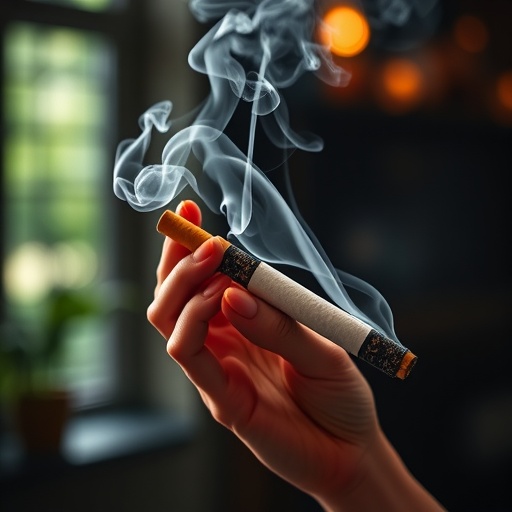
In a groundbreaking advancement for public health, a new comprehensive study has established quantitative reference levels for thirdhand smoke (THS) residues in indoor environments. The systematic review and meta-analysis, recently published in the Journal of Exposure Science and Environmental Epidemiology, delves into the lingering chemical remnants of tobacco products after active smoking has ceased—residues that pose hidden risks to nonsmokers, especially children and vulnerable populations.
Thirdhand smoke refers to the residual tobacco pollutants that adhere to surfaces such as walls, furniture, and dust long after the visible smoke has cleared. Unlike secondhand smoke, which is inhaled directly, THS toxins persist in the environment, gradually releasing volatile compounds back into the air and coming into contact with indoor inhabitants through skin contact, ingestion, or inhalation of dust particles. Quantifying these residues has been a longstanding challenge due to variability in environmental conditions and incomplete data, but this latest meta-analysis integrates multiple datasets worldwide to create standardized reference values.
The study meticulously analyzed environmental measurements from hundreds of indoor sites with varying exposure histories, extracting key chemical markers including nicotine, tobacco-specific nitrosamines, and polycyclic aromatic hydrocarbons. By synthesizing this data, the authors derived concentration ranges that can serve as baseline benchmarks in indoor spaces impacted by tobacco smoke. These reference levels enable regulators and researchers to more accurately assess health risks, monitor environmental remediation efforts, and develop policies targeting THS pollution control.
Scientific insight into the persistence of THS compounds highlights their tenacity; these toxicants can remain detectable for months or even years on surfaces in homes, cars, and public spaces. The toxicological implications are significant, as many THS chemicals have mutagenic and carcinogenic properties. Vulnerable populations exposed to these residues face increased risks of respiratory issues, allergic reactions, and possibly long-term diseases. The quantitative thresholds identified by this research provide a crucial framework for evaluating exposure levels that were previously difficult to interpret.
Moreover, this study underscores the importance of comprehensive indoor air quality management that goes beyond eliminating active smoking. Conventional cleaning methods often fail to remove ingrained THS pollutants effectively. The findings point to the need for specialized decontamination protocols and increased public awareness about prolonged tobacco residue contamination. It also suggests revisiting smoking regulations indoors and in multi-unit housing to better protect nonsmokers from hidden harms.
By establishing these standardized concentration guidelines, the research paves the way for future investigations into the mechanisms of THS exposure and its health effects. It also empowers environmental health professionals to develop more targeted interventions and remediation strategies, such as identifying hotspots of contamination and measuring cleanup efficacy. The clear quantitative benchmarks represent a critical tool for longitudinal surveillance of indoor environments historically impacted by smoking.
In essence, this landmark meta-analysis not only illuminates the invisible legacy of tobacco smoke residues but also equips stakeholders with the scientific footing needed to mitigate thirdhand smoke exposure risks. As the world continues to grapple with tobacco-related health challenges, understanding and controlling THS contamination emerges as a vital frontier in protecting indoor environmental health for current and future generations.
Cite Scienmag News
Ophelia Keating. (July 13, 2026). New Quantitative Standards Defined for Thirdhand Tobacco Smoke Indoors. Scienmag. https://scienmag.com/new-quantitative-standards-defined-for-thirdhand-tobacco-smoke-indoors/
Ophelia Keating. "New Quantitative Standards Defined for Thirdhand Tobacco Smoke Indoors." Scienmag, 13 July 2026, https://scienmag.com/new-quantitative-standards-defined-for-thirdhand-tobacco-smoke-indoors/. Accessed 3 September 2026.
Ophelia Keating. "New Quantitative Standards Defined for Thirdhand Tobacco Smoke Indoors." Scienmag. July 13, 2026. https://scienmag.com/new-quantitative-standards-defined-for-thirdhand-tobacco-smoke-indoors/


