


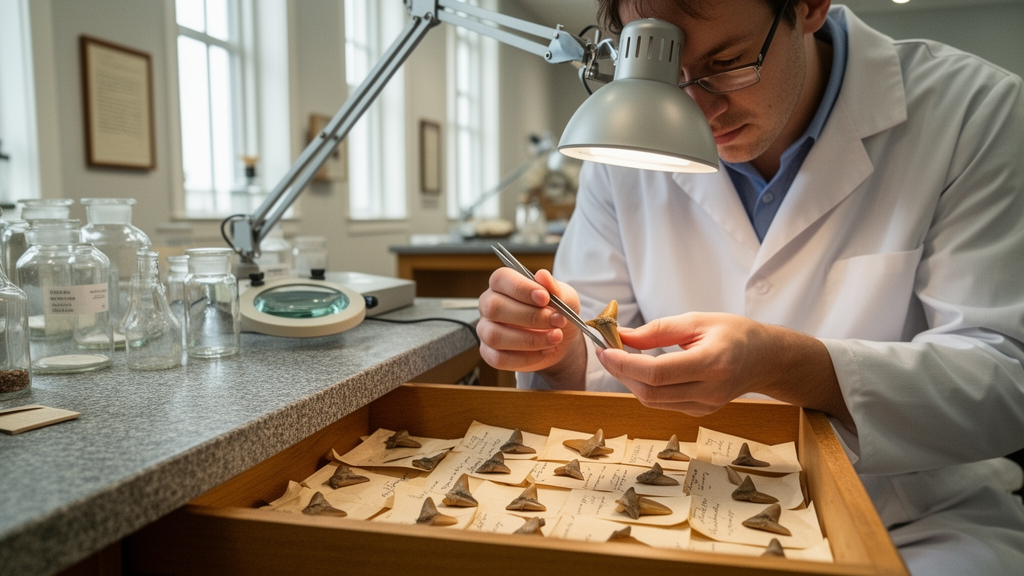
Deep in the historical collections of the Geological Survey of Alabama in Tuscaloosa, a small wooden drawer of fossil shark teeth sat largely unnoticed for more than a century. The 17 teeth, cataloged under the number GSA–V447, carried a handwritten label in a style used by the survey during the late 1800s and early 1900s, stating only that they had been collected from the lower Paleocene Porters Creek Formation on the McConnico Plantation near Prairie Creek in Wilcox County, Alabama. When two researchers revisited the specimens, they realized the teeth did not match any known species. The result, published in the journal Fossil Record, is the description of a brand-new extinct shark: Palaeohypotodus bizzocoi, a predatory lamniform that swam the warm coastal waters of the Gulf of Mexico roughly 62 million years ago, in the dawn of the age of mammals.
The timing of this shark’s existence is what makes the discovery so compelling. The Danian Stage, the earliest slice of the Paleocene, began immediately after the asteroid impact that wiped out the non-avian dinosaurs and roughly three-quarters of all species on Earth. Because the teeth of P. bizzocoi occur in the lowermost Danian units of Alabama and Arkansas, including the Pine Barren Member of the Clayton Formation and the equivalent lower beds of the Clayton Formation in Arkansas, the species was already patrolling Gulf Coastal Plain waters shortly after the extinction event. Its presence in the younger Porters Creek Formation shows that it persisted through the entire Danian Stage, making it one of the earliest well-documented lamniform sharks to appear in North America after the catastrophe.
Reconstructing a shark from loose teeth is a formidable technical challenge, and the team approached it with unusual rigor. Because no field notes survive to confirm that the 17 teeth came from a single individual, the researchers treated them as an artificial tooth set, referring to each specimen individually as GSA–V447.1 through .17. Nine of the teeth are complete. For each one, the team recorded a standardized battery of linear measurements, including total height, root width, main cusp height and width, root thickness, and the depth of the interlobe area between the root lobes, along with counts of lateral cusplets and notes on labial ornamentation. From these they calculated ratios such as the proportion of total tooth height contributed by the main cusp and by the root, allowing direct quantitative comparison across tooth positions and with other species.
To interpret what these isolated teeth meant for the whole jaw, the researchers turned to the jaws of modern relatives. They directly examined dentitions of extant lamniform sharks held at the McWane Science Center in Birmingham and the South Carolina State Museum in Columbia, including the bigeye thresher, pelagic thresher, great white shark, juvenile and adult shortfin and longfin mako, sandtiger shark, and porbeagle, supplemented by published images of additional species. This comparative framework let them assign each fossil tooth to a position in the mouth, distinguishing anterior, intermediate, lateral, and posterior files in both the upper jaw, or palatoquadrate, and the lower jaw, or Meckel’s cartilage. Nine of the teeth proved to be from the upper jaw and eight from the lower, spanning both sides of the head.
The analysis revealed that P. bizzocoi displayed all three major forms of tooth variation known in sharks. Monognathic heterodonty, meaning teeth change shape along the length of a single jaw, was evident in the contrast between anterior and lateral files. Upper anterior teeth bear a tall, narrow, nearly symmetrical main cusp with height-to-width ratios of 1.44 to 1.55, whereas upper lateral teeth are shorter, broader, and increasingly hooked toward the back of the mouth, with ratios of only 1.01 to 1.21. Dignathic heterodonty, differences between upper and lower jaws, showed up in the roots as much as the crowns: lower teeth have longer, less divergent root lobes and a deeper interlobe area, with the root making up 36 to 39 percent of total tooth height compared with only 26 to 32 percent in upper teeth. Upper anterior teeth also have complete cutting edges, while those of the lower jaw stop short of the cusp base, an arrangement not seen in any living lamniform.
The additional 17 isolated teeth, recovered from four counties in Alabama and Hot Spring County in Arkansas and held at the McWane Science Center and the Mississippi Museum of Natural Science, added a third dimension: ontogenetic heterodonty, or change with growth. Sorting the complete teeth by size revealed that juveniles carry more pairs of lateral cusplets than adults. All upper anterior teeth smaller than 24 millimeters in total height have two pairs of cusplets, while larger specimens have only one, and three pairs occur exclusively on the smallest upper lateral teeth. As the shark matured, the root grew proportionally longer and the interlobe area deepened, even though the overall height-to-width proportions stayed essentially constant, meaning juvenile teeth were effectively miniature versions of adult ones. One lower anterior tooth from the Clayton Formation exceeds the largest comparable tooth in the type series by more than five millimeters, hinting that the species grew even bigger than the holotype suggests.
Separating P. bizzocoi from its closest relatives required a careful reexamination of the entire genus. Palaeohypotodus had previously contained three recognized species: the Late Cretaceous P. bronni from the Netherlands and Belgium, and the Paleogene P. rutoti, originally from Belgium, and P. volgensis from Russia. The new species differs from P. bronni in having narrower, more needle-like cusplets, thinner root lobes of even width, and dramatically longer root lobes. The depth of the interlobe area, a feature the authors quantified across dozens of published and museum specimens, averages 31 percent of tooth height in P. bizzocoi but only about 20 percent in P. bronni and 24 percent in P. rutoti. P. rutoti, meanwhile, typically sports two to three pairs of robust, well-separated cusplets, whereas adult P. bizzocoi usually has just one pair. P. volgensis appears to lack the labial plications that define the genus entirely, leading the authors to suggest it may not even belong in Palaeohypotodus.
The study also carries broader implications for shark evolution and classification. The distinctive combination of features in Palaeohypotodus, including mesiodistally wide and distally hooked upper lateral teeth, plications along the labial crown base, and the unusual pattern of complete cutting edges above but incomplete edges below, matches no living lamniform family. The genus shares traits with both the sandtiger family Carchariidae and the Odontaspididae, and its dentition closely resembles those of the extinct genera Hypotodus and Jaekelotodus. The authors therefore resurrect the family Jaekelotodontidae, first erected by the Soviet paleontologist Glückman in 1964, to house these three genera, arguing that they represent an extinct type of lamniform dentition with no modern analogue.
There is even a human story woven into the science. The species name bizzocoi honors the late Bruce D. Bizzoco, a dedicated volunteer at the McWane Science Center whose lifelong commitments included education and the preservation of local Alabama history. The rediscovery of the McConnico Plantation locality itself was a piece of detective work: the researchers located the historic collecting site by overlaying an 1870 property map of Wilcox County onto a modern geologic map, pinpointing the only patch of the property underlain by the Porters Creek Formation. Sun bleaching and root etching on the teeth suggest they were gathered from an erosional gulley in a field rather than a creek gravel bar, and a rich fossil mollusk assemblage from the site, including more than a dozen species of gastropods and bivalves, confirms the early-to-middle Paleocene age.
Finally, the discovery serves as a reminder that museum drawers still hold untold surprises, and that old identifications deserve fresh scrutiny. The authors reviewed reported occurrences of Palaeohypotodus across North America and found that many, including records from Maryland, Virginia, New Jersey, and South Carolina, cannot be confirmed or likely belong to other genera, while teeth from the Danian Cannonball Formation of North Dakota may represent yet another, still-unnamed species. The Alabama and Arkansas occurrences of P. bizzocoi currently stand as the only verified records of the genus in the entire Gulf Coastal Plain, and future fieldwork in Mississippi, Louisiana, and eastern Texas may extend its range further. What began as a forgotten box of teeth has rewritten a chapter of shark evolution in the aftermath of Earth’s worst day.
Subject of Research: A new Paleocene lamniform shark species described from fossil teeth in Alabama
Article Title: A new species of Palaeohypotodus Glückman, 1964 ( Chondrichthyes , Lamniformes ) from the lower Paleocene (Danian) Porters Creek Formation, Wilcox County, Alabama, USA
Article References: Ebersole, J. A., Cicimurri, D. J., & Harrell Jr., T. L. (2024). A new species of Palaeohypotodus Glückman, 1964 (Chondrichthyes, Lamniformes) from the lower Paleocene (Danian) Porters Creek Formation, Wilcox County, Alabama, USA. Fossil Record, 27(1), 111-134. https://doi.org/10.3897/fr.27.112800
Image Credits: AI Generated
DOI: 10.3897/fr.27.112800
Keywords: Palaeohypotodus bizzocoi, paleontology, fossil shark teeth, Paleocene, Danian, lamniform sharks, Alabama, Porters Creek Formation, heterodonty, K/Pg extinction, Geological Survey of Alabama, Jaekelotodontidae
Cite Scienmag News
Violet Maxwell. (October 19, 2026). New prehistoric shark species identified from century-old museum teeth in Alabama. Scienmag. https://scienmag.com/new-prehistoric-shark-species-identified-from-century-old-museum-teeth-in-alabama/
Violet Maxwell. "New prehistoric shark species identified from century-old museum teeth in Alabama." Scienmag, 19 October 2026, https://scienmag.com/new-prehistoric-shark-species-identified-from-century-old-museum-teeth-in-alabama/. Accessed 19 October 2026.
Violet Maxwell. "New prehistoric shark species identified from century-old museum teeth in Alabama." Scienmag. October 19, 2026. https://scienmag.com/new-prehistoric-shark-species-identified-from-century-old-museum-teeth-in-alabama/


