


Researchers at the University of Bremen have quantified the errors introduced by finite interferograms in Fourier transform infrared emission spectroscopy and proposed a modified calibration method to mitigate these inaccuracies. The study, published in Atmospheric Measurement Techniques, addresses a fundamental limitation in the standard total power calibration procedure, which is theoretically valid only for infinitely long, double-sided interferograms. By developing a phase correction technique, the team demonstrates that accurate spectral estimates can be obtained from the unequal-sided interferograms required for high-resolution atmospheric measurements.
The research focuses on the NYAEM-FTS, a spectrometer deployed at the Ny-Ålesund research station in Svalbard, which has been measuring thermally emitted atmospheric radiation since August 2019. This instrument operates in single-sided interferogram mode to achieve a high spectral resolution of 0.08 cm⁻¹, a significant improvement over the 1 cm⁻¹ resolution of the commonly used Atmospheric Emitted Radiance Interferometer. To reach this resolution, the spectrometer records interferograms with a maximal optical path difference of 11.25 cm on one side and approximately 1 cm on the other, creating an unequal-sided configuration that complicates standard calibration methods.
The standard total power calibration method, originally described by Revercomb et al. in 1988, relies on linear interpolation between two blackbody sources at different temperatures. This approach assumes that the instrument’s response to incoming radiance is linear and that the interferograms are infinite and symmetric. However, real-world interferograms are finite and often asymmetric due to instrumental dispersion and sampling issues. The authors demonstrate that when absorption lines are present in the blackbody spectra, the finiteness of the interferograms introduces significant errors into the calibrated atmospheric spectra if the standard method is applied directly to unequal-sided data.
To address this, the team developed a modified calibration routine that incorporates a phase correction step. This method uses a low-resolution phase spectrum derived from the difference between the hot and cold blackbody measurements. By applying this phase correction to the numerator and denominator of the calibration equation, the researchers show that the resulting spectral estimate is equivalent to that obtained from equal-sided interferograms. This theoretical advancement allows for the use of high-resolution single-sided interferograms without incurring the large errors associated with the standard Revercomb formula.
The study includes a detailed case study using simulated atmospheric and blackbody spectra generated by a line-by-line radiative transfer model. The simulations employed representative summer and winter atmospheric profiles for the Ny-Ålesund site, with total water vapor columns of 16.6 mm and 1.9 mm, respectively. The authors compared the best spectral estimate, derived from symmetric truncation, with the results from the standard Revercomb method applied to unequal-sided interferograms and their new modified method. This quantitative analysis allows for the assessment of radiance errors and the selection of appropriate retrieval windows for trace gas measurements.
However, in spectral regions with strong water vapor absorption lines, particularly above 1350 cm⁻¹, the errors can be substantially larger. The study finds that the modified calibration method reduces the maximal error in a band just below 1350 cm⁻¹ from 0.39% to 0.07% in winter and from 3.4% to 0.6% in summer for unequal-sided interferograms.
The researchers also verified the prerequisites for total power calibration by testing the detector linearity and phase stability of the NYAEM-FTS. Measurements of a blackbody at various temperatures between 40 and 95 °C confirmed that the relationship between incident radiance and the measured signal is linear across the probed wavenumbers. Additionally, a time series analysis of blackbody spectra from April 2020 showed that the instrument’s phase remains stable within 0.03 rad, with no significant drift over the measurement cycle. These findings support the validity of the linear calibration model and the stability required for accurate spectral retrieval.
The implications of this work extend to the selection of retrieval windows for high-resolution atmospheric measurements. The authors note that while the Arctic atmosphere’s low water vapor content allows for the use of spectral regions close to strong water vapor lines, the quantitative effects of finite interferograms must be assessed for each specific use case. The modified method enables the extension of retrieval bands up to 1350 cm⁻¹, but errors increase significantly beyond this point, especially during summer when humidity is higher. This highlights the importance of performing a quantitative error analysis when applying total power calibration to new instruments or sites.
The standard calibration method, while widely used, has inherent limitations that can lead to significant biases in the retrieved atmospheric parameters if not properly addressed.
The findings are supported by a comprehensive theoretical treatment that includes the effects of lab air absorption on blackbody spectra and the phase errors arising from asymmetric interferograms. The authors demonstrate that the emission from the lab air cancels out in the calibration equation when realistic blackbody spectra are used, simplifying the calibration process. This work not only improves the calibration of the NYAEM-FTS but also offers a generalizable approach for other FTIR instruments operating in single-sided mode.
By quantifying the errors associated with finite interferograms, the team provides a basis for optimizing retrieval strategies and improving the quality of atmospheric data.
The authors recommend that such quantitative analyses be performed routinely when applying total power calibration, as the effects vary depending on the instrument, measurement site, and intended use of the spectra. This approach allows for informed decisions regarding the necessity of phase correction and the selection of spectral windows for trace gas retrievals.
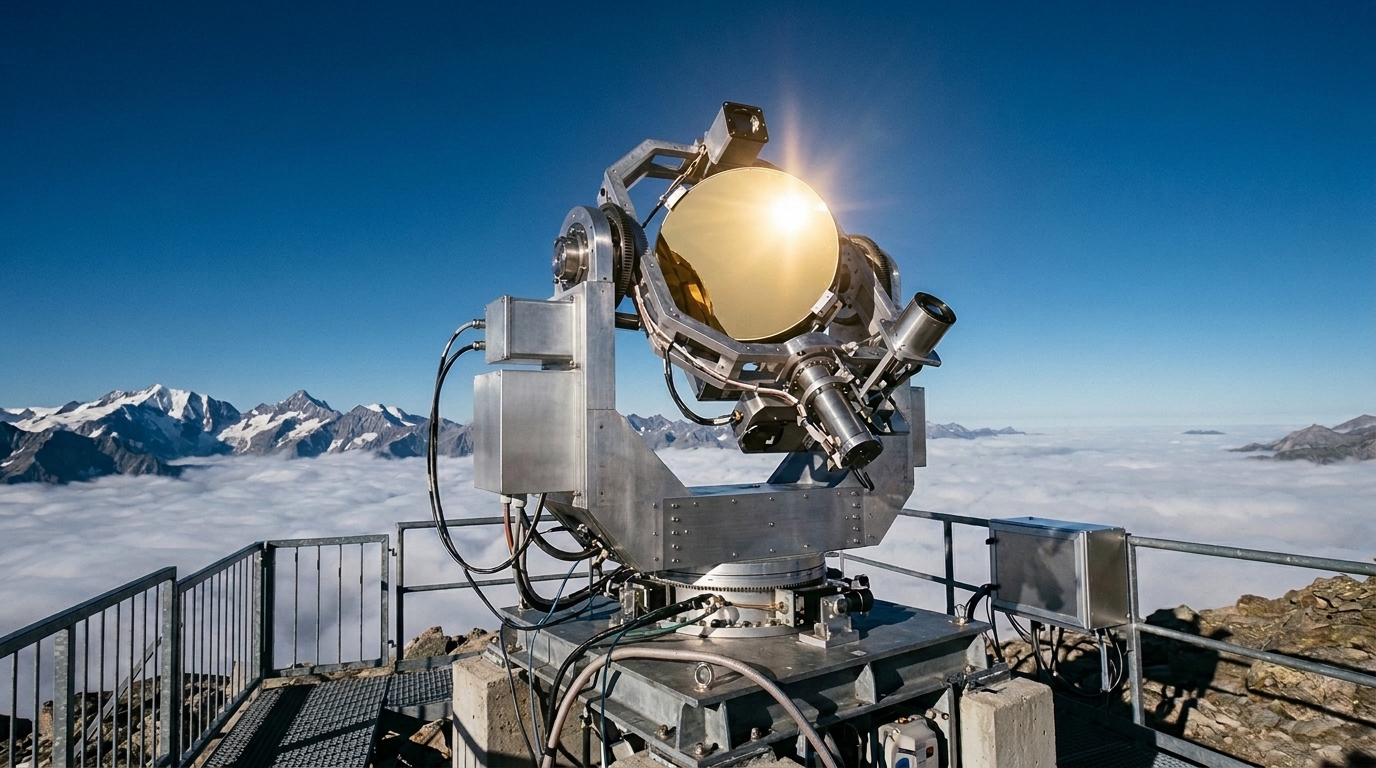
The NYAEM-FTS instrument is mounted inside the AWIPEV atmospheric observatory, approximately 2 meters below a roof inlet that automatically opens and closes based on weather conditions. To protect the equipment in the Arctic environment, the system requires wind speeds to remain below 15 m s⁻¹ and prohibits precipitation or snow drift. Incoming vertical radiation is deflected by a motorized gold mirror into the spectrometer’s emission port. The core of the system is a commercial Bruker Vertex 80 FTIR spectrometer, selected for its high resolution of 0.08 cm⁻¹ in single-sided mode and its reduced number of mirrors compared to other models used for solar absorption spectroscopy at the same site. The instrument utilizes a liquid nitrogen-cooled mercury cadmium telluride detector, which is essential for suppressing noise when detecting thermal radiation emitted at atmospheric temperatures. This detector covers a wavenumber range of 400 to 2500 cm⁻¹ and requires weekly refilling of the liquid nitrogen by station engineers.
Radiometric calibration is performed using two blackbody sources at distinct temperatures. The high-temperature source is a commercial SR800 blackbody maintained at 110 °C, featuring a 10 cm × 10 cm square surface with a specified temperature uniformity of ±0.01 °C and an emissivity of 0.98 ± 0.02. The low-temperature calibration point is provided by home-made blackbodies at room temperature, constructed from high-emissivity coating foil glued to aluminum plates with continuous temperature sensors. This setup replaced an earlier configuration that alternated a single blackbody between 20 and 110 °C, a process that ultimately damaged the Peltier elements after several months of deployment. The entrance mirror rotates to allow the instrument to select between the sky view and either of the two blackbody sources for sequential measurements.
The theoretical framework accounts for the fact that real-world blackbody spectra are not smooth functions of wavenumber but exhibit absorption lines from gases, particularly water vapor, in the air column between the blackbody and the spectrometer’s beam splitter. The authors demonstrate that the emission from this lab air layer cancels out in the calibration equation when realistic blackbody spectra are used, allowing the calibrated atmospheric spectrum to be obtained without needing to know the exact state or composition of the lab air. This simplification is crucial for applying the calibration to real-world measurements where the lab air conditions may vary. The study also addresses phase errors arising from asymmetric interferograms, which can result from instrumental dispersion or sampling points not aligning with the zero path difference. By incorporating a phase correction step, the modified method ensures that the internal phase contributions cancel in the subtraction and external phases cancel in the quotient, yielding a real-valued spectral estimate that matches the best estimate from symmetric truncation.
The instrument’s operational history includes a period of hardware issues with the Vertex 80, which led to increasingly frequent faulty interferograms. To mitigate this, the resolution was temporarily lowered to 0.3 cm⁻¹ in August 2020. The instrument was subsequently shipped to the manufacturer for repair, involving the replacement of the drive coil, resulting in a downtime from September 2022 until August 2024. During this period, testing was conducted in Bremen. The study’s quantitative analysis is based on simulated spectra using site-representative atmospheric composition and thermodynamic profiles, as infinite interferograms are not available from actual measurements. This approach allows for the assessment of radiance errors arising from finite interferograms and informs decisions on retrieval window selection, particularly in spectral regions where water vapor lines are strong but not fully saturated.
Subject of Research: Calibration of FTIR emission spectroscopy for finite interferograms
Article Title: Total power calibration in FTIR emission spectroscopy for finite interferograms
Article References: Heizmann, L., Palm, M., Notholt, J., & Buschmann, M. (2026). Total power calibration in FTIR emission spectroscopy for finite interferograms. Atmospheric Measurement Techniques, 19(21), 6875-6890. https://doi.org/10.5194/amt-19-6875-2026
Image Credits: AI Generated
Keywords: FTIR spectroscopy, atmospheric remote sensing, calibration, interferograms, phase correction, radiative transfer, trace gas retrieval, Svalbard, Total, power, FTIR, emission
Cite Scienmag News
Russell Cooper. (November 9, 2026). New Phase Correction Improves FTIR Atmospheric Calibration. Scienmag. https://scienmag.com/new-phase-correction-improves-ftir-atmospheric-calibration/
Russell Cooper. "New Phase Correction Improves FTIR Atmospheric Calibration." Scienmag, 9 November 2026, https://scienmag.com/new-phase-correction-improves-ftir-atmospheric-calibration/. Accessed 11 November 2026.
Russell Cooper. "New Phase Correction Improves FTIR Atmospheric Calibration." Scienmag. November 9, 2026. https://scienmag.com/new-phase-correction-improves-ftir-atmospheric-calibration/




