Tuesday, November 10, 2026
Science
No Result
View All Result
  • Login
  • HOME
  • SCIENCE NEWS
  • CONTACT US
  • HOME
  • SCIENCE NEWS
  • CONTACT US
No Result
View All Result
Scienmag
No Result
View All Result
Home Science News Earth Science

New Model Predicts Surface Subsidence from Sublevel Caving Mining

November 10, 2026
in Earth Science, Technology and Engineering
Denise Maddox
By Denise Maddox Scienmag Editorial Profile - Mechanical Engineering
Reading Time: 2 mins read
0
New Model Predicts Surface Subsidence from Sublevel Caving Mining

New Model Predicts Surface Subsidence from Sublevel Caving Mining

65
SHARES
587
VIEWS
Share on FacebookShare on Twitter
ADVERTISEMENT

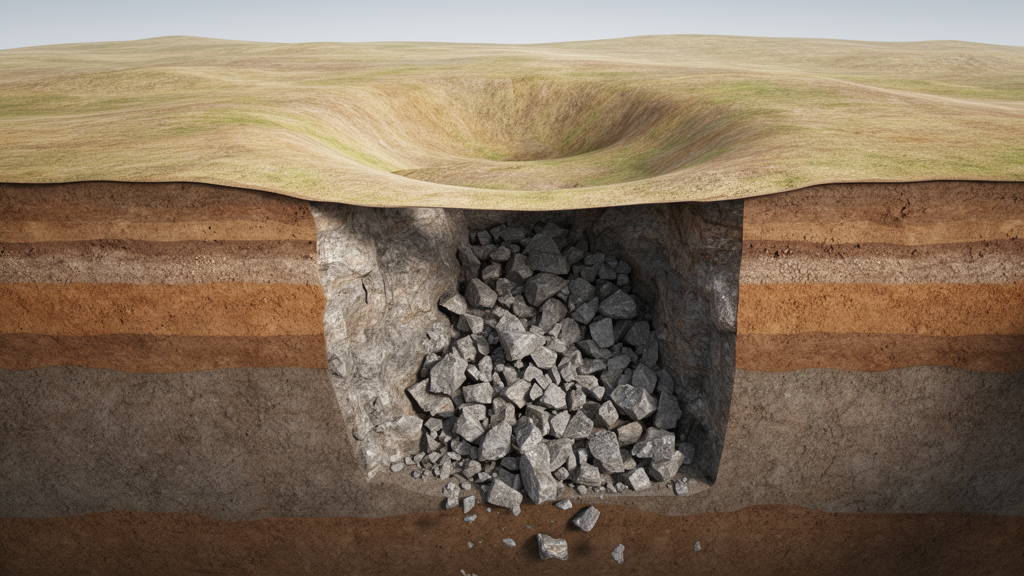
Researchers have developed a new mechanical model to analyze surface movement dynamics and predict displacement ranges resulting from sublevel caving operations in metalliferous deposits. The study, published in Geomechanics and Geophysics for Geo-Energy and Geo-Resources, introduces a novel conceptualization of the subsidence angle, accompanied by a calculation methodology derived from mechanical principles.

The reliability of the newly proposed method was validated through a combined approach involving surface and underground monitoring at the Dahongshan Iron Mine, along with numerical simulation calculations.

The investigation specifically examines how topographical variations, the initial caved zone backfill elevation, and mining depth influence surface deformation patterns.

One of the key findings of the research is that the reconceptualized subsidence angle, defined as the horizontal angle between the movement boundary extending from the deepest extraction level edge to the surface movement perimeter, creates maximum surface fracturing zones.

The study also highlights the impact of terrain on subsidence patterns. Under flat terrain, subsidence zones manifest symmetrically on both sides of the undercut. In contrast, sloped landscapes produce asymmetrical subsidence patterns, with hanging wall subsidence angles exceeding footwall measurements. This asymmetry is attributed to the hanging wall topographic line intersecting the movement boundary at greater distances, which results in hanging wall subsidence zones exhibiting larger dimensions.

Furthermore, the research investigates the role of backfilling initial caved zones in mitigating surface fracturing. The findings indicate that while backfilling minimally affects the distribution areas of tensile stress, it significantly diminishes stress magnitude. However, the study notes that the effect is primarily on stress intensity rather than the spatial extent of the stress distribution.

The influence of mining depth on surface deformation is also explored. The study finds that increasing extraction depths correlates with expanded tensile stress zones, though this is accompanied by decreased stress intensity.

For combined extraction methodologies, the research describes the distribution of principal stress on the surface, extending from the subsidence center towards the open-pit slope. This distribution can be sequentially divided into four distinct zones: the compression stress decay zone, the tensile stress gradual increase zone, the tensile stress fluctuation zone, and the rapid increase zone of compression stress.

Subject of Research: Theoretical model and patterns of surface subsidence by sublevel caving mining

Article Title: Research on theoretical model and patterns of surface subsidence by sublevel caving mining under multiple factors

Article References: Ma, K., Zhao, Y., Yang, T., Liu, H., Liu, Y., Hou, J., He, R., He, Y., Li, J., & Li, X. (2026). Research on theoretical model and patterns of surface subsidence by sublevel caving mining under multiple factors. Geomechanics and Geophysics for Geo-Energy and Geo-Resources. https://doi.org/10.1007/s40948-026-01226-3

Image Credits: AI Generated

DOI: 10.1007/s40948-026-01226-3

Keywords: sublevel caving, surface subsidence, geomechanics, mining engineering, Dahongshan Iron Mine, subsidence angle, numerical simulation, surface deformation, Research, theoretical, model, patterns

Cite Scienmag News

Denise Maddox. (November 10, 2026). New Model Predicts Surface Subsidence from Sublevel Caving Mining. Scienmag. https://scienmag.com/new-model-predicts-surface-subsidence-from-sublevel-caving-mining/

Denise Maddox. "New Model Predicts Surface Subsidence from Sublevel Caving Mining." Scienmag, 10 November 2026, https://scienmag.com/new-model-predicts-surface-subsidence-from-sublevel-caving-mining/. Accessed 10 November 2026.

Denise Maddox. "New Model Predicts Surface Subsidence from Sublevel Caving Mining." Scienmag. November 10, 2026. https://scienmag.com/new-model-predicts-surface-subsidence-from-sublevel-caving-mining/

Tags: Dahongshan Iron Minegeomechanicsmining engineeringmodelnumerical simulationpatternsResearchsublevel cavingsubsidence anglesurface deformationsurface subsidencetheoretical
Share26Tweet16
Previous Post

Microbiota-targeted interventions for metabolic syndrome-related parameters in adolescents with overweight or obesity: a systematic review and meta-analysis

Next Post

Biochar and Fungi Boost Soil Function in Reclaimed Coal Mines

Related Posts

Improved Path Planning Algorithm Guides Autonomous Robots Through Rugged Gobi Orchards
Technology and Engineering

Improved Path Planning Algorithm Guides Autonomous Robots Through Rugged Gobi Orchards

November 10, 2026
New Clustering Method Balances Speed and Accuracy in District Heating Simulation
Technology and Engineering

New Clustering Method Balances Speed and Accuracy in District Heating Simulation

November 10, 2026
FPGA CNNs Enable Fast Topological Triggers for HL-LHC
Technology and Engineering

FPGA CNNs Enable Fast Topological Triggers for HL-LHC

November 10, 2026
Multimodal Retrieval Framework Enhances Technical Reasoning and Accuracy in Architectural Design
Technology and Engineering

Multimodal Retrieval Framework Enhances Technical Reasoning and Accuracy in Architectural Design

November 10, 2026
Soviet Art Museum in Ukraine Faces Political Neglect
Archaeology

Soviet Art Museum in Ukraine Faces Political Neglect

November 10, 2026
Long-Read RNA Sequencing Reveals Active Transposable Elements in Human Cell Types
Biotechnology

Long-Read RNA Sequencing Reveals Active Transposable Elements in Human Cell Types

November 10, 2026
Next Post
Biochar and Fungi Boost Soil Function in Reclaimed Coal Mines

Biochar and Fungi Boost Soil Function in Reclaimed Coal Mines

  • Mothers who receive childcare support from maternal grandparents show more optimized

    Mothers who receive childcare support from maternal grandparents show more parental warmth, finds NTU Singapore study

    27656 shares
    Share 11059 Tweet 6912
  • University of Seville Breaks 120-Year-Old Mystery, Revises a Key Einstein Concept

    1061 shares
    Share 424 Tweet 265
  • Bee body mass, pathogens and local climate influence heat tolerance

    682 shares
    Share 273 Tweet 171
  • Researchers record first-ever images and data of a shark experiencing a boat strike

    546 shares
    Share 218 Tweet 137
  • Groundbreaking Clinical Trial Reveals Lubiprostone Enhances Kidney Function

    531 shares
    Share 212 Tweet 133
Science

Embark on a thrilling journey of discovery with Scienmag.com—your ultimate source for cutting-edge breakthroughs. Immerse yourself in a world where curiosity knows no limits and tomorrow’s possibilities become today’s reality!

RECENT NEWS

  • Chilean School Study Details Bullying Rates, Socioeconomic Disparities, and Protective Factors
  • Improved Path Planning Algorithm Guides Autonomous Robots Through Rugged Gobi Orchards
  • Knocking Down circAKT3 Protects Heart Cells From Reperfusion Injury
  • Fibroblast Growth Factor Signalling Emerges as Target in Alzheimer’s Disease Review

Categories

  • Agriculture
  • Anthropology
  • Archaeology
  • Athmospheric
  • Biology
  • Biotechnology
  • Blog
  • Bussines
  • Cancer
  • Chemistry
  • Climate
  • Earth Science
  • Editorial Policy
  • Marine
  • Mathematics
  • Medicine
  • Pediatry
  • Policy
  • Psychology & Psychiatry
  • Science Education
  • Science News
  • Social Science
  • Space
  • Technology and Engineering

Subscribe to Blog via Email

Enter your email address to subscribe to this blog and receive notifications of new posts by email.

Join 5,150 other subscribers

© 2025 Scienmag - Science Magazine

Welcome Back!

Login to your account below

Forgotten Password?

Retrieve your password

Please enter your username or email address to reset your password.

Log In
No Result
View All Result
  • HOME
  • SCIENCE NEWS
  • CONTACT US

© 2025 Scienmag - Science Magazine

Discover more from Science

Subscribe now to keep reading and get access to the full archive.

Continue reading