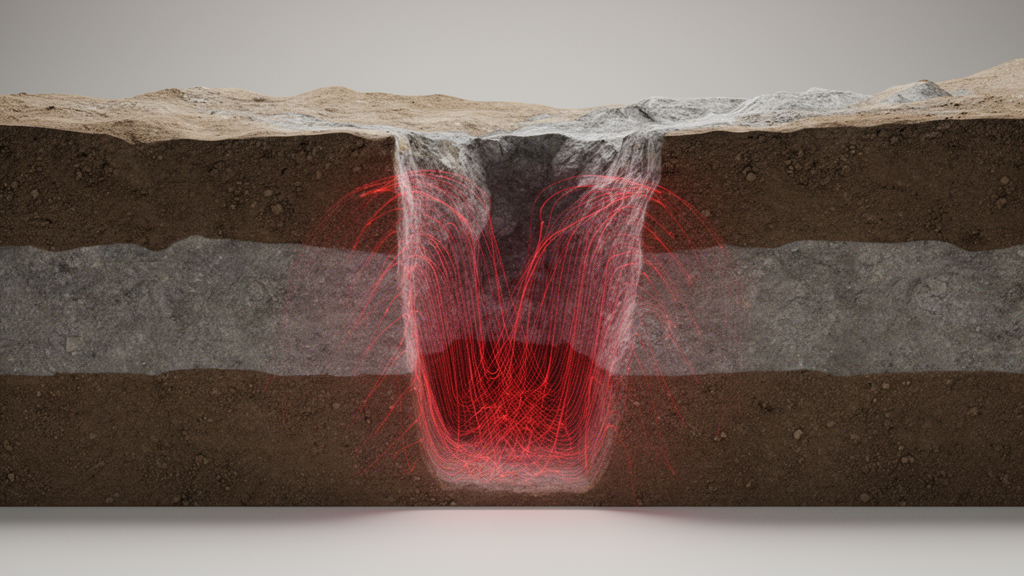
Underground mining activities often lead to significant movement and deformation of the strata above the extraction zone. However, the mechanisms behind surface horizontal displacement remain poorly understood, complicating the explanation of observed phenomena. A recent study published in Geomechanics and Geophysics for Geo-Energy and Geo-Resources addresses this gap by identifying two distinct causes of horizontal displacement and developing a new prediction model to account for them.
The research, led by Yuanfei Chen and colleagues, utilized numerical simulations to analyze the mechanisms behind horizontal displacement caused by underground mining. The team identified that horizontal displacement is not a single uniform process but rather the result of two different types of movement. The first type is rotational displacement, which occurs due to the inclination of the overburden at the boundary of the goaf.
The second identified mechanism is translational displacement, which results from a distinct “Z”-shaped movement pattern of the overburden during the mining process. This translational displacement concentrates in the central mining-influenced area and resembles ground subsidence. By distinguishing between these two types of displacement, the study offers a more nuanced understanding of how the ground moves in response to underground extraction.
Based on these findings, the authors proposed a new prediction model known as the R&T model. This model integrates both rotational and translational components to provide a comprehensive estimate of surface horizontal displacement. The development of this model represents a significant advancement in the theory of mining subsidence, as it moves beyond traditional approaches that often fail to account for the asymmetry and complexity of horizontal movement. This research contributes to deformation prediction and the mitigation of geological hazards associated with mining activities.
To verify the reliability of the R&T model, the study applied it to four engineering cases. The performance of the new model was compared against two existing models: the Probability Integral Model (PIM) and the Improved Probability Integral Model (IPIM). The results demonstrated that the R&T model achieved a relative Root Mean Square Error (RMSE) of below 15% in these cases. This level of accuracy is significantly higher than that of the traditional PIM, which exhibited a relative RMSE of 69.7%, and the IPIM, which showed a relative RMSE of 53.8%.
The study also highlights a critical limitation of traditional theories in explaining observed phenomena. Specifically, the surface horizontal displacement in the strike direction is often asymmetric, a feature that conventional models struggle to account for. By providing a reasonable explanation for these observed asymmetries, the research enhances the theoretical framework used to understand mining-induced ground movement. This improved understanding is crucial for accurately assessing the risks associated with underground mining activities.
The findings of this study advance the field of mining subsidence by providing a clearer mechanism-based explanation for horizontal displacement.
Subject of Research: Mechanisms and prediction of surface horizontal displacement caused by underground mining
Article Title: The dual mechanism and prediction model of surface horizontal displacement caused by underground mining
Article References: Chen, Y., Wang, L., Chi, S., Zha, J., & Zhang, Y. (2026). The dual mechanism and prediction model of surface horizontal displacement caused by underground mining. Geomechanics and Geophysics for Geo-Energy and Geo-Resources. https://doi.org/10.1007/s40948-026-01229-0
Image Credits: AI Generated
DOI: 10.1007/s40948-026-01229-0
Keywords: underground mining, surface displacement, geomechanics, subsidence, prediction model, numerical simulation, geological hazards, stratum movement, dual, mechanism, prediction, model
Cite Scienmag News
Violet Maxwell. (November 9, 2026). New Model Predicts Mining Surface Displacement. Scienmag. https://scienmag.com/new-model-predicts-mining-surface-displacement/
Violet Maxwell. "New Model Predicts Mining Surface Displacement." Scienmag, 9 November 2026, https://scienmag.com/new-model-predicts-mining-surface-displacement/. Accessed 9 November 2026.
Violet Maxwell. "New Model Predicts Mining Surface Displacement." Scienmag. November 9, 2026. https://scienmag.com/new-model-predicts-mining-surface-displacement/