


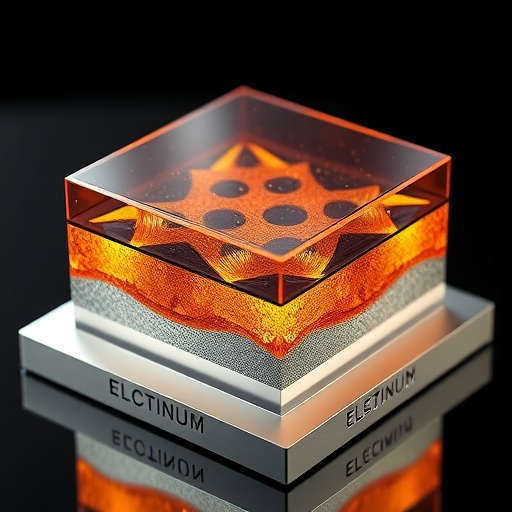
In a groundbreaking advance poised to reshape our understanding of electrochemical interfaces, researchers have developed a comprehensive model capturing the intricate behavior of the electric double layer on stepped platinum electrodes. This highly detailed representation not only demystifies the complex interplay occurring at these surfaces but also opens new avenues for designing more efficient catalytic systems, vital for energy conversion and storage technologies. As the world intensifies its search for sustainable energy solutions, the implications of this research resonate far beyond academic circles, capturing the imagination of scientific and industrial communities alike.
The electric double layer (EDL) is fundamental in electrochemistry, impacting processes ranging from fuel cells to sensors. Traditionally, models describing the EDL have struggled to account for the variations introduced by surface features such as steps and kinks, which are common in practical electrode materials. These surface irregularities profoundly influence how ions and molecules interact with the electrode, affecting reaction rates and selectivity in catalytic processes. The team led by Fröhlich, Liu, and Ojha has now delivered an unprecedented, all-encompassing theoretical treatment that bridges this knowledge gap, marking a pivotal shift in the field.
Historically, the study of the EDL has relied on simplified approaches assuming atomically flat surfaces, a far cry from the real-world complexity inherent in catalysts’ nanostructured surfaces. However, recent experimental advancements have revealed that stepped electrodes exhibit distinctly different electrochemical behavior due to altered local electric fields and site-specific adsorption phenomena. The newly proposed model captures this nuanced reality by integrating surface morphology with electrostatic interactions and molecular-scale dynamics, enabling predictions with remarkable accuracy that align with experimental findings.
At the core of this innovative model lies a sophisticated representation of the charged interface, accounting for the microscopic structural features of stepped platinum electrodes. Unlike uniform surfaces, steps create discontinuities in atomic arrangements, changing the distribution of electron density and the local potential landscape. The research meticulously characterizes these spatial variations and their effects on ion distributions, water structuring, and the energetics of adsorption, factors that collectively define the electric double layer’s properties and influence catalytic efficiency.
Furthermore, the model incorporates advanced statistical mechanics methodologies alongside quantum mechanical calculations, providing a holistic framework that captures multiple scales of interaction. This multiscale approach is crucial for understanding the combined effects of electrostatics, solvation, and quantum surface states. By doing so, the researchers bridge the gap between theoretical predictions and experimental electrochemical signatures, achieving a level of detail and reliability previously unattainable.
One of the most striking revelations from this study is the identification of specific features in the electric double layer unique to stepped surfaces, such as non-uniform capacitance distributions and localized charge accumulations. These findings challenge conventional assumptions that have long treated the EDL as a smooth, continuous layer, emphasizing the need to reconsider design principles in catalysis. The implications extend to optimizing electrode materials in fuel cells, electrolysis cells, and other renewable energy conversion devices where platinum and other noble metals serve as key catalysts.
In practical terms, understanding the intricate EDL structure on stepped electrodes enables more precise control of reaction environments. By tailoring step density and geometry, researchers can selectively enhance reaction pathways or suppress undesirable side reactions. This insight drives the rational design of next-generation catalysts with enhanced activity, selectivity, and durability. The model’s predictive power offers a powerful computational tool to screen electrode materials and surface treatments before experimental implementation, accelerating innovation cycles significantly.
Beyond catalysis, the comprehensive model provides vital insights applicable to diverse electrochemical systems, including batteries, supercapacitors, and corrosion science. The electric double layer governs charge storage and transfer phenomena central to these technologies. Consequently, a nuanced understanding of how surface morphology influences EDL characteristics directly informs efforts to improve energy density, charging rates, and material stability, bridging fundamental science with real-world applications.
Notably, the researchers validated their model through rigorous comparison with experimental data, including cyclic voltammetry and electrochemical impedance spectroscopy on well-characterized platinum electrodes. The alignment between theoretical predictions and observed behavior underscores the model’s robustness and establishes a new benchmark for electrochemical interface studies. This meticulous validation builds confidence that the model will serve as a cornerstone for future investigations into complex electrode surfaces.
The impact of this research extends into the realms of fundamental physical chemistry, offering fresh perspectives on the interactions between charged surfaces and electrolytes at the atomic scale. By revealing how atomic step sites modulate the electrostatic landscape and thereby influence the structure and dynamics of the double layer, the study enriches our understanding of interfacial phenomena. These insights have the potential to inspire novel theoretical approaches and experimental methods probing nanoscale electrochemical processes.
Moreover, the work’s interdisciplinary nature, intersecting computational physics, surface chemistry, and electrochemical engineering, exemplifies the collaborative spirit necessary for addressing the multifaceted challenges in energy science. It highlights how integrating diverse expertise can yield transformative advancements that single-discipline efforts might struggle to achieve. The comprehensive model stands as a testament to the power of synergistic research, setting a precedent for future studies on complex electrochemical interfaces.
Looking ahead, the model offers a flexible platform adaptable to different metallic surfaces beyond platinum, potentially encompassing alloys and other nanostructured materials. This adaptability invites exploration of a vast range of electrode configurations, accelerating the discovery of optimized materials for various electrochemical applications. As researchers refine and extend this framework, it promises to become an indispensable component of the electrochemist’s toolkit.
In sum, the introduction of a comprehensive model for the electric double layer on stepped platinum electrodes marks a significant milestone in electrochemical science. It combines rigorous theoretical innovation with practical relevance, forging a path toward more efficient and sustainable energy technologies. By resolving long-standing uncertainties about how surface morphology shapes interfacial electrical behavior, the research lays a robust foundation for both fundamental studies and technological advancements in the coming decades.
This pioneering contribution not only heralds a new era in understanding electrochemical interfaces but also exemplifies the profound impact of molecular-level insights on macroscopic technology development. The careful marriage of theory and experiment embodied in this work underscores the importance of detailed mechanistic comprehension in driving forward the renewable energy revolution. As the transition to clean energy accelerates, such breakthroughs in electrode science will play a crucial role in meeting global energy demands sustainably.
The comprehensive model also provides valuable guidance for experimentalists aiming to design electrodes with tailored properties. It elucidates how subtle variations in step arrangements influence measurable parameters such as double-layer capacitance and reaction kinetics. Armed with this knowledge, researchers can strategically engineer electrode surfaces to achieve desired electrochemical performance, reducing trial-and-error approaches and enhancing efficiency in material synthesis.
Finally, the authors’ commitment to making their model accessible to the broader community ensures that the benefits of this research will be widely disseminated and adopted. By providing computational tools and detailed protocols, they empower others to explore complex electrochemical systems with unprecedented resolution and predictability. This openness fosters a collaborative ecosystem propelling the entire field toward more sophisticated and effective energy solutions.
Cite Scienmag News
Bethany Barker. (February 2, 2026). New Model Explains Stepped Platinum Electrode Layers. Scienmag. https://scienmag.com/new-model-explains-stepped-platinum-electrode-layers/
Bethany Barker. "New Model Explains Stepped Platinum Electrode Layers." Scienmag, 2 February 2026, https://scienmag.com/new-model-explains-stepped-platinum-electrode-layers/. Accessed 4 September 2026.
Bethany Barker. "New Model Explains Stepped Platinum Electrode Layers." Scienmag. February 2, 2026. https://scienmag.com/new-model-explains-stepped-platinum-electrode-layers/


