

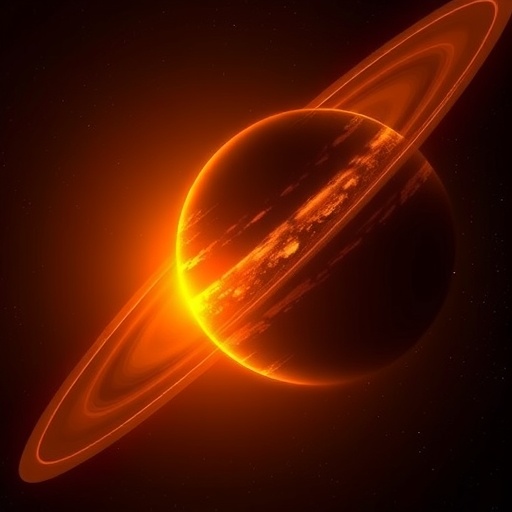
In the vast and dynamic cosmos, the visible light radiated by stars is merely the tip of the energetic iceberg. Beyond the luminous glow apparent to human eyes, many celestial bodies, including planets, are enveloped by radiation belts—regions teeming with charged particles energized to phenomenal speeds. Unlike stars, which generate their own particles, these radiation belts capture particles originating from nearby stellar sources. Yet, the precise mechanics by which these belts accelerate particles to such astounding energies have long eluded astrophysicists.
Recent breakthroughs have been made by Associate Professor Adnane Osmane of the University of Helsinki, who has developed a novel model elucidating the enigmatic process of particle acceleration within planetary radiation belts. Osmane’s work uncovers a fundamental relationship between the intensity of a planet’s surface magnetic field and the maximum energy particles can achieve in its surrounding radiation belts. This insight not only advances theoretical astrophysics but also has profound implications for our understanding of exoplanet magnetospheres and their potential habitability.
The heart of Osmane’s model lies in the concept that the strength of a planetary magnetic field directly controls particle acceleration. As the magnetic field intensifies, so too does the velocity imparted to charged particles within the belt. However, this acceleration is not unbounded. The particles themselves radiate away energy as they reach extreme velocities, a counteracting force that imposes a stringent upper limit on their achievable energy. Thus, a delicate balance emerges where magnetic field strength both fuels and constrain particle acceleration, establishing a universal cap.
Quantitatively, this upper limit manifests at a magnetic field intensity of approximately 0.0004 teslas for protons—a key charged particle—and about 0.00004 teslas for electrons. For perspective, Earth’s equatorial magnetic field measures around 0.00003 teslas, indicating that planet-wide fields slightly stronger than Earth’s can push particles close to this energetic ceiling. Remarkably, this upper bound translates into particle energies on the order of 7 teraelectronvolts (TeV), an astronomical value exceeding a trillion times the energy carried by a photon of visible light.
Such immense energies have profound physical implications. When particles reach these thresholds and radiate energy, the feedback mechanism inherently limits further acceleration despite increasing magnetic field strengths. This mechanistic insight tightly constrains the potential energies of particles in radiation belts across a variety of celestial environments. Importantly, Osmane’s model is not restricted to terrestrial planets; it extends seamlessly to gas giants and even brown dwarfs, objects straddling the line between massive planets and low-mass stars, vastly broadening its applicability.
The theoretical framework was developed in collaboration with scientists from the Johns Hopkins University Applied Physics Laboratory in the United States, who provided extensive empirical datasets derived from direct observations within the solar system as well as cutting-edge radio telescope measurements. This fusion of observational and computational inputs enhanced the robustness of Osmane’s model, grounding its predictive power in a comprehensive astrophysical context. This interdisciplinary approach exemplifies the contemporary synergy between theory and observation essential to space physics.
One compelling aspect of this research is its potential to revolutionize the search for exoplanets. By establishing a predictive relationship between magnetic field intensity and particle acceleration energy limits, astronomers can now infer characteristics of unseen planetary radiation belts through their radio emission wavelengths. This newly-found diagnostic tool opens up unprecedented opportunities to detect and analyze exoplanet magnetospheres remotely, a key factor in assessing their magnetic environments and protective capabilities.
The presence of a strong planetary magnetic field plays a crucial role in shielding the surface from harmful cosmic and solar radiation. This protection helps preserve atmospheres, which are otherwise vulnerable to being stripped away by energetic particles. Consequently, understanding radiation belt dynamics is central to evaluating planetary habitability. Osmane’s model provides a quantitative framework to correlate magnetic field strengths and their shielding efficacy, thereby refining criteria in the ongoing quest for potentially life-supporting worlds beyond our solar system.
Furthermore, the implications extend to astrophysical phenomena associated with brown dwarfs. These substellar objects, which do not sustain hydrogen fusion like stars but still exhibit complex magnetic activity, have baffled astronomers for years regarding their magnetospheric particle behaviors. Osmane’s findings suggest that their magnetic fields and associated radiation belts obey similarly stringent energetic bounds, offering an avenue to unify the behavior of a broad class of magnetized bodies under a single theoretical umbrella.
The underlying physics rests on the interplay between magnetic field-induced acceleration and radiative energy losses, a balance elegantly captured by Osmane’s single-variable model. This simplicity contrasts sharply with the complexity typically attributed to space plasma dynamics, making the model not only powerful but also accessible for integration into broader astrophysical simulations and predictive frameworks. Its universality underscores fundamental plasma and magnetic field principles operative across diverse cosmic environments.
Beyond its theoretical significance, the research embodies a milestone in computational modeling. The extensive simulations and calculations were pivotal in quantifying these limits with unprecedented precision, demonstrating the transformative role of computational astrophysics in decoding celestial mysteries. The model will likely serve as a springboard for future investigations, stimulating exploration into magnetic field evolution, particle acceleration mechanisms, and their interactions with planetary atmospheres.
In summary, Adnane Osmane’s work provides a landmark contribution to space physics by establishing universal energy limits to particle acceleration within radiation belts shaped by planetary and brown dwarf magnetic fields. This breakthrough advances our grasp of high-energy processes in magnetospheric systems and offers practical tools for probing exoplanetary environments critical to life’s possibility. As new telescopes and observational platforms come online, this research will undoubtedly underpin pivotal discoveries in planetary science, astrophysics, and the enduring quest to contextualize Earth in the cosmic arena.
Subject of Research: Not applicable
Article Title: Universal energy limits of radiation belts in planetary and brown dwarf magnetospheric systems
News Publication Date: 4-Mar-2026
Web References:
https://www.science.org/doi/10.1126/sciadv.aea4945
References:
Osmane, A., Turner, D. L., et al. (2026). Universal energy limits of radiation belts in planetary and brown dwarf magnetospheric systems. Science Advances. DOI: 10.1126/sciadv.aea4945.
Image Credits:
Jani Närhi
Keywords
Radiation belts, particle acceleration, magnetic fields, planetary magnetospheres, brown dwarfs, exoplanets, plasma physics, high-energy astrophysics, computational modeling, space physics, magnetic field constraints, particle energy limits


