

Friday, June 26, 2026
Science
No Result
View All Result
  • Login
  • HOME
  • SCIENCE NEWS
  • CONTACT US
  • HOME
  • SCIENCE NEWS
  • CONTACT US
No Result
View All Result
Scienmag
No Result
View All Result
Home Science News Mathematics

New method cracked for high-capacity, secure quantum communication

July 5, 2024
in Mathematics
Reading Time: 2 mins read
0
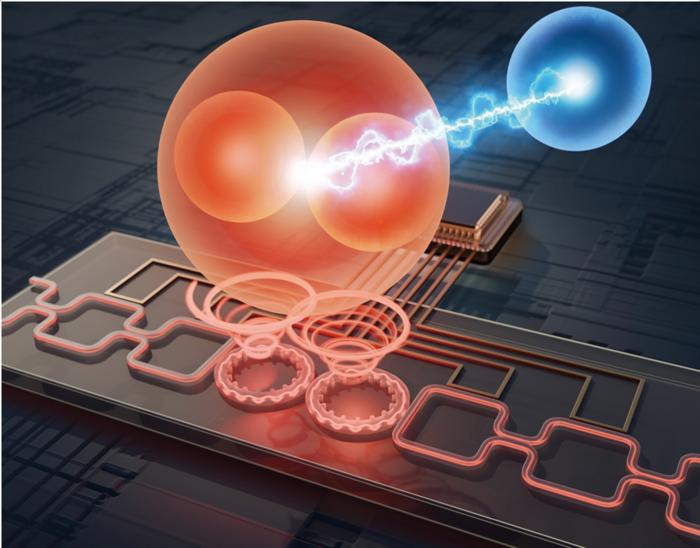
Fig. 1. The integrated photonic circuit for generation and manipulation of flying qudits.
68
SHARES
618
VIEWS
Share on FacebookShare on Twitter
ADVERTISEMENT

Scientists have made a significant breakthrough in creating a new method for transmitting quantum information using particles of light called qudits. These qudits promise a future quantum internet that is both secure and powerful.

Fig. 1. The integrated photonic circuit for generation and manipulation of flying qudits.

Credit: by Haoqi Zhao, Yichi Zhang, Zihe Gao, Jieun Yim, Shuang Wu, Natalia M. Litchinitser, Li Ge, and Liang Feng

Scientists have made a significant breakthrough in creating a new method for transmitting quantum information using particles of light called qudits. These qudits promise a future quantum internet that is both secure and powerful.

Traditionally, quantum information is encoded on qubits, which can exist in a state of 0, 1, or both at the same time (superposition). This quality makes them ideal for complex calculations but limits the amount of data they can carry in communication. Conversely, qudits can encode information in higher dimensions, transmitting more data in a single go.

The new technique harnesses two properties of light – spatial mode and polarization – to create four-dimensional qudits. These qudits are built on a special chip that allows for precise manipulation. This manipulation translates to faster data transfer rates and increased resistance to errors compared to conventional methods.

One of the key advantages of this approach is the qudits’ ability to maintain their quantum properties over long distances. This makes them perfect for applications like satellite-based quantum communication, where data needs to travel vast distances without losing its integrity.

The process starts with generating a special entangled state using two photons. Entanglement is a phenomenon where two particles become linked, sharing the same fate regardless of physical separation. In this case, one photon (the signal photon) is manipulated on the chip to create a 4D qudit using its spatial mode and polarization. The other photon (idler photon) remains unchanged and acts as a remote control for the signal photon (Fig. 1). By manipulating the idler photon, scientists can control the state of the signal photon and encode information onto it (Fig. 2).

This new method has the potential to revolutionize the field of quantum communication. It paves the way for a high-speed quantum internet that can transmit massive amounts of data securely over long distances. Additionally, it can lead to the development of unbreakable encryption protocols and contribute to the creation of powerful quantum computers capable of tackling problems beyond the reach of classical computers.

The researchers are currently focusing on improving the accuracy of the qudits and scaling up the technology to handle even higher dimensions. They believe this approach has the potential to revolutionize quantum communication.


Journal

eLight

DOI

10.1186/s43593-024-00066-6

Article Title

Integrated Preparation and Manipulation of High-dimensional Flying Structured Photons

Share27Tweet17
Previous Post

SIAM Conference on Mathematics of Data Science (MDS24)

Next Post

Ab initio methods help scientists make sense of complex particle collisions

Related Posts

Mathematics

New Computer Model Promises Bridges and Buildings Using Less Material

June 24, 2026
New Study Reveals Leadership, Not Just Technology, Drives BIM Success — Mathematics
Mathematics

New Study Reveals Leadership, Not Just Technology, Drives BIM Success

June 24, 2026
Mathematicians Achieve Massive Speedup in Supercomputer Molecular Simulations — Mathematics
Mathematics

Mathematicians Achieve Massive Speedup in Supercomputer Molecular Simulations

June 24, 2026
Preliminary Evaluation of 2025-2026 COVID-19 Vaccine Effectiveness in Adults Using a Test-Negative Study — Mathematics
Mathematics

Preliminary Evaluation of 2025-2026 COVID-19 Vaccine Effectiveness in Adults Using a Test-Negative Study

June 23, 2026
High-Speed and Comfortable SSVEP-BCI Achieved Through Text Sequence Stimulation — Mathematics
Mathematics

High-Speed and Comfortable SSVEP-BCI Achieved Through Text Sequence Stimulation

June 23, 2026
TU Graz Researcher Thomas Pock Awarded Prestigious ERC Advanced Grant — Mathematics
Mathematics

TU Graz Researcher Thomas Pock Awarded Prestigious ERC Advanced Grant

June 23, 2026
Next Post
Ab initio methods help scientists make sense of complex particle collisions

Ab initio methods help scientists make sense of complex particle collisions

  • Mothers who receive childcare support from maternal grandparents show more parental warmth, finds NTU Singapore study

    Mothers who receive childcare support from maternal grandparents show more parental warmth, finds NTU Singapore study

    27656 shares
    Share 11059 Tweet 6912
  • University of Seville Breaks 120-Year-Old Mystery, Revises a Key Einstein Concept

    1061 shares
    Share 424 Tweet 265
  • Bee body mass, pathogens and local climate influence heat tolerance

    682 shares
    Share 273 Tweet 171
  • Researchers record first-ever images and data of a shark experiencing a boat strike

    546 shares
    Share 218 Tweet 137
  • Groundbreaking Clinical Trial Reveals Lubiprostone Enhances Kidney Function

    531 shares
    Share 212 Tweet 133
Science

Embark on a thrilling journey of discovery with Scienmag.com—your ultimate source for cutting-edge breakthroughs. Immerse yourself in a world where curiosity knows no limits and tomorrow’s possibilities become today’s reality!

RECENT NEWS

  • Tracking Lanthanide-Labeled Microplastics in Plants
  • POSTECH Researchers Slash Cost of Reconstituted Cell-Free Systems by 95%
  • AI and Physics Collaborate to Design Advanced Hydrogen Storage Materials
  • ECMWF Integrates Cloud Radar Data into Global Forecasting System for the First Time Worldwide

Categories

  • Agriculture
  • Anthropology
  • Archaeology
  • Athmospheric
  • Biology
  • Biotechnology
  • Blog
  • Bussines
  • Cancer
  • Chemistry
  • Climate
  • Earth Science
  • Editorial Policy
  • Marine
  • Mathematics
  • Medicine
  • Pediatry
  • Policy
  • Psychology & Psychiatry
  • Science Education
  • Social Science
  • Space
  • Technology and Engineering

Subscribe to Blog via Email

Success! An email was just sent to confirm your subscription. Please find the email now and click 'Confirm Follow' to start subscribing.

Join 5,147 other subscribers

© 2025 Scienmag - Science Magazine

Welcome Back!

Login to your account below

Forgotten Password?

Retrieve your password

Please enter your username or email address to reset your password.

Log In
No Result
View All Result
  • HOME
  • SCIENCE NEWS
  • CONTACT US

© 2025 Scienmag - Science Magazine
