


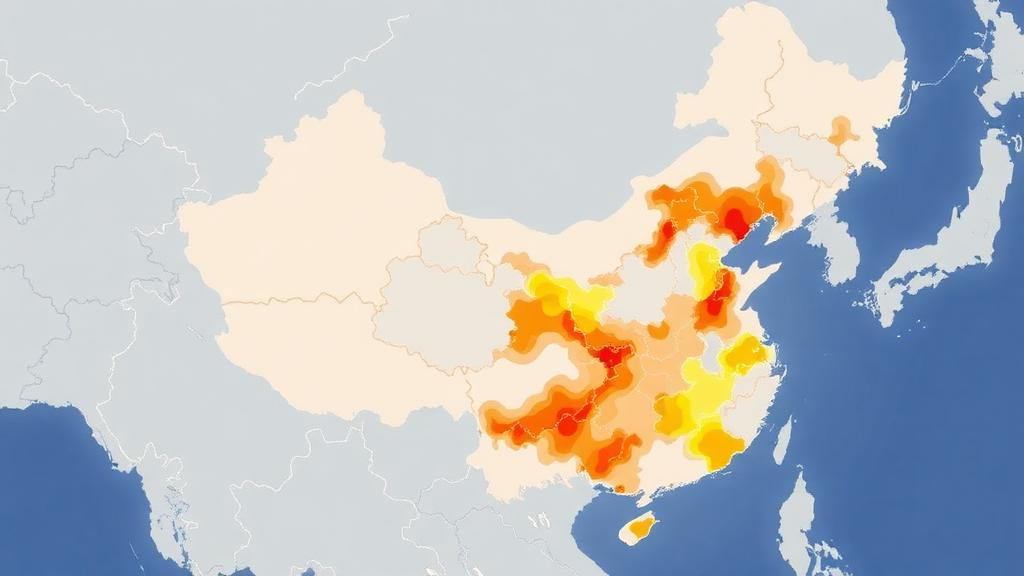
China’s coastline is one of the most intensively used and most heavily pressured interfaces between people and nature anywhere on Earth. Deltas, estuaries, bays, and rocky shores support ports, aquaculture, tourism, and sprawling cities while simultaneously delivering shoreline protection, carbon sequestration, water purification, and nursery habitat. Sea-level rise, extreme weather, nutrient loading, and habitat fragmentation all press against these same systems, and their effects spill across administrative boundaries and the land-sea divide. A new study published in Frontiers in Ecology and Evolution offers the most systematic attempt yet to measure how much capacity these coupled social-ecological systems have to absorb such shocks—not by predicting the next storm, but by assessing the underlying conditions that determine whether a coast can cope with whatever comes next.
The research, conducted by Niantao Jiao and Yiyan Zhang of Shandong Technology and Business University, draws on the concept of general resilience. Unlike hazard-specific assessments, which measure exposure, sensitivity, and recovery from a named threat such as a storm surge or harmful algal bloom, general resilience asks a broader question: does the system possess the diversity, redundancy, connectivity, learning capacity, and governance structures needed to handle uncertain disturbances of many kinds? A taller seawall may improve resilience to one particular storm, the authors note, but it does nothing for nutrient accumulation, industrial volatility, or ecological threshold shifts. Conversely, habitat diversity and cooperative networks may not hold back any single wave, yet they provide alternative pathways and coordination when unfamiliar crises strike.
To make this abstract idea measurable, the team built a three-tier framework with ten attributes. The first tier, system attributes, covers diversity, slow variables such as soil conditions and shoreline morphology, and ecosystem services. The second, dynamic adaptation, captures openness, redundancy, innovation capacity, and social capital. The third, governance coordination, includes modularity, overlapping governance, and tight feedbacks between monitoring and decision-making. Crucially, the researchers treated several attributes as having ecological optima rather than simple linear benefits: too little connectivity starves a system of replenishment and information, while too much connectivity allows pollution, disease, and disturbance to spread rapidly. Indicators were standardized accordingly, scoring units by their distance from an appropriate range rather than rewarding maximum values blindly.
The framework was applied at two nested scales. At the national level, the authors assessed 290 county-level land units covering roughly 248,300 square kilometers of coastal mainland China, alongside marine waters of about 304,700 square kilometers represented on a grid of cells roughly 8.09 kilometers wide. A nominal 2025 baseline drew on Landsat 8/9 and Sentinel-2 land-cover data, MODIS vegetation products, soil information, marine environmental observations from MODIS and VIIRS, aquaculture records, county statistics, and governance documents. Slowly updated variables, such as soil properties and aquaculture distribution, used the nearest reliable earlier products, with actual observation years documented to keep the temporal window transparent rather than pretending to a synchronized snapshot.
The national results reveal a striking contrast between land and sea. The mean general resilience capacity index was 0.359 for coastal land but 0.470 for coastal waters, on a scale where higher values indicate greater coping potential. On land, low and relatively low classes together accounted for 39.75 percent of the assessed area, forming continuous belts along parts of the Bohai coast, the Liaodong coast, and intensively developed eastern shoreline segments. In the waters, moderate and relatively high classes dominated, jointly covering 65.48 percent of the assessed area, with low values concentrated around the Yellow River estuary and Laizhou Bay and near the Yangtze River estuary, where land-based inputs, shifting sediments, and competing uses converge.
Spatial statistics confirmed that these patterns are far from random. Global Moran’s I, a measure of spatial autocorrelation, reached 0.6123 for coastal land and 0.9743 for coastal waters, both highly significant under 999 random permutations. In practical terms, high and low resilience cluster geographically: degraded belts extend across multiple counties, and marine low-value zones pool around estuaries and semi-enclosed bays. The authors interpret these clusters as hypotheses for verification rather than proven causes. Northern land belts may reflect wetland loss, salinization, low soil organic carbon, and fragmentation by urban and industrial shorelines, while southern high-value areas in Hainan, the western Beibu Gulf, and the southeast may benefit from intact vegetation, diverse habitats, and stronger ecological buffers.
The second, finer scale focused on Rongcheng, a city at the eastern tip of the Shandong Peninsula whose 492-kilometer convoluted shoreline of bays, headlands, and islands supports some of China’s most intensive kelp and shellfish aquaculture. Here the grid resolution dropped to roughly 180 meters on land and 264 meters at sea, and locally enhanced indicators were added: 20-meter habitat patches, nutrient variability, aquaculture duration, raft permeability, integrated multi-trophic aquaculture, cooperative networks, and water-quality sampling frequency. The authors stress that these local variables could enter the index only when their theoretical meaning mapped cleanly onto one of the ten shared attributes, preventing local data abundance from inflating the framework without discipline.
The Rongcheng results exposed heterogeneity invisible at the national scale. Across nearly 39,000 land cells, the mean index was 0.5826, with moderate and relatively low classes jointly covering 68.30 percent of the domain; central high-value patches sat alongside low-value belts near the coast and margins. The marine domain was even more internally divided: relatively low and relatively high classes together accounted for 56.33 percent of cells, and the coefficient of variation of 0.282 signaled pronounced bay-to-bay differences. In Rongcheng’s bays, restricted water exchange, dense raft structures, nutrient fluctuations, and benthic habitat degradation may combine into low-capacity pockets, while better-exchanged waters with diverse production and monitoring feedback score higher.
Perhaps the most important methodological message of the study is what it refuses to do. Because the national and Rongcheng assessments differ simultaneously in indicators, weights, and spatial support, their scores cannot be ranked against each other, and the finer detail in Rongcheng cannot be attributed to resolution alone. The authors also showed that classification choices matter: the share of national coastal land placed in the two lowest classes was roughly 39.7 percent under Jenks natural breaks, a startling 0.3 percent under equal intervals, and 40.4 percent under quintiles. Categorical maps, they argue, should always be read alongside continuous scores and spatial clustering, or readers risk drawing conclusions from cartographic convention rather than data structure.
The practical payoff is a chain of evidence linking screening to governance. National maps identify broad regions for monitoring priorities, while nested local diagnosis pinpoints bays, shoreline segments, and patches that warrant field verification. The authors propose keeping aquaculture pressure in a separate layer from the capacity index, so that diagnostic combinations such as high pressure paired with low capacity can be identified and matched to appropriate responses, from restoration and pressure reduction to capacity-based early warning. They call for repeated assessments over multiple periods, sensitivity testing of weights and thresholds, and independent observations of disturbance and performance to validate whether higher capacity actually translates into smaller functional losses when compound disturbances arrive. In an era when coastal pressures arrive unpredictably and interact across scales, measuring the conditions for adaptability—rather than merely the risk of any single hazard—may prove the more durable investment for the world’s crowded shorelines.
Subject of Research: Multiscale assessment of general resilience capacity in China's coastal social-ecological systems
Article Title: A multiscale assessment of general resilience capacity in China’s coastal social-ecological systems: a national baseline and nested diagnosis in Rongcheng
Article References: Jiao, N., & Zhang, Y. (2026). A multiscale assessment of general resilience capacity in China’s coastal social-ecological systems: a national baseline and nested diagnosis in Rongcheng. Frontiers in Ecology and Evolution, 14, Article 1969265. https://doi.org/10.3389/fevo.2026.1969265
Image Credits: AI Generated
DOI: 10.3389/fevo.2026.1969265
Keywords: general resilience, coastal social-ecological systems, multiscale assessment, China coastline, Rongcheng, aquaculture, social-ecological resilience, spatial autocorrelation, land-sea governance, ecosystem services, resilience indicators, multiscale
Cite Scienmag News
Gavin Prescott. (October 15, 2026). New Map of China’s Coasts Reveals Where Resilience Lives—and Fails. Scienmag. https://scienmag.com/new-map-of-chinas-coasts-reveals-where-resilience-lives-and-fails/
Gavin Prescott. "New Map of China’s Coasts Reveals Where Resilience Lives—and Fails." Scienmag, 15 October 2026, https://scienmag.com/new-map-of-chinas-coasts-reveals-where-resilience-lives-and-fails/. Accessed 15 October 2026.
Gavin Prescott. "New Map of China’s Coasts Reveals Where Resilience Lives—and Fails." Scienmag. October 15, 2026. https://scienmag.com/new-map-of-chinas-coasts-reveals-where-resilience-lives-and-fails/


