


The field of photonics has seen significant advancements in recent years, particularly with the development of circuits that manipulate light for computational purposes. These circuits are crucial for a variety of next-gen technologies, including quantum computing and artificial intelligence. Traditionally, photonic circuits have faced challenges related to optical losses that increase with the scale and complexity of the systems. This highlights a key limitation in traditional methods, especially when attempts are made to scale them for large-scale applications, such as multiphoton experiments or substantial all-optical systems.
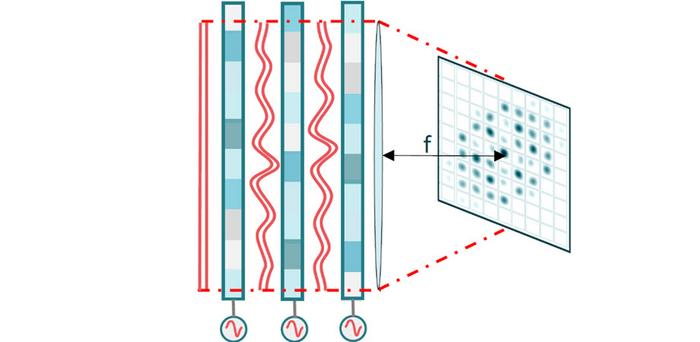
Researchers at the University of Naples Federico II have made a groundbreaking advancement in this domain by introducing a liquid-crystal-based optical processor. This innovative system is capable of managing hundreds of optical modes within a compact, two-dimensional setup. In their recent publication in Advanced Photonics, the researchers have addressed the recurrent issue of increasing optical losses, which the traditional photonic circuits encounter as complexity scales up. By leveraging liquid-crystal technology, they have created a platform that promises to minimize these losses, a significant breakthrough in the quest for efficient photonic systems.
The liquid-crystal metasurfaces used in this new system are finely engineered to simulate quantum phenomena, including processes like the "quantum walk." This concept represents the quantum-mechanical analogue of the classical random walk, where particles randomly move through space. Previous experimental setups have primarily focused on one-dimensional configurations. However, the team has now successfully expanded this technology to operate in two dimensions, a feat that posed new challenges, including potential disruptions in the liquid-crystal patterns that could affect optical behavior.
To counter these disruptions, the researchers implemented a novel algorithm that generates smooth patterns incorporating isolated vortices. These vortices are instrumental in maintaining the stability of light propagation, ensuring that they do not interfere negatively with the performance of the optical processor. This ingenious design allows for the simulation of up to 800 optical modes—an achievement that significantly outstrips the capabilities of the earlier one-dimensional approaches.
The versatility and adaptability of this liquid-crystal platform have exciting implications for a multitude of computational and simulation tasks. It presents the possibility of designing low-loss circuits tailored for various applications, further pushing the boundaries of photonic quantum experiments. According to Filippo Cardano, the corresponding author and a physics professor at the University of Naples, this advancement signifies that the circuits can theoretically handle an unlimited number of modes while maintaining optical losses at a constant level.
The potential applications of this technology extend far beyond just academic interest. Quantum computing, for instance, requires thorough simulation of complex systems to validate theories and concepts. Traditional techniques often face limitations due to energy loss and system stability. However, the capabilities demonstrated by this new LC-based optical processor provide an optimistic outlook towards solving these significant challenges.
This impressive development comes after previous successful experiments conducted by Cardano’s team, which demonstrated the potential of their technology in achieving record numbers of quantum walk steps in simpler, one-dimensional setups. However, scaling this success to a two-dimensional structure presented more intricate issues that needed to be addressed, showcasing the researchers’ ingenuity and persistence in overcoming the inherent challenges in the advancement of photonic technologies.
The researchers’ work exemplifies the profound impact that innovative engineering can have on scientific progress, and it opens the door to a new era of efficient and highly functional photonic circuits. These developments may eventually lead to a breakthrough in how quantum information is processed, making quantum computing more attainable and practical.
In conclusion, the groundbreaking research undertaken at the University of Naples represents a significant step forward in the field of photonics. The liquid-crystal-based platform stands to redefine the applications of optical processors and demonstrates the capacity for continued innovation in this vital area of technology. As researchers continue to explore the potential of photonics, such advancements are poised to catalyze further discoveries and applications that will reshape our understanding of computation and information processing.
Keywords
Photonic circuits, quantum computing, optical losses, liquid crystals, optical processors, quantum walk, two-dimensional systems, advanced technologies, energy efficiency, photonics research.
Cite Scienmag News
Katie Riggs. (March 27, 2025). New Liquid-Crystal Technology Enhances Optical Performance in Photonic Circuits. Scienmag. https://scienmag.com/new-liquid-crystal-technology-enhances-optical-performance-in-photonic-circuits/
Katie Riggs. "New Liquid-Crystal Technology Enhances Optical Performance in Photonic Circuits." Scienmag, 27 March 2025, https://scienmag.com/new-liquid-crystal-technology-enhances-optical-performance-in-photonic-circuits/. Accessed 4 September 2026.
Katie Riggs. "New Liquid-Crystal Technology Enhances Optical Performance in Photonic Circuits." Scienmag. March 27, 2025. https://scienmag.com/new-liquid-crystal-technology-enhances-optical-performance-in-photonic-circuits/


