


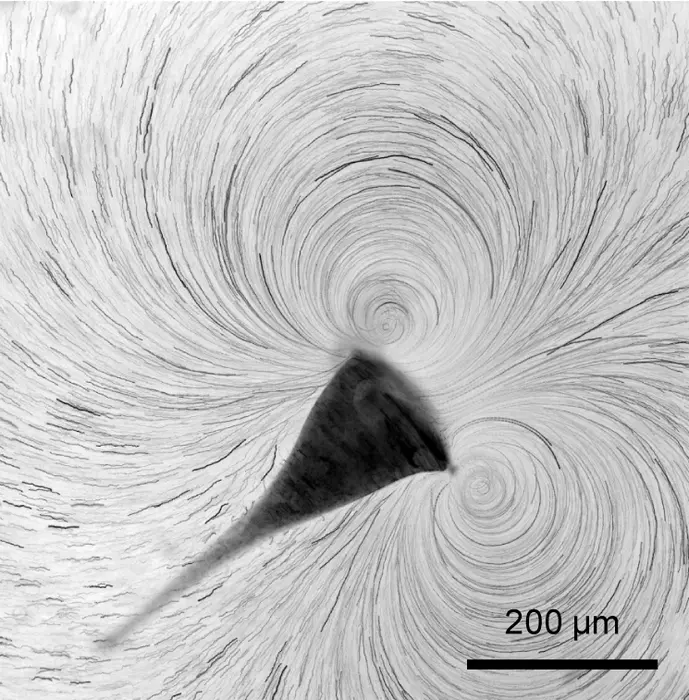
A recent study published in Nature Physics presents a groundbreaking exploration into how unicellular organisms might have laid the groundwork for the evolution of multicellular life. By investigating the fluid dynamics involved in the feeding behavior of the ciliate Stentor coeruleus, researchers have unearthed significant insights that reveal how physical forces can influence evolutionary processes.
Shashank Shekhar, an assistant professor of physics at Emory University and lead author of the study, embarked on this research after observing the fascinating filter feeding habits of stentors. These single-celled giants, known for their trumpet-like shape and large size, thrive in freshwater environments and utilize their cilia to generate currents that draw in food particles suspended in the water. Shekhar’s curiosity about these creatures’ fluid dynamics led him on a path that ultimately connects micro-scale behaviors to macro-scale evolutionary implications.
The research process began with Shekhar filming individual stentors in controlled laboratory conditions. Using video microscopy, he recorded their feeding patterns, closely examining how their cilia operated to create vortices that effectively enhanced their ability to capture food. The results were not only visually stunning but also rich with potential evolutionary significance. These initial observations propelled Shekhar and his team to investigate how these dynamics change when stentors form pairs or clumped communities, known as colonies.
As the researchers delved deeper, they discovered that stentors feed more efficiently when they collaborate, generating stronger water flows that enable them to draw in food from greater distances. This cooperative feeding strategy suggests that the dynamics of their interactions could provide a model for understanding how early life forms transitioned from simple unicellular organisms to more complex multicellular structures. This significant insight adds a novel layer to existing theories of evolution, which often focus primarily on chemical processes, neglecting the physical forces at play.
One of the most striking findings from the study is the "I love you, I love you not" movement, a playful term coined by Shekhar to describe the behavior of stentors as they come together and drift apart during feeding. This behavior is not haphazard; instead, it is a strategic dance that enhances the feeding effectiveness of both individuals by creating combined currents. When they cluster, stentors synergize their efforts, resulting in a more powerful hydrodynamic effect that allows for improved food capture. This phenomenon could have implications for understanding early cooperative behaviors that eventually facilitated the evolution of complex multicellular organisms.
As the research progressed, the team formulated a hypothesis regarding why certain stentors would occasionally separate from a group. It was proposed that individual stentors of varying strengths engage differently; weaker members may benefit more from forming partnerships than stronger stentors, which can fend for themselves relatively well. This dynamic may resemble social structures observed in more complex animals, where cooperation arises from unequal contributions to foraging.
In addition to the experimental observations, the researchers employed mathematical modeling to substantiate their findings. This incorporated the expertise of co-authors John Costello and Eva Kanso, who contributed their backgrounds in marine biology and mathematical analysis, respectively. By leveraging rigorous models, the team was able to demonstrate that the more dynamic the colony’s structure, including fluidity in partnerships, the greater the enhancement of the overall feeding flow rate for individual stentors.
The research indicates that these cooperative interactions, while observed in a simple organism, could hint at early forms of social behaviors that were critical in the evolution of multicellularity. This challenges long-standing perceptions of the evolution of complexity, suggesting that behaviors rooted in cooperation could have emerged much earlier than previously imagined, even in organisms without brains or sophisticated neural networks.
Interestingly, the stentor’s capacity for regeneration — a characteristic that allows them to regrow when cut into pieces — adds additional complexity to the story of multicellularity. Such regenerative capabilities, combined with their cooperative feeding strategies, provide a rich area for further exploration around how these organisms might serve as a model for understanding not only the origins of multicellularity but also the evolutionary routes taken by organisms towards increased complexity.
Despite the significant implications of this research, it is essential to recognize that the findings are only the beginning. Shekhar emphasizes the ongoing journey of addressing these profound biological questions. By continuing to explore the principles that govern the dynamics of stentor feeding and connectivity, we might glean more insights into the evolutionary narrative — not just of stentors, but of many other life forms that followed.
As this line of inquiry develops, its implications could reach far beyond stentors themselves. Concepts surrounding cooperation and hydrodynamic efficiency could inform not just biological sciences but also engineering and computational modeling, facilitating a cross-disciplinary dialogue on resilience, structure, and function in complex systems.
Ultimately, this research reiterates the interconnectedness of life and the fundamental forces shaping its every aspect. By peeling back the layers on how single-celled organisms interact and thrive, we might just begin to understand the intricate tapestry of life that has unfolded over billions of years.
Cite Scienmag News
Gavin Prescott. (March 31, 2025). New Insights into the Evolution of Multicellular Life. Scienmag. https://scienmag.com/new-insights-into-the-evolution-of-multicellular-life/
Gavin Prescott. "New Insights into the Evolution of Multicellular Life." Scienmag, 31 March 2025, https://scienmag.com/new-insights-into-the-evolution-of-multicellular-life/. Accessed 4 September 2026.
Gavin Prescott. "New Insights into the Evolution of Multicellular Life." Scienmag. March 31, 2025. https://scienmag.com/new-insights-into-the-evolution-of-multicellular-life/


