


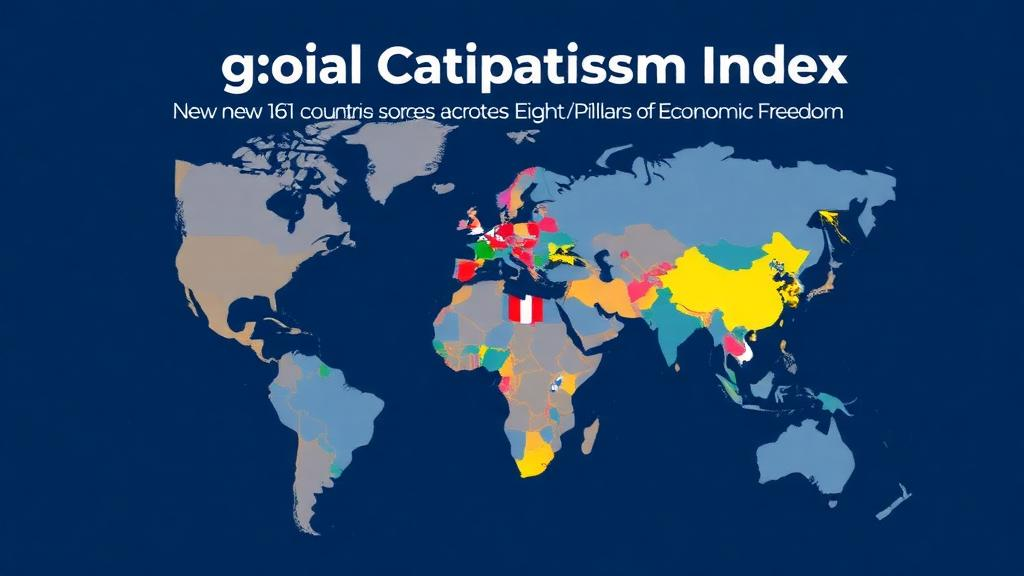
A team of researchers at the University of Virginia has unveiled the Global Capitalism Index, a first-of-its-kind quantitative data set that measures the state of capitalism in 161 countries using a transparent, statistically driven methodology. Three years in the making, the index was assembled by an interdisciplinary cohort led by the Karsh Institute of Democracy’s Democracy and Capitalism Lab and UVA Darden’s Institute for Business in Society. Its inaugural release draws on underlying data spanning 2009 through 2025 and will be updated annually, offering scholars, policymakers, and business leaders a common empirical baseline for a term that has long resisted precise definition.
The scale of the undertaking is considerable. The GCI synthesizes 242 individual data sets across 33 domains, organized into eight independent subindices: property rights, market policy, labor market openness, market competition, banking system strength, new business growth, and the free flow of goods and capital. Rather than relying on expert judgment or subjective weighting, the researchers compiled and weighted the components through a custom principal components analysis, a statistical technique that identifies the underlying structure in large, correlated data sets and assigns weights based on the variance each component explains. The result is a composite score on a 1-to-100 scale for each country and year, along with granular pillar-level profiles that reveal where each economy is strong and where it is fragile.
The motivation, according to lead author Scott Miller, Assistant Professor of Business Administration at Darden and Director of the Democracy and Capitalism Lab, stems from the sheer ambiguity of the word itself. “If you ask anyone what capitalism is, the answers are all different, and that makes it hard to argue about the validity or value of it,” Miller said. “We concluded that this word—capitalism—matters to everyone, so it matters to define it and measure how it really works across the globe.” By grounding the debate in measurable conditions rather than ideology, the index aims to shift conversations about markets from rhetoric toward evidence.
Under the 1-to-100 ranking framework, Switzerland emerges as the top-ranked country in the inaugural release, while Angola sits at the bottom. But the aggregate rankings tell only part of the story. The index’s sectoral and regional views surface counterintuitive findings: Zimbabwe and Algeria rank among the top-improving economies for capitalist conditions, while Sierra Leone, with a decline of 23.9 points since 2009, and Venezuela, down 23.2 points, experienced the sharpest deteriorations. Nordic countries occupy notably high positions despite their association with extensive social support systems, a result that complicates popular assumptions that generous welfare states are incompatible with robust capitalist conditions.
The sixteen years of underlying data also reveal broad structural trends. On average, the index shows an incremental global reduction in capitalist conditions over the period, suggesting that the world’s economic operating environment has tightened rather than liberalized in the aggregate. Regional divergences are widening: Central Asia has improved, while Latin America and Western Europe have declined. Across all countries, capital markets and banking emerge as the weakest universal pillars, indicating that financial-sector depth and stability lag behind other dimensions of capitalism nearly everywhere. Property rights, by contrast, prove to be the most differentiating feature—the dimension that separates high scorers from low scorers more sharply than any other.
Country case studies accompanying the first release illustrate how the index can illuminate dynamics that headline economic indicators obscure. In China, the data capture a surge in new business formation in 2019 tied to a foreign investment law, yet the overall profile shows surprisingly strong business conditions alongside increasingly restricted flows of goods and capital. “For individual countries, the index makes it much easier to identify what conditions are conducive to capitalism and which are not,” Miller said. “Using China as an example, we can see in sharper relief the profile and shape of the underlying economy.” Germany presents the opposite puzzle: a wealthy economy whose banking score is structurally weak. India’s case shows strong GDP growth concealing deepening restrictions on its capital account, while Lebanon’s banking stability indicator tracked the collapse of its financial system in real time. In The Gambia, the property rights pillar registered the fall of a dictator in 2017.
Beyond individual countries, the index’s statistical structure reveals that capitalism is far from a monolithic model. The researchers identify four archetypes that currently capture how capitalist conditions cluster around the world. Entrepreneurial capitalism, exemplified by Switzerland, Hong Kong, and the United States—the top three in that cohort—is typically strong in new business formation and market policies but weaker in property rights and the free flow of goods and capital. Corporate capitalism, led by Japan and South Korea, features robust capital markets and banking stability and growth but is notably weak in market competition, labor market freedom, market policy, and business formation. Institutional capitalism, led by Norway and much of Western Europe, excels in the real economy—market competition, labor markets, and business formation—while suffering significant weakness in the financial sector. Commercial capitalism, defined by the primacy of free flows of goods and capital along with property rights and private ownership, with everything else negative, counts Singapore and France among its notable members.
The GCI is also designed as a tool for investigating one of the most contested questions in the social sciences: whether and how capitalist conditions relate to broader societal outcomes. To demonstrate this utility, the index’s creators applied the inaugural data set to a series of questions, including whether capitalist societies are more unequal and more corrupt, whether citizens of countries with capitalist systems report higher well-being and greater happiness, whether capitalist and democratic systems can co-exist, and whether capitalist economies must feature low taxes. The data set’s breadth—covering 161 countries over 17 years across eight dimensions—gives researchers the statistical leverage to probe these relationships with more nuance than binary or single-measure approaches allow.
Miller emphasizes that the project’s ambitions extend well beyond the academy. “This is not just an academic project,” he said. “The GCI can have real-world implications for policymakers and business leaders in terms of understanding the upside and downside of decisions.” The combination of methodological rigor and comparative simplicity makes the index attractive to a wide range of potential users: scholars studying comparative economic systems, internationally active businesses assessing conditions in foreign markets, economic and monetary policymakers, cross-border regulators designing rules, and labor market participants comparing conditions between countries. Because the underlying data will be refreshed annually, the index can also serve as a longitudinal monitor of how national and regional economies evolve in response to policy shifts, geopolitical shocks, and technological change.
For a field long divided over how to define—and defend—market economies, the arrival of a comprehensive, subjectively unweighted, globally comparable measure of capitalism marks a significant methodological milestone. By decomposing capitalism into eight measurable pillars and tracing them across 161 countries and 17 years, the Global Capitalism Index transforms a perennially abstract debate into an empirical one, and its first findings suggest that the health of the world’s market economies is more varied, more dynamic, and more surprising than conventional wisdom assumes.
Subject of Research: Development of a Global Capitalism Index measuring capitalist conditions in 161 countries across eight subindices
Article Title: New Global Capitalism Index (GCI) and rankings reveal remarkable insights across the world’s national and regional economies
Article References: New Global Capitalism Index (GCI) and rankings reveal remarkable insights across the world’s national and regional economies. (n.d.). Original publication
Image Credits: AI Generated
DOI: Not provided
Keywords: Global Capitalism Index, University of Virginia, capitalism, economic indicators, property rights, market competition, banking stability, business formation, democracy, inequality, principal components analysis, comparative economics
Cite Scienmag News
Courtney Benton. (October 6, 2026). New Global Capitalism Index Scores 161 Countries Across Eight Pillars of Economic Freedom. Scienmag. https://scienmag.com/new-global-capitalism-index-scores-161-countries-across-eight-pillars-of-economic-freedom/
Courtney Benton. "New Global Capitalism Index Scores 161 Countries Across Eight Pillars of Economic Freedom." Scienmag, 6 October 2026, https://scienmag.com/new-global-capitalism-index-scores-161-countries-across-eight-pillars-of-economic-freedom/. Accessed 6 October 2026.
Courtney Benton. "New Global Capitalism Index Scores 161 Countries Across Eight Pillars of Economic Freedom." Scienmag. October 6, 2026. https://scienmag.com/new-global-capitalism-index-scores-161-countries-across-eight-pillars-of-economic-freedom/


