


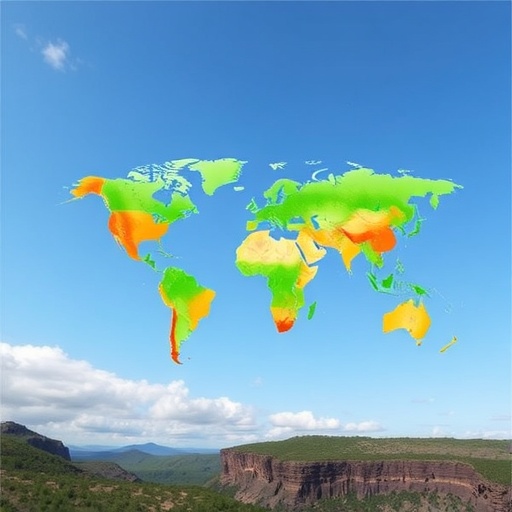
In an era marked by accelerating climate change and its far-reaching impacts on public health, a groundbreaking study led by Wang, P., O’Brien, F., Son, JY., and colleagues introduces a sophisticated, updated modeling framework that promises to revolutionize our understanding of climate health vulnerability. Published in Nature Communications in 2026, this research arrives at a critical moment when societies around the globe urgently need more accurate tools to predict and mitigate the health risks associated with environmental stressors intensified by climate change.
The climate health vulnerability index (CHVI) is an emblematic tool designed to quantify the susceptibility of populations to climate-induced health risks by integrating a wide array of environmental, social, and physiological indicators. Wang and collaborators have enhanced this methodology, addressing previous limitations and introducing a more dynamic and sensitive model. Their work dives deep into the intricacies of how climate variability, socioeconomic disparities, and human physiological responses intertwine, reshaping the landscape of vulnerability assessment.
Traditional models often suffered from a lack of granularity and responsiveness to real-time changes in climate variables and public health data. The updated framework features a high-dimensional sensitivity analysis that dissects the impact of various inputs on vulnerability outcomes, allowing researchers and policymakers to identify the most critical factors driving health risks. This accuracy is not merely academic; it translates into actionable intelligence for targeted interventions and resource allocation in vulnerable communities.
Central to the model is its innovative incorporation of multi-layered data streams, including fine-scale climate projections, demographic shifts, and emerging epidemiological patterns. The interdisciplinary approach synthesizes data from satellite observations, climate models, and population health surveys, creating a comprehensive picture of vulnerability that acknowledges the heterogeneity of environmental and social determinants at local and global scales.
A particularly novel aspect of this framework is its handling of temporal dynamics in vulnerability. Recognizing that health risks are not static, the model integrates time-sensitive variables that capture seasonal fluctuations, extreme weather event occurrences, and even long-term trends such as urbanization and aging populations. By doing so, it provides a predictive lens that anticipates future vulnerability landscapes rather than merely describing current or past states.
The sensitivity analysis conducted by Wang et al. extends beyond mere parameter tuning; it serves as a diagnostic tool that reveals the model’s robustness and priorities. By systematically adjusting inputs, the team identified key drivers such as heatwave frequency, air quality indices, and socioeconomic deprivation metrics. This precision offers a pathway to calibrate public health responses according to the most pressing climate impacts in specific regions, optimizing mitigation strategies with unprecedented specificity.
Equally significant is the model’s adaptability to diverse geographical contexts. The framework is engineered to be scalable and transferrable, accommodating distinct climatic zones and healthcare infrastructures. Whether applied to densely populated urban centers confronting heat island effects or rural areas susceptible to vector-borne diseases, the model maintains its predictive integrity, thus broadening its utility across varied environments and administrative boundaries.
The research also thoughtfully addresses data uncertainties that have long challenged environmental health modeling. By embedding stochastic elements and uncertainty quantification protocols, the framework acknowledges variability inherent in climate forecasts and health outcome measurements. This transparency in uncertainty enhances stakeholder confidence and facilitates more informed decision-making under conditions of imperfect knowledge.
Underlying the model is a sophisticated computational engine leveraging machine learning algorithms and high-performance computing infrastructures. This technological backbone permits the assimilation of vast datasets and the execution of complex simulations within manageable timeframes. The integration of artificial intelligence approaches elevates the framework beyond deterministic models, allowing it to uncover non-linear interactions and subtle patterns that traditional analyses might overlook.
Wang and colleagues emphasize the critical role of community engagement and participatory modeling in refining vulnerability assessments. The framework supports the inclusion of local knowledge and experiential data, thereby increasing the cultural relevance and acceptance of model outputs. This approach fosters a collaborative environment where scientists, policymakers, and affected populations co-create strategies to enhance resilience against climate-mediated health threats.
The implications of this research are broad and profound. For public health officials, it offers a data-driven compass to navigate the uncertainties of climate change impacts on health. For urban planners and environmental managers, it underscores the importance of integrating health considerations into climate adaptation policies. For the global scientific community, it sets a new benchmark in environmental epidemiology modeling, paving the way for future innovations that could incorporate genetic and behavioral factors alongside environmental metrics.
Furthermore, the updated CHVI can serve as an early warning system, identifying hotspots of vulnerability before crises unfold. This proactive capability is vital for disaster preparedness, allocation of medical resources, and tailoring community outreach programs. By aligning climate science with health advocacy through a robust modeling framework, this research steps towards bridging the often fragmented domains of environmental policy and public health.
Importantly, the study’s transparency in methodology and open access publication ensure that its benefits are widely disseminated and adaptable by a broad spectrum of users ranging from international organizations to grassroots NGOs. This democratization of advanced modeling tools empowers decentralized action and fosters global cooperation in tackling the health dimensions of climate change.
Looking ahead, the research team acknowledges areas for further refinement, including deeper integration of emerging infectious disease data, mental health impacts, and the socio-political determinants of vulnerability. These expansions will undoubtedly enhance the comprehensiveness and relevance of the CHVI, ensuring that it remains a vital instrument in a rapidly evolving environmental context.
In sum, the work by Wang, O’Brien, Son, and their collaborators marks a significant leap forward in climate health vulnerability assessment. By deploying advanced computational methods, thorough sensitivity analyses, and multidisciplinary data integration, they have crafted a powerful tool that enhances our ability to foresee, understand, and ultimately mitigate the health risks posed by our changing planet. As climate challenges intensify, such innovations illuminate the path to sustained human resilience and well-being.
Cite Scienmag News
Ophelia Keating. (January 9, 2026). New Framework Enhances Climate Health Vulnerability Analysis. Scienmag. https://scienmag.com/new-framework-enhances-climate-health-vulnerability-analysis/
Ophelia Keating. "New Framework Enhances Climate Health Vulnerability Analysis." Scienmag, 9 January 2026, https://scienmag.com/new-framework-enhances-climate-health-vulnerability-analysis/. Accessed 5 September 2026.
Ophelia Keating. "New Framework Enhances Climate Health Vulnerability Analysis." Scienmag. January 9, 2026. https://scienmag.com/new-framework-enhances-climate-health-vulnerability-analysis/


