


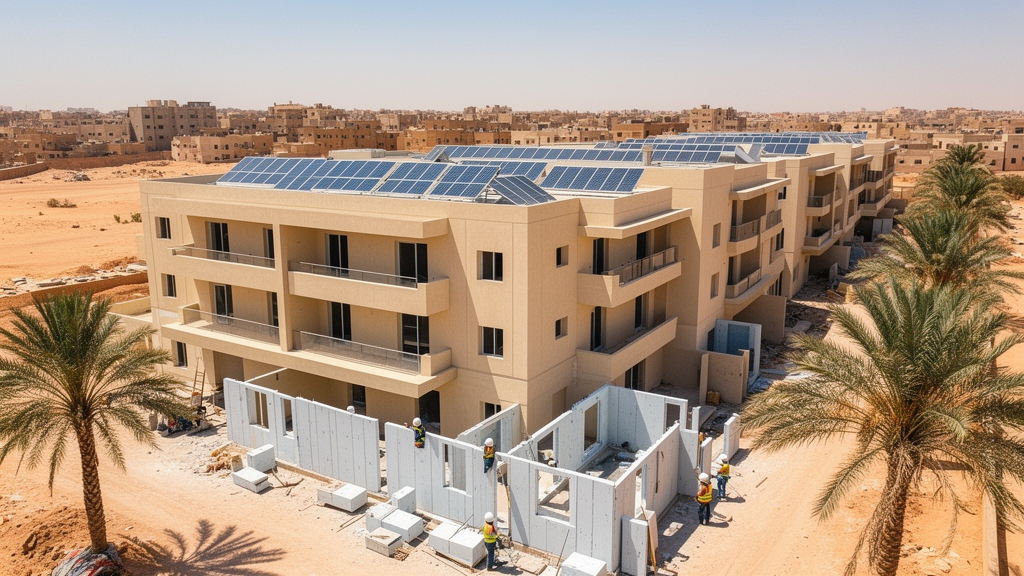
Egypt faces the largest demand for affordable housing in the MENA region, driven by a large and rapidly growing population and comparatively low household incomes. Yet the country's housing market presents a striking paradox: the 2017 Census identified almost 11.7 million vacant apartments, while housing price inflation has outpaced income growth by more than three times since 2017. When social housing is delivered, it often comes at the expense of resource efficiency, and the resulting quality of life frequently proves inadequate, pushing low-income families toward informal settlements that may offer good locations and job opportunities but lack infrastructure and resource management.
A new study addresses this tension directly, proposing a Resource-Efficient Social Housing (RESH) implementation framework designed to deliver affordability and adequate living conditions simultaneously in Egypt's challenging institutional and climatic context. The research, grounded in a mixed analytical and empirical approach, began with a systematic mapping of six international rating systems, including LEED-ND, BREEAM Communities, SBTool 2012, the Green Building Index, the Green City Index, and CASBEE-UD. Each system was disaggregated into its constituent indicators and tabulated against seven resource-flow categories: materials, digital infrastructure and technology, mobility, waste, water, energy, and affordability and quality of life.
This mapping produced an initial pool of 117 indicator formulations. A two-stage filtration process then reduced redundancy and excluded indicators lacking relevance to Egypt's institutional, climatic, and socio-economic conditions, yielding 25 indicators that were combined with eight affordability and quality-of-life indicators drawn from the literature, for a total of 33. The framework's developers argue that this contextual filtration distinguishes their work from direct transplantation of international tools.
Previous research, such as a documented performance gap when LEED criteria developed for the Global North were applied without modification in Türkiye, supports the need for local adaptation. The study also advances the field by explicitly integrating affordability and quality of life as an outcome dimension alongside six resource-flow dimensions, mapping indicators onto the housing project lifecycle from pre-design through operation, and cross-checking core assumptions against a real, occupied government social housing project. The analytical work drew on established housing-adequacy theory, including the 5 A's of adequate housing: availability, accessibility, affordability, acceptability, and adaptability.
To validate the indicator set, the researchers distributed a structured questionnaire to 32 experts drawn from Cairo University, the Institute for Housing and Urban Development Studies, the Housing and Building National Research Center, GIZ, UN-Habitat, the Social Housing and Mortgage Finance Fund, and the Urban Development Fund. More than half of the respondents had over 20 years of professional experience, and 84% had some involvement in social or affordable housing projects. Experts rated each indicator on a three-point Likert scale across four criteria: Basic Need Fulfillment, Cost-Effectiveness, Contextual Suitability, and Scalability and Replicability.
Reliability analysis produced a Cronbach's Alpha of 0.948, indicating high internal consistency among the questionnaire items. After consolidating conceptually overlapping indicators into 24 analytical units, the team calculated a classification threshold of approximately 1.37, the arithmetic grand mean of 96 criterion-level scores. Indicators with composite means above this threshold were classified as Essential; those at or below it as Conditional.
The results revealed a consistent prioritization logic favoring measures that address immediate housing needs and offer cost-efficient, scalable solutions. Climate-change adaptation measures, such as shading and urban heat mitigation, scored as essential under both basic need fulfillment and scalability. By contrast, district heating and cooling recorded some of the lowest values in the dataset, with a contextual suitability mean of about 0.66, classifying it as conditional and sensitive to financial feasibility.
The pattern extended across resource flows. Recycled materials were seen as economically and strategically valuable but not a primary driver of immediate housing adequacy, scoring essential under cost-effectiveness at roughly 1.59 yet conditional under basic need fulfillment at about 1.00. Smart demand-and-supply systems fell below the essential threshold for basic needs and contextual suitability, while information service performance emerged as essential.
Low-carbon transport measures scored below the threshold for basic need fulfillment at approximately 0.97, signaling that emission reduction in transport is considered secondary to physical accessibility in social housing. Affordability and quality-of-life indicators, analyzed as a combined unit, reached essential levels, particularly under basic need fulfillment with a mean of about 1.62. A sensitivity analysis varying the threshold by plus or minus 0.10 points shifted the split from 18 Essential and 6 Conditional at 1.27 to 7 Essential and 17 Conditional at 1.47, underscoring that indicators near the cut-off should be treated as borderline.
The finalized RESH framework organizes the indicators across five interconnected project stages: strategic foundation, pre-design, design, implementation and construction, and occupancy and operation. Location-related and planning indicators, such as smart location, compact development, and distance to facilities, were overwhelmingly assigned to the design phase, reflecting expert understanding that spatial decisions are irreversible once construction begins. Operational indicators, including transport carbon emissions, information service performance, and water-use reduction, were most frequently assigned to the operation phase.
Cross-phase indicators concentrated in infrastructure, energy, and waste management, confirming the need for continuous oversight of these resource flows. The framework also embeds financial innovation early, emphasizing incentive-based financing, concessional loans, and blended finance models to mitigate the higher initial costs often associated with resource-efficient housing. The expert consultation also identified the principal barriers to implementation.
Budget constraints emerged as the most significant limitation, cited by approximately 80% of respondents. Limited awareness, training gaps, and stakeholder resistance followed, noted by around 60 to 70% of experts, while weak regulatory enforcement, procurement challenges, and insufficient technical capacity were acknowledged by 50 to 55% of participants. The study's policy analysis found that Egypt's national strategies, including Vision 2030, the National Climate Change Strategy 2050, the updated Nationally Determined Contributions, the NWFE program, and the National Urban Policy, collectively cover most indicator areas, with energy the most addressed sector followed by water.
However, material efficiency is not taken into account in these plans, revealing a significant policy gap. Water measures carry particular weight in a country where 97% of water resources are transboundary, and Egypt's renewable-energy target of 42% of total power, originally set for 2035, was accelerated to 2030 in the 2022 updated NDCs. To test feasibility, the researchers conducted a preliminary field validation at Al-Asmarat in Cairo, a national prototype social housing project of approximately 14,300 households developed by the Urban Development Fund.
Fieldwork in December 2025 involved 202 face-to-face household questionnaires across the project's three development phases, three focus groups, and a semi-structured interview with the project's government management. The baseline household cost burden, the share of monthly income spent on rent, water, energy, waste, and transport, was calculated at 0.34, based on average monthly spending of 839 EGP against average income of 2,458 EGP. Notably, 69% of surveyed residents identified job or income creation, rather than direct cost reduction, as their most pressing need.
Modelling low-cost interventions drawn from the framework's water, energy, waste, and mobility indicators, including faucet aerators, LED lighting retrofits, waste-fee incentives for household separation, and improved walkability, reduced the modelled cost burden to approximately 0.30, an affordability improvement of roughly 13%, equivalent to about 108 EGP per household per month. Scaled across all 14,300 households, this scenario extrapolates to approximately 18.5 million EGP per year. The authors stress that these are modelled estimates based on survey-derived baseline spending and literature or product-specification efficiency parameters, not measured post-installation results, and that implementation costs were not deducted.
The expert sample was purposive rather than statistically representative, the household survey used convenience sampling, and the complete framework has not been piloted through a full project lifecycle. Findings are specific to Egypt's context, and any application elsewhere in the MENA region would require local adaptation and re-validation. Even so, the study offers a structured, lifecycle-based decision-support tool intended to help bridge the gap between Egypt's strategic sustainability commitments and practical housing delivery.
Subject of Research: A resource-efficient social housing implementation framework for affordability and quality of life in Egypt
Article Title: Resource efficient social housing: An implementation framework for enhancing affordability and quality of life in the Egyptian context
Article References: Medhat, M., Khalil, H. A. E. E., & Gammaz, S. (2026). Resource efficient social housing: An implementation framework for enhancing affordability and quality of life in the Egyptian context. Results in Engineering, 32, Article 113680. https://doi.org/10.1016/j.rineng.2026.113680
Image Credits: AI Generated
DOI: 10.1016/j.rineng.2026.113680
Keywords: social housing, resource efficiency, Egypt, affordability, quality of life, sustainable urban development, expert validation, Al-Asmarat, housing policy, MENA region, building indicators, lifecycle framework
Cite Scienmag News
Denise Maddox. (October 26, 2026). New Framework Aims to Make Egypt’s Social Housing Affordable and Resource-Efficient. Scienmag. https://scienmag.com/new-framework-aims-to-make-egypts-social-housing-affordable-and-resource-efficient/
Denise Maddox. "New Framework Aims to Make Egypt’s Social Housing Affordable and Resource-Efficient." Scienmag, 26 October 2026, https://scienmag.com/new-framework-aims-to-make-egypts-social-housing-affordable-and-resource-efficient/. Accessed 26 October 2026.
Denise Maddox. "New Framework Aims to Make Egypt’s Social Housing Affordable and Resource-Efficient." Scienmag. October 26, 2026. https://scienmag.com/new-framework-aims-to-make-egypts-social-housing-affordable-and-resource-efficient/


