


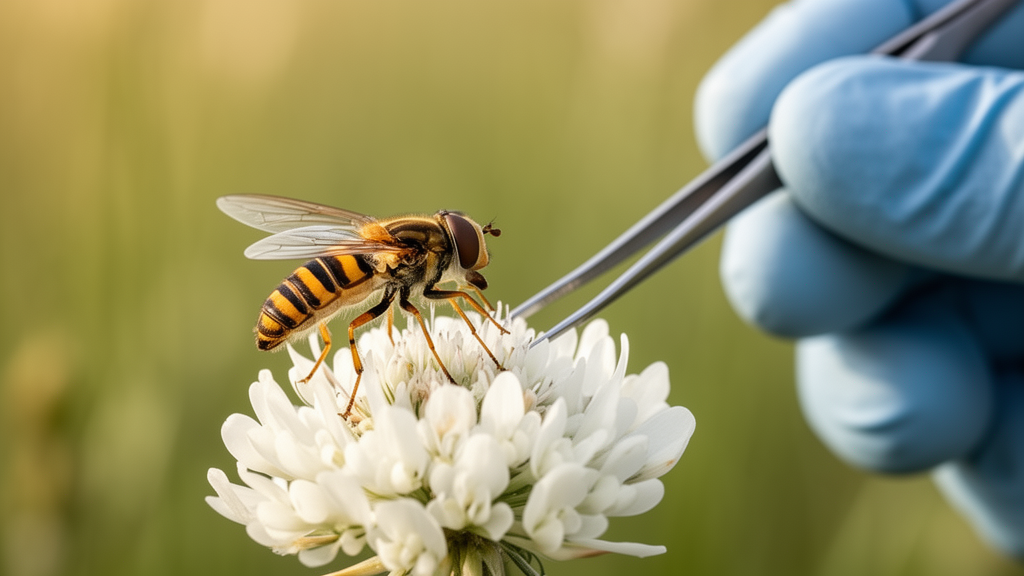
Hoverflies are among the most familiar insects in the European countryside, yet many of them are extraordinarily difficult to tell apart, even for trained entomologists. A new study has taken a substantial step toward solving that problem for France by building a large DNA sequence reference library for the family Syrphidae, the true flies renowned for their hovering flight and their bee- and wasp-like appearances. Using a short fragment of the mitochondrial 16S rRNA gene, researchers generated sequences from 713 specimens representing 352 species, drawn from the private collection of specialist entomologists Jean-Pierre and Véronique Sarthou. After a customised validation workflow removed contaminated or unreliable sequences, 561 sequences covering 316 species were retained, representing roughly 60 percent of the French hoverfly fauna.
The scale of the undertaking reflects the biological importance of the group. Mainland France hosts 566 documented Syrphidae species, the highest recorded number of any country in Europe, ahead of Italy with 513 and Switzerland with 492. Across Europe as a whole, 1,025 hoverfly species are currently recorded, and 37.2 percent of them, or 314 species, are considered threatened under the European Red List criteria as Critically Endangered, Endangered or Vulnerable. Nearly 6,300 species of Syrphidae are recognised worldwide, divided into four subfamilies and sixteen tribes. Effective conservation of such a diverse group depends on monitoring tools that can identify species quickly and reliably, which is precisely what molecular reference libraries are designed to provide.
The ecological stakes are considerable. Adult hoverflies are regarded as the second most important group of pollinators of food crops after bees, and in certain parts of northern Europe they are considered the most important pollinators of some culinary herbs and fruit trees or shrubs, particularly under harsh climatic conditions. The larvae of many species contribute to biological control of crop pests, with 355 species identified as aphidophagous, meaning they prey on aphids, in Europe. One of the most prolific is Episyrphus balteatus, whose females can produce between 2,000 and 4,500 eggs over a lifetime; the nocturnal larvae specialise in aphid predation, and in south-western France up to seven generations of this species can occur annually.
Why, then, do hoverflies need a DNA-based identification system at all? The answer lies in the limits of morphology. Many species exhibit mimicry of bees and wasps, which can lead to misidentification by non-specialists; the well-known Volucella bombylans, for example, can imitate several species of bumblebees. Even specialists relying on morphological identification keys run into trouble in certain taxa, where adults cannot be reliably distinguished without information from larval stages or ecological data. This is particularly true for the genus Microdon, whose myrmecophilous species spend part of their life cycle concealed within ant nests and whose adults closely resemble one another. Identification becomes still harder in species complexes such as Merodon and in genera with pronounced sexual dimorphism, such as Sphaerophoria and Pipizella, where females are frequently indistinguishable from one another.
The choice of genetic marker was itself a deliberate technical decision. The most widely used animal DNA barcode, a fragment of the mitochondrial COI gene, does not always deliver species-level resolution in flies. A comprehensive COI barcode reference library for German Diptera, encompassing 5,200 Barcode Index Numbers, achieved reliable species-level assignments in many cases but revealed low interspecific divergence within several dipteran families, including Syrphidae. COI was likewise shown to be inefficient for identifying species of the genus Sphaerophoria, and within the genus Melanostoma all German species were assigned to the same Barcode Index Number. The 250-base-pair 16S rRNA marker, described a few years ago as effective for insect barcoding and metabarcoding, had already been applied in environmental DNA studies of vertebrate diversity from airborne samples and of pollinator communities from flower-derived material, and had previously been used to build a 16S rRNA reference library for wild bees in the same laboratory.
The workflow behind the new dataset combined field-collected material with rigorous bioinformatics. Specimens were captured in France with nets, morphologically identified using standard identification keys, and stored in ethanol. DNA was extracted from a single leg of each specimen using the Chelex method, and the 16S rRNA fragment was amplified with the primer pair ins16S_1R/ins16S_1F before sequencing on an Illumina MiSeq. Raw reads were merged and processed through the FROGS pipeline, and candidate sequences were compared against the GenBank nucleotide database using BLASTn. Sequences were then aligned and genetic distances calculated in the BOLD workbench using the Kimura two-parameter model. A sequence was considered validated when its cluster assignment matched the specimen’s morphological identification and its similarity to conspecific specimens and position in neighbour-joining trees supported the match. The marker was judged discriminant for a species when the maximum intraspecific genetic distance was lower than the distance to the nearest neighbour.
The results varied markedly across the hoverfly tree. The 16S rRNA marker successfully discriminated all species within the tribes Volucellini, Microdontini and Cerioidini, and showed particularly high proportions of discriminated species in the Eristalini at 89 percent and the Milesiini at 87 percent. Yet the marker’s performance was far from uniform: the tribes Bacchini and Brachyopini contain similar numbers of species with at least one valid sequence, 29 and 28 respectively, but discriminative power was twice as high for Brachyopini at 79 percent as for Bacchini at 38 percent. Validated species proportion ranged from 65 to 100 percent across tribes, with eleven tribes exceeding 80 percent validation, and for 36 species no valid sequence could be obtained at all.
Among the success stories, all five French Volucella species were distinguished, although the authors note a cautionary detail: Volucella pellucens shares an identical sequence in GenBank with Volucella latifasciata, a non-European species, underscoring the importance of locally built, expert-validated reference databases. In Melanostoma, sequences generated for Melanostoma certum and Melanostoma scalare diverged by 0.93 percent and were also distinct from available sequences of M. mellinum, a promising result for a genus that COI has failed to resolve. For Paragus, a genus whose females are morphologically indistinguishable and whose abdominal colouration varies enormously with geography, the marker discriminated five of the eight French species sequenced.
The marker also has clear limits, which the study documents candidly. For the remaining 150 species in the dataset, 16S rRNA enables identification only at the genus level, and species-level resolution would require additional specimens to be sequenced. Discriminative power falls below 20 percent for four genera: Sphaerophoria at 18 percent, Chrysotoxum at 10 percent, Pipiza at 12 percent and Pipizella at 14 percent. Most strikingly, in the genus Eupeodes, for which sequences were generated for nine French species, the marker failed to discriminate any of them. Four further genera without validated sequences could not be assessed at all. These failures matter for monitoring programmes, because a metabarcoding pipeline relying on 16S rRNA alone would collapse some species pairs into single operational units.
The dataset, deposited with sequences in FASTA format under the identifier DS-BCSY16S, is framed by its authors as a first step toward a comprehensive multi-marker reference library for French Syrphidae. Such libraries are the foundation of DNA barcoding and metabarcoding, approaches that have gained considerable traction for biodiversity monitoring because of their rapid data acquisition and large-scale applicability, qualities especially valuable for insects, whose immense taxonomic diversity makes conventional monitoring daunting. The authors also highlight a geographic dimension: the three south-eastern French regions, Occitanie, Provence-Alpes-Côte d’Azur and Auvergne-Rhône-Alpes, emerge as major hotspots of hoverfly diversity, and future sampling and sequencing efforts should prioritise them to complete the national dataset. Like many other pollinator groups, hoverfly diversity is declining, and while their high species richness and migratory capacity may confer some resilience to environmental change, no French national Red List assessment yet exists for the family. A curated genetic reference covering roughly 60 percent of the national fauna is a practical tool for closing that knowledge gap, one verified sequence at a time.
Subject of Research: A 16S rRNA DNA sequence reference dataset for identifying French hoverfly species
Article Title: 16S rRNA sequence dataset for the identification of the French hoverflies ( Diptera , Syrphidae )
Article References: Marquisseau, A., Ollivier, M., Klopp, C., Pascal, G., Pornon, A., Escaravage, N., Sarthou, V., Sarthou, J.-P., & Pichon, M. (2026). 16S rRNA sequence dataset for the identification of the French hoverflies (Diptera, Syrphidae). Biodiversity Data Journal, 14, Article e189822. https://doi.org/10.3897/bdj.14.e189822
Image Credits: AI Generated
Keywords: hoverflies, Syrphidae, DNA barcoding, 16S rRNA, biodiversity monitoring, France, pollinators, metabarcoding, reference library, entomology, species identification, mitochondrial DNA
Cite Scienmag News
Juliet Wilcox. (October 27, 2026). New DNA Reference Library Identifies French Hoverflies With a Single Genetic Marker. Scienmag. https://scienmag.com/new-dna-reference-library-identifies-french-hoverflies-with-a-single-genetic-marker/
Juliet Wilcox. "New DNA Reference Library Identifies French Hoverflies With a Single Genetic Marker." Scienmag, 27 October 2026, https://scienmag.com/new-dna-reference-library-identifies-french-hoverflies-with-a-single-genetic-marker/. Accessed 27 October 2026.
Juliet Wilcox. "New DNA Reference Library Identifies French Hoverflies With a Single Genetic Marker." Scienmag. October 27, 2026. https://scienmag.com/new-dna-reference-library-identifies-french-hoverflies-with-a-single-genetic-marker/


