


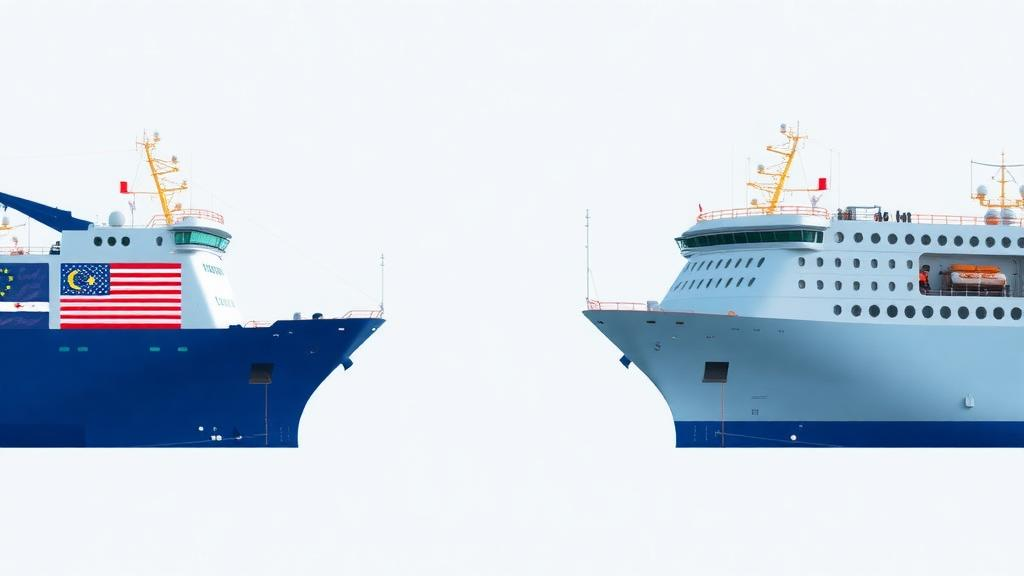
Ships at sea do not operate under a single flag authority. A container vessel registered in one country may need to exchange sensitive navigation data with a port authority, a coast guard station, or another merchant ship administered by an entirely different maritime domain. Getting two such parties to agree on a shared encryption key has long been an awkward problem, because the obvious solution—asking the sender’s home authority to vouch for it in real time—collapses when satellite links drop, bandwidth runs thin, or the home authority is simply unreachable. A research team at Shanghai Maritime University, working with a colleague at East China Normal University, has now proposed a way around this bottleneck, and their answer touches on one of cryptography’s most stubborn weaknesses: bad randomness.
The scheme, published in Mobile Networks and Applications, is called a randomness-resilient one-pass authenticated key-establishment protocol. The phrase one-pass is the crucial part. In a one-pass protocol, the sender transmits a single message and the receiver can immediately derive a shared secret key from it. No round trips, no back-and-forth handshake, no waiting for a distant certificate server to respond. For vessels crossing oceans on intermittent high-frequency and satellite channels, where every extra message costs time and precious spectrum, cutting the exchange to a single transmission is not a luxury—it is often the difference between a secure session and no session at all.
One-pass designs carry a well-known structural risk. Because the sender produces the key-encapsulation material alone, the security of the entire session hinges on the quality of the random numbers the sender’s device generates. Cryptographers have documented this weakness repeatedly in the real world. Studies of network devices have found widespread weak keys traceable to poor random number generation, and virtual machine reset vulnerabilities have caused systems to reuse randomness that should never repeat. If a shipboard embedded computer, starved of entropy during a cold boot at sea, produces predictable randomness, an attacker who guesses or reconstructs that randomness can recover the session key and read everything the vessel transmits.
The Shanghai team’s answer is to make the protocol resilient to exactly this failure mode. Instead of trusting the sender’s random source blindly, the scheme derives the key-encapsulation mechanism randomness from both the sender-side random source and the session context—the specific identities and parameters of the exchange in progress. This hedging approach follows a line of research that began with hedged public-key encryption, where the ciphertext is bound to the message and the public key so that even repeated or partially predictable randomness does not produce catastrophic key reuse. In the maritime setting, the session context acts as a second, deterministic input that an attacker cannot freely choose, blunting the damage that a weak onboard random number generator can do.
The second half of the problem is cross-domain authentication. When a receiver gets a message from a vessel it has never dealt with, it must confirm two things: that the sender genuinely belongs to the administrative domain it claims, and that its certificate is valid. Traditional public-key infrastructures would have the receiver contact the sender’s home domain authority to check. The new scheme replaces that live lookup with commitments. A coordinator commits to the registered domain records, and each domain’s log commits to the certificate records it currently holds. These commitments, built on Merkle tree structures of the kind used in certificate transparency systems, allow the receiver to verify the sender’s domain and certificate locally, against commitments it has already accepted, without any network contact with the sender’s home authority during session establishment.
This is where the design connects to a broader movement in security engineering. Certificate transparency, accountable key infrastructures, and attack-resilient PKI designs all share the insight that verifiable, append-only logs can replace trust-on-each-connection queries to a central authority. Bringing that model to the open ocean is a natural but nontrivial step. Maritime communication standards have explored public key authentication for the Automatic Identification System and the VHF Data Exchange System, but cross-domain verification has remained expensive in bandwidth and latency. By pushing verification into committed logs that can be synchronized in advance, the new protocol makes the trust check essentially free at session time.
The security analysis is carried out in the random oracle model, a standard idealization in which hash functions are treated as truly random functions. Within that model, the authors prove three properties. First, session-key indistinguishability: an adversary, even one who can observe the single transmitted ciphertext, cannot tell the real session key from a random string. Second, sender authentication: the receiver can be confident the message originated from the claimed vessel within the claimed domain. Third, and more unusually, sender identity hiding: the public ciphertext itself does not leak who sent it, a property formalized through a defined identity-hiding experiment. Identity concealment matters at sea, where vessel movements and communications patterns can be commercially or strategically sensitive, and where broadcasting the sender’s identity in the clear would undermine the confidentiality the protocol is meant to provide.
Performance is where the scheme makes its case for practical deployment. The team implemented a prototype and measured it across multiple combinations of cryptographic primitives, including post-quantum key-encapsulation mechanisms aligned with the recently standardized module-lattice schemes from NIST, alongside classical elliptic-curve options. Across all evaluated combinations, both sender and receiver computation came in under one millisecond. That figure matters because shipboard hardware is often modest, and because the protocol is intended to sit underneath authenticated encryption modes such as Galois/Counter Mode, adding negligible overhead to the actual data exchange. The authors also quantify the communication cost of the cross-domain verification material, giving network planners a concrete measure of what the added security overhead looks like on a bandwidth-constrained maritime link.
The timing of this work is not accidental. Post-quantum cryptography has moved from theory to deployment, with NIST finalizing its module-lattice key-encapsulation and signature standards in 2024, and researchers across vehicular, edge, and unmanned-aerial settings racing to build authenticated key agreement that will survive quantum adversaries. Maritime systems, with their long equipment lifecycles and slow upgrade cycles, face particular pressure to adopt quantum-resistant primitives early. A scheme that already accommodates lattice-based KEMs and signatures, while tolerating the imperfect randomness of real embedded devices, positions itself for that transition. The work was supported in part by the National Natural Science Foundation of China and Shanghai municipal research programs, reflecting institutional investment in securing the digital maritime corridor.
What the Shanghai team has delivered, in essence, is a careful reconciliation of three demands that usually pull against each other: one-message efficiency for unreliable links, verifiable trust across administrative boundaries without live authority contact, and robustness against the entropy failures that plague real-world devices. None of these ingredients is entirely new on its own—hedged encryption, Merkle commitments, and one-pass key establishment each have established research lineages. The contribution lies in composing them into a protocol whose security properties are proven formally and whose cost has been measured, not merely estimated. As autonomous shipping, e-navigation services, and cross-border vessel data exchange expand, the plumbing that lets a ship under one flag prove itself to a receiver under another—in a single message, over a fading link, with imperfect hardware—may quietly become some of the most consequential cryptography on the water.
Subject of Research: Randomness-resilient one-pass authenticated key establishment for cross-domain maritime communication
Article Title: Randomness-Resilient One-Pass Authenticated Key Establishment for Cross-Domain Maritime Communication
Article References: Wei, L., Zhu, H., Meng, X., Yu, L., Li, X., Zhu, C., & Lei, H. (2026). Randomness-Resilient One-Pass Authenticated Key Establishment for Cross-Domain Maritime Communication. Mobile Networks and Applications. https://doi.org/10.1007/s11036-026-02556-y
Image Credits: AI Generated
DOI: 10.1007/s11036-026-02556-y
Keywords: authenticated key establishment, maritime communication, cross-domain authentication, weak randomness, key-encapsulation mechanism, Merkle commitment, post-quantum cryptography, random oracle model, identity hiding, certificate transparency, VHF data exchange, ship-to-ship security
Cite Scienmag News
Denise Maddox. (October 3, 2026). New Cryptographic Scheme Lets Ships From Different Nations Talk Securely in One Message. Scienmag. https://scienmag.com/new-cryptographic-scheme-lets-ships-from-different-nations-talk-securely-in-one-message/
Denise Maddox. "New Cryptographic Scheme Lets Ships From Different Nations Talk Securely in One Message." Scienmag, 3 October 2026, https://scienmag.com/new-cryptographic-scheme-lets-ships-from-different-nations-talk-securely-in-one-message/. Accessed 4 October 2026.
Denise Maddox. "New Cryptographic Scheme Lets Ships From Different Nations Talk Securely in One Message." Scienmag. October 3, 2026. https://scienmag.com/new-cryptographic-scheme-lets-ships-from-different-nations-talk-securely-in-one-message/


