


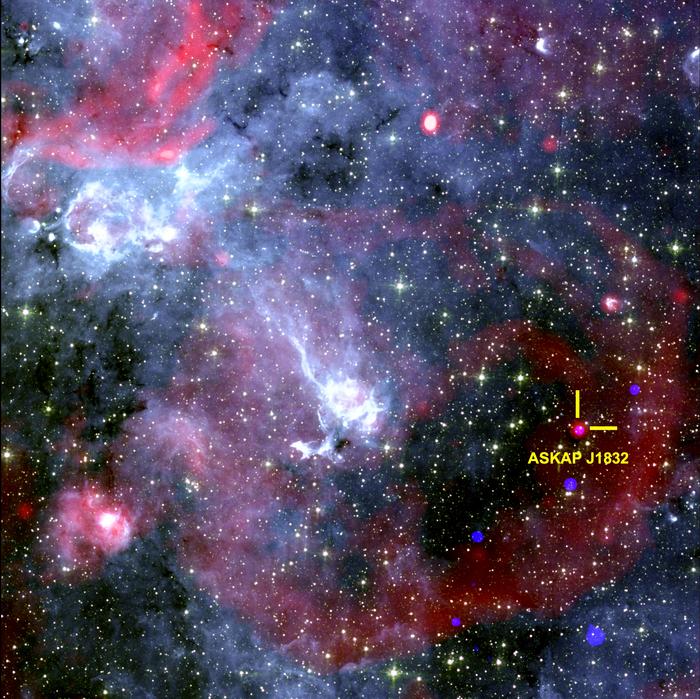
In a remarkable advancement in the domain of astrophysics, astronomers affiliated with the International Centre for Radio Astronomy Research (ICRAR) have unveiled a groundbreaking cosmic phenomenon labeled ASKAP J1832-0911. This celestial entity has captured the attention of the scientific community due to its unusual behavior of emitting distinctive pulses of radio waves accompanied by X-rays at periodic intervals. The phenomenon occurs for approximately two minutes every 44 minutes, presenting a compelling case for further investigation into its origins and mechanisms. The discovery not only challenges existing paradigms within astrophysics but also opens new avenues for understanding long-period transients (LPTs), a classification recently introduced into the astronomical lexicon.
Prior to this remarkable finding, LPTs primarily existed within theoretical frameworks, lacking substantial empirical evidence. The detection of ASKAP J1832-0911 marks a significant milestone, as it is the first observation of such an object in X-ray emissions. Astronomers have lauded this achievement, postulating that it may shed light on similar enigmatic signals detected sporadically throughout our universe. The implications of this discovery are extensive, suggesting profound insights into the nature of cosmic evolution and the unpredictable phenomena that populate the skies above.
The key to uncovering the mystery behind ASKAP J1832-0911 lies in its unique detection method. The astronomical community exploited the capabilities of the ASKAP radio telescope, located on Wajarri Country in Australia, to capture these elusive radio signals. In a serendipitous alignment, NASA’s Chandra X-ray Observatory was concurrently monitoring the same section of the sky, allowing researchers to correlate the received radio signals with the unexpected X-ray pulses. The fact that two powerful observational platforms converged on this particular cosmic event showcases the intricate fabric of collaboration across scientific disciplines.
Lead author Dr. Ziteng (Andy) Wang of the Curtin University node of ICRAR emphasized the astonishing nature of the discovery, likening the process to “finding a needle in a haystack.” The ASKAP’s wide field view efficiently captures vast sections of the night sky, yet Chandra’s narrow focus can often miss these unique transient events. This chance synchronization speaks to the fortuitous nature of astronomical research, where precise timing can enrich our understanding of the universe.
The concept of long-period transients (LPTs), as established through subsequent research, represents an exciting frontier in astrophysics. These objects are characterized by their capability to emit radio pulses spaced minutes or hours apart, ultimately leading to their recent classification as a new category of cosmic phenomena. Since the initial identification of LPTs by ICRAR researchers in 2022, the astronomical community has successfully documented an additional ten instances, underscoring a significant breakthrough in the detection and study of such transitory cosmic events.
Despite this progress, the underlying mechanisms driving the emissions from ASKAP J1832-0911 remain shrouded in mystery. Presently, there is no consensus on the origins of these signals, nor any definitive explanation for their periodic nature. Researchers speculate that ASKAP J1832-0911 could potentially embody the remnants of deceased stellar objects, such as magnetars, which are known for their extraordinary magnetic fields. Alternatively, it might represent a binary star system in which a highly magnetized white dwarf is engaged in an intricate cosmic dance with its companion star.
However, even these hypotheses fail to completely account for the peculiar behavior exhibited by ASKAP J1832-0911. As researchers delve deeper into understanding this phenomenon, the possibility arises that it may signal a need for unprecedented shifts in our current physics models or frameworks for stellar evolution. The discovery of ASKAP J1832-0911 could herald new hypotheses or frameworks that allow astronomers to better describe and predict the behaviors of such elusive cosmic entities.
Furthermore, the tandem detection of X-ray and radio emissions from this object could catalyze a more extensive exploration of similar phenomena. Scientists emphasize that finding one such transient likely hints at numerous undiscovered counterparts lurking in the cosmos. According to second author Professor Nanda Rea from the Institute of Space Science (ICE-CSIC) and the Catalan Institute for Space Studies (IEEC) in Spain, the identification of ASKAP J1832-0911 may inspire astronomers to search systematically for LPTs, thereby unveiling a new layer of ceaseless wonder and mystery within our universe.
The incorporation of multiple observational techniques, including X-ray and radio wave detection, not only enhances the specificity of the findings but also enriches our comprehension of their fundamental nature. In essence, exploring both higher-energy X-rays and lower-energy radio signals provides clues essential in piecing together a puzzle that was once regarded as an abstract notion of cosmic phenomena. Through such integrative research, astronomers are better positioned to advance their understanding of the universe’s complexity and drive future investigations into unexplored realms of astrophysics.
The paper detailing these extraordinary findings, titled “Detection of X-ray Emission from a Bright Long-Period Radio Transient,” has been published in the prestigious journal Nature. This publication represents a convergence of collaborative genius from researchers and institutions spanning the globe. As interest abounds regarding the outcomes of this study, the astronomical community looks towards the future with bated breath, eager to unravel the intricacies of ASKAP J1832-0911 and its implications for the broader understanding of cosmic phenomena.
ASKAP J1832-0911 resides within the Milky Way galaxy, approximately 15,000 light-years from Earth. This proximity offers an exceptional opportunity for astronomers to scrutinize the details of the object, potentially leading to significant insights into its structure and behavior. As observational techniques advance and coordination among different telescopes becomes more refined, the prospects of unveiling the mysteries of ASKAP J1832-0911 grow increasingly tangible, promising to revolutionize our conception of such anomalous cosmic signals.
The phenomena surrounding ASKAP J1832-0911 cast light upon intriguing questions regarding the workings of the universe and the myriad manifestations of stellar life and death. As we continue to deepen our understanding of cosmic transients and their dynamics, it becomes evident that we are on the cusp of entering a new epoch in astrophysics—one that bridges theoretical conclusions with empirical observations and offers new horizons into the cosmic ballet that plays out across the universe.
Keywords
Cite Scienmag News
Grant Pearson. (May 28, 2025). New Cosmic Enigma: Astronomers Discover Object Emitting Signals in Both Radio Waves and X-Rays. Scienmag. https://scienmag.com/new-cosmic-enigma-astronomers-discover-object-emitting-signals-in-both-radio-waves-and-x-rays/
Grant Pearson. "New Cosmic Enigma: Astronomers Discover Object Emitting Signals in Both Radio Waves and X-Rays." Scienmag, 28 May 2025, https://scienmag.com/new-cosmic-enigma-astronomers-discover-object-emitting-signals-in-both-radio-waves-and-x-rays/. Accessed 5 September 2026.
Grant Pearson. "New Cosmic Enigma: Astronomers Discover Object Emitting Signals in Both Radio Waves and X-Rays." Scienmag. May 28, 2025. https://scienmag.com/new-cosmic-enigma-astronomers-discover-object-emitting-signals-in-both-radio-waves-and-x-rays/


