

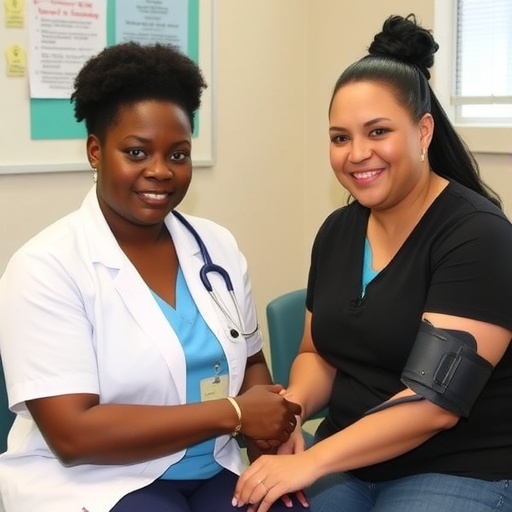
High blood pressure, or hypertension, holds a notorious reputation as a silent killer, stealthily contributing to a vast number of fatalities annually in the United States. Despite the arsenal of medications and lifestyle modifications at medical professionals’ disposal, over half of American adults find themselves grappling with readings above the clinical threshold of 130/80 mm Hg. The startling prevalence of this condition, particularly in economically disadvantaged communities, underscores the urgent need for innovative, effective interventions tailored to vulnerable populations.
Recent groundbreaking research spearheaded by epidemiologists at Tulane University offers a beacon of hope. Their study deployed a comprehensive, team-oriented care model across 36 federally qualified health centers in Louisiana and Mississippi—regions emblematic of the high hypertension burden yet often underserved by the healthcare system. These community clinics, pivotal for patients of limited financial means and healthcare access, became the crucible for evaluating an intervention designed to surpass the impact of conventional care.
The intervention integrated an evidence-based, multifaceted strategy wherein healthcare teams collaborated closely to implement tailored blood pressure management regimens. This approach extended beyond pharmacological treatment to include health coaching—delivered both in-person and through virtual platforms—emphasizing sustainable lifestyle adjustments such as dietary improvements, increased physical activity, and self-monitoring techniques. Patients received kits to monitor their blood pressure at home, empowering them in managing their conditions actively rather than relying solely on episodic clinical visits.
Contrasting the intervention group, clinics categorized under the enhanced usual care group continued standard practice but with limited augmentation; physicians in these centers received updated educational materials on hypertension management guidelines but lacked the integrated team dynamics or patient empowerment tools central to the new program. This comparison allowed for a rigorous assessment of the added value generated by the team-based, holistic care approach.
The study’s results after an 18-month follow-up period were nothing short of compelling. Patients engaged in the team-based program exhibited an average reduction of 15.5 mm Hg in their systolic blood pressure compared to a 9.1 mm Hg decrease observed in the enhanced usual care cohort. This statistically and clinically significant difference highlights the intervention’s potential to transform blood pressure control in real-world clinical settings. Importantly, medication adherence—a critical determinant of hypertensive outcome improvement—was markedly higher among those receiving the team-oriented care, underscoring the role of continuous support and education.
Dr. Katherine Mills, the principal investigator and a distinguished professor at Tulane University’s School of Public Health and Tropical Medicine, emphasized the study’s implications. She noted that while effective pharmacologic tools for blood pressure management exist, their optimal utilization hinges on primary care implementation and sustained patient engagement. The trial demonstrates that structured, collaborative strategies employing multidisciplinary teams can overcome persistent hurdles in managing hypertension, particularly in resource-limited rural and urban populations frequently marginalized in healthcare delivery.
The significance of these findings is further illuminated when considering hypertension’s role as the paramount modifiable risk factor for cardiovascular disease (CVD)—the leading cause of mortality in the United States. By enabling better blood pressure control in populations historically plagued by healthcare access disparities, such interventions possess the transformative potential to reduce the population-level incidence of heart attacks, strokes, and other catastrophic vascular events.
The study encompassed a robust sample of 1,272 patients aged 40 years or older, all characterized by uncontrolled hypertension despite previous lifestyle modifications or treatment. This demographic authenticity enhances the study’s external validity, as it reflects the typical patient profile encountered in primary care settings—patients often burdened with chronic comorbidities and socioeconomic challenges that complicate therapeutic adherence.
Co-first author Dr. M.A. “Tonette” Krousel-Wood, a seasoned expert in epidemiology and medicine, reflected on the robustness of the intervention in these complex cases. Her comments underscored the practical applicability of the approach, affirming that sustained reductions in blood pressure are achievable even among patients with long-standing hypertension, a population often labeled as refractory to treatment.
Demographically, the study participants presented a diverse yet socioeconomically challenged group: nearly 75% reported annual family incomes below $25,000, approximately 63% identified as Black, and around 76% were unemployed. These characteristics mirror the chronic health inequities faced by many in the Southern United States, an area disproportionately affected by hypertension-related morbidity and mortality. The study’s success in this context speaks volumes about the effectiveness of culturally and contextually sensitive healthcare frameworks.
Another crucial takeaway underscored by Dr. Krousel-Wood is the demonstration that interventions to manage blood pressure can thrive within federally qualified health centers. These centers represent the frontline for underserved communities and are therefore strategic anchors for combating health disparities at a systemic level.
Given the national landscape—with approximately 1,400 federally qualified health centers serving millions of patients—there is considerable optimism that the care delivery model evaluated in this study can be scaled and adapted nationwide. Such broad implementation could catalyze a paradigm shift in hypertension management, improving healthcare outcomes on a national scale.
The study further revealed that the success of the intervention correlated with clinics that embraced ownership and leadership over program components. This finding suggests that empowerment and engagement at the institutional level are pivotal for embedding sustainable improvements in clinical practice, moving beyond temporary project-specific gains.
In conclusion, this seminal trial from Tulane University offers an inspiring blueprint for addressing the hypertension epidemic through team-based, patient-centered care models. By harnessing multi-disciplinary collaboration, patient education, technological tools for home monitoring, and personalized coaching, healthcare providers can offer far more than medication prescriptions—they can provide comprehensive support that transforms patient engagement and health outcomes, particularly in populations where disparities in care and outcomes remain pronounced.
Subject of Research: Multifaceted strategies for hypertension control in low-income patients
Article Title: Multifaceted Strategies for Hypertension Control in Low-Income Patients
News Publication Date: 8-Apr-2026
Web References: http://dx.doi.org/10.1056/NEJMoa2504068
Keywords: Cardiovascular disorders, Heart disease, Hypertension, Health care, Health disparity, Health equity, Medical facilities, Blood pressure


