


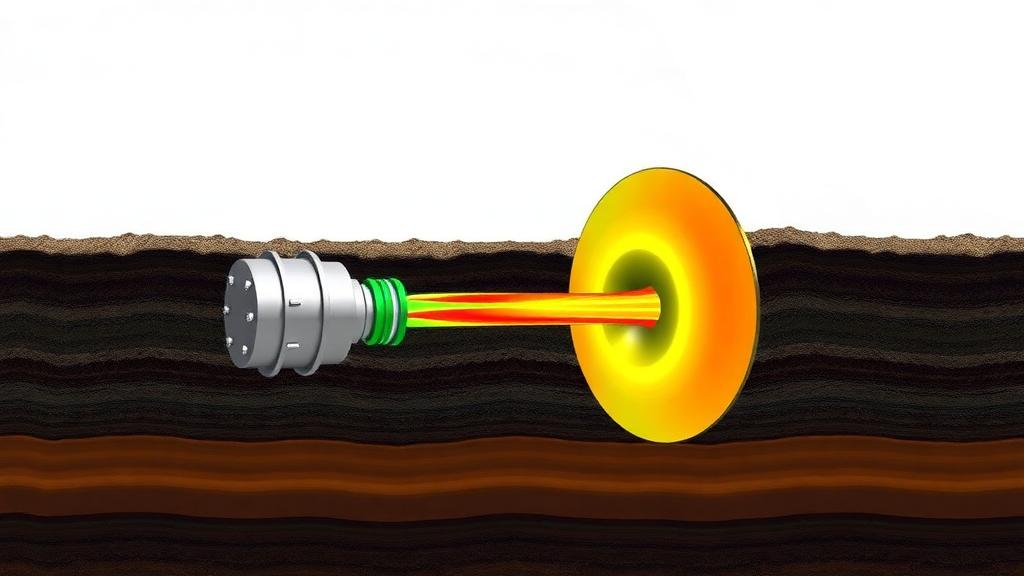
Carbon dioxide has become one of the most intriguing working fluids in modern petroleum engineering, prized for its ability to fracture tight rock while simultaneously locking away greenhouse gas deep underground. Yet the very property that makes CO2 so useful—its extreme compressibility—has long made it notoriously difficult to model inside a wellbore. A new study published in Results in Engineering by Caiyun Xiao and colleagues tackles this problem head-on, presenting a conserved-variable wellbore flow model that tracks how temperature, pressure, and phase state evolve as frigid liquid CO2 plunges more than three kilometers toward a hot reservoir. The work, validated against field data from a CO2 fracturing operation in China’s Sulige gas field, offers the clearest picture yet of why pressure at the bottom of a well lags behind pressure at the surface, and how operators can exploit that delay.
The challenge stems from the peculiar thermodynamics of carbon dioxide. Unlike water, whose density and viscosity barely change under typical downhole conditions, CO2 responds dramatically to shifts in temperature and pressure. Its density, viscosity, and heat capacity can swing by orders of magnitude as it crosses from liquid to supercritical states near the critical point of 304.13 K and 7.38 MPa. Traditional wellbore models, many descended from Henry Ramey’s landmark 1962 heat-transfer formulation, treat fluid properties as constants or rely on iterative conversions between enthalpy and temperature—conversions that can erode numerical accuracy when the fluid is as compressible as CO2. The new model sidesteps this fragility by formulating the governing equations of mass, momentum, and energy conservation directly in terms of conserved variables: mass density, momentum density, and total specific enthalpy.
This conserved-variable approach is more than a mathematical elegance. Because the energy equation for a compressible fluid does not yield temperature directly, conventional solutions must repeatedly transform between specific enthalpy and temperature using property tables, a process prone to convergence failures near phase boundaries. By solving for density as the principal unknown and retrieving thermophysical properties from a structured interpolation table built on the NIST standard database, the researchers’ scheme advances segment by segment down the discretized wellbore, using a Runge-Kutta method to accelerate convergence. The result is a model that remains stable even where CO2 teeters on the edge of supercriticality, and one whose open structure allows future coupling with reservoir seepage, proppant transport, and phase-equilibrium models.
The centerpiece of the study is a new quantity the authors call the wellbore compressibility response coefficient, denoted C. Physically, it represents the average rate at which bottomhole pressure rises per second of injection, given a particular pump rate and the instantaneous compressibility of the fluid column. The derivation is elegant: because the wellbore volume is effectively fixed, every cubic meter of CO2 pumped in must be absorbed by compressing the fluid already inside. Summing the compression of each wellbore segment yields a simple analytical expression—pump rate divided by the compressibility-weighted wellbore volume. A large coefficient means the fluid column behaves like a stiff spring, transmitting pressure quickly to the bottomhole; a small coefficient means the column acts as a buffer, soaking up injected fluid and delaying pressure buildup.
This buffering effect has profound implications for fracturing operations. Before the reservoir rock breaks down, fracture propagation can be viewed as the cumulative result of fracture initiation, and the injected CO2 persistently accumulates within the wellbore, gradually raising pressure until the rock fails in tension. The greater the overall compressibility of the fluid column, the longer this pressurization takes. The team validated their coefficient against field measurements from an early injection stage in which bottomhole pressure climbed from 33.06 MPa to 41.45 MPa over roughly five minutes at a pump rate near 0.5 cubic meters per minute. The measured response coefficient of about 0.0280 MPa/s compared with a model prediction of 0.0291 MPa/s—an error of just 3.93 percent.
The full temperature and pressure predictions fared equally well. At a pump rate of 0.5 cubic meters per minute, calculated bottomhole temperature of 368.36 K deviated from the measured 368.97 K by only 0.17 percent, while bottomhole pressure erred by 3.20 percent. At the higher rate of 4.0 cubic meters per minute, temperature error fell to 0.05 percent and pressure error to 0.78 percent. The model slightly underpredicts temperature and overpredicts pressure, discrepancies the authors attribute in part to the geometry of the downhole monitoring device, whose inner and outer diameters differ from those of the tubing and are not represented in the model. Still, all errors remained below the five percent threshold that matters for engineering design.
Among the study’s most striking findings is the non-monotonic relationship between pump rate and bottomhole pressure. Counterintuitively, pumping harder does not always pressurize the well more effectively. At baseline conditions of 258.15 K injection temperature and 20 MPa injection pressure, bottomhole pressure peaked at 51.21 MPa when the pump rate reached 1.4 cubic meters per minute, then declined as frictional losses grew. By 5.0 cubic meters per minute, bottomhole pressure had fallen to 42.50 MPa—17.01 percent below the maximum. The explanation lies in the competition between gravitational head, which pushes pressure up with depth, and flow friction, which scales with velocity squared. At low rates gravity dominates; at high rates friction wins, and the excess energy is dissipated as heat rather than delivered as pressure.
That dissipated heat is not trivial. The researchers systematically evaluated two thermal effects often neglected in simpler models: frictional heating at the fluid–wellbore interface and the Joule-Thomson effect, the temperature change that accompanies pressure changes in a expanding or compressing fluid. Frictional heat consistently warms the wellbore, and its influence grows sharply with pump rate—the temperature difference it introduces rose by a factor of 12.9 to 62.5 when the pump rate increased from 0.5 to 4.0 cubic meters per minute, reaching up to about 3 K. The Joule-Thomson effect, by contrast, can cut either way. At low temperature and high pressure, CO2’s Joule-Thomson coefficient is negative, so pressure increases cool the fluid; at warmer conditions the coefficient turns positive and pressure increases heat it. When the coefficient is negative, the two effects oppose each other; when positive, they reinforce. Both matter primarily for temperature, with little direct bearing on pressure.
Phase behavior emerges as a sensitive function of operating conditions. At the low pump rate of 0.5 cubic meters per minute, CO2 absorbed enough formation heat to cross into the supercritical state at roughly 1530 meters depth. At 4.0 cubic meters per minute, the fluid moved too quickly to equilibrate, and bottomhole temperature stayed at 300.15 K—below the critical temperature—so CO2 remained liquid the entire way down. The team defines an all-liquid time, the duration for which bottomhole CO2 cannot reach supercritical conditions, and found it collapses rapidly with pump rate: 340 hours at 0.5 cubic meters per minute, 120 minutes at 2.0, and just 15 minutes at 4.0. Because CO2 soaking alters rock mechanical properties in ways that depend on temperature and pressure, controlling this window could directly influence fracture initiation.
Sensitivity analyses distilled the operational levers into a clear hierarchy. Lower injection temperature, higher injection pressure, and higher pump rate all promote wellbore pressurization by raising the compressibility response coefficient, which climbed from 0.00724 MPa/s at 0.1 cubic meters per minute to 0.891 MPa/s at 5.0—though returns diminish sharply beyond that, with a further increase to 7.0 yielding only 19.44 percent more. Injection temperature and pressure act linearly: warming the injected CO2 from 253.15 K to 318.15 K dropped the response coefficient from 0.489 to 0.171 MPa/s, while raising injection pressure from 4 to 30 MPa lifted it from 0.261 to 0.572 MPa/s. Pump rate, however, remains the dominant control, governing temperature, pressure, and phase state simultaneously. The authors caution that the model applies to continuous injection of pure CO2 and does not yet capture downhole seepage, proppant transport, or gas–liquid phase transitions—but its conserved-variable structure, free of implicit solution procedures, is deliberately built to absorb those extensions. For an industry betting on CO2 as both a fracturing fluid and a climate solution, knowing exactly how fast pressure travels down the pipe may prove one of the most practical numbers in the business.
Subject of Research: Compressible CO2 wellbore flow and pressure transmission during CO2 fracturing
Article Title: Fluid compressibility and the pressure-transmission mechanism of CO 2 injection based on a conserved-variable wellbore flow model
Article References: Xiao, C., Zhang, X., Zhou, Y., Han, L., & Jia, Y. (2026). Fluid compressibility and the pressure-transmission mechanism of CO2 injection based on a conserved-variable wellbore flow model. Results in Engineering, 32, Article 113324. https://doi.org/10.1016/j.rineng.2026.113324
Image Credits: AI Generated
DOI: 10.1016/j.rineng.2026.113324
Keywords: CO2 fracturing, wellbore flow model, fluid compressibility, pressure transmission, Joule-Thomson effect, frictional heat, supercritical CO2, CCUS, enhanced oil recovery, bottomhole pressure, heat transfer, Sulige gas field
Cite Scienmag News
Denise Maddox. (October 10, 2026). New CO2 Wellbore Model Reveals How Compressibility Delays Pressure Underground. Scienmag. https://scienmag.com/new-co2-wellbore-model-reveals-how-compressibility-delays-pressure-underground/
Denise Maddox. "New CO2 Wellbore Model Reveals How Compressibility Delays Pressure Underground." Scienmag, 10 October 2026, https://scienmag.com/new-co2-wellbore-model-reveals-how-compressibility-delays-pressure-underground/. Accessed 10 October 2026.
Denise Maddox. "New CO2 Wellbore Model Reveals How Compressibility Delays Pressure Underground." Scienmag. October 10, 2026. https://scienmag.com/new-co2-wellbore-model-reveals-how-compressibility-delays-pressure-underground/


