


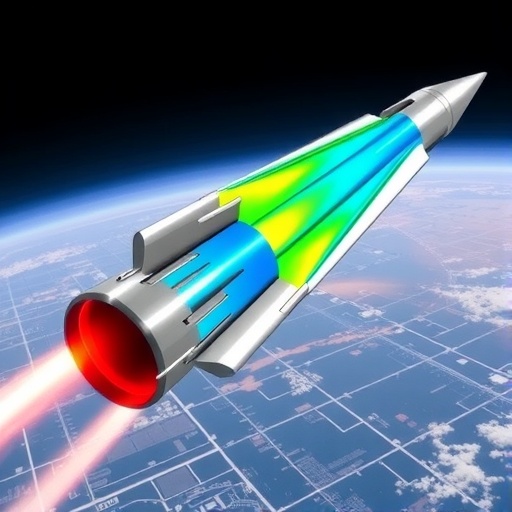
In an era characterized by relentless advancements in aerospace technology, the evolution of hypersonic flight represents a paramount frontier. A recent study by Soni et al. shines exceptional light on this field, focusing specifically on the numerical simulation and analysis of scramjet inlets under off-design conditions within hypersonic flows. The findings have significant implications not only for theoretical models but also for the practical applications that could revolutionize air travel and military operations.
Scramjets, or supersonic combustion ramjets, invigorate the conversation around hypersonic flight propulsion systems thanks to their ability to sustain high-speed operation without the need for mechanical compressors. Rather, they capitalize on the high kinetic energy of incoming air to facilitate combustion processes. This innovative approach is crucial for achieving velocities that exceed Mach 5, a critical threshold that defines hypersonic conditions. Soni and his colleagues delve deep into the complexities involved in optimizing these systems, which in turn could lead to groundbreaking advancements in aerospace capabilities.
At the core of their study lies the focus on off-design performance, a crucial concept for scramjets. Off-design conditions refer to operational states where the vehicle’s speed or altitude deviates from those for which the design has been optimized. Such situaties challenge both the theoretical frameworks and practical implementations of scramjet technology. The researchers underscored that understanding the nuances of off-design performance is indispensable for the development of robust scramjet systems that can adapt dynamically to varying operational demands.
Through meticulously detailed numerical simulations, the study aims to uncover the intricate behaviors of airflow through scramjet inlets when operating under off-design conditions. Previous approaches to modeling scramjet performance often relied heavily on idealized scenarios; however, this study advocates for a more nuanced perspective that incorporates real-world variances in conditions. This approach not only enhances accuracy but also enhances the reliability of predictions regarding scramjet performance.
The researchers employed advanced computational fluid dynamics (CFD) techniques to model the intricate interactions of airflow within scramjet inlets. Each phase of the simulation captured distinct elements of flow dynamics, thermal behavior, and combustion efficiency, allowing for a comprehensive analysis of scramjet performance. By varying parameters such as intake geometry, flight Mach numbers, and angle of attack, they explored a myriad of operational scenarios, further enriching the depth of their findings.
One groundbreaking aspect revealed by this study is the significant impact that inlet geometry can have on scramjet performance. As the researchers illustrated through their simulations, deviations in geometry tailored for ideal flight conditions can dramatically reduce efficiency. This finding underscores the importance of designing versatile inlet solutions capable of accommodating a range of operational states, thus ensuring optimal performance even when conditions deviate from the norm.
As the aerospace community forges ahead toward hypersonic travel, the implications of the research conducted by Soni et al. extend far beyond technical performance metrics. Achieving sustained hypersonic flight has the potential to revolutionize military defense strategies, with applications such as rapid response systems and long-range precision strike capabilities. Additionally, commercial implications exist, as the ability to streamline air travel could drastically reduce flight times and redefine global connectivity.
The interdisciplinary nature of the research also highlights the importance of collaboration among experts in various fields. Involving aerospace engineers, fluid dynamicists, and computational scientists enables a comprehensive approach to tackle the complex challenges of hypersonic flight. Such collaboration serves not only to optimize scramjet performance but also to unlock innovative methods of propulsion and flight strategies that could shape the future of aerospace exploration.
Soni et al. further emphasize the significance of rigorous validation methods to ensure the accuracy and reliability of their simulations. While numerical methods offer powerful tools for analysis, the necessity of validating these models through experimental data remains critical for the advancement of hypersonic research. As the complexity of the phenomena involved grows, so does the imperative for methodologies that can confirm theoretical predictions with empirical evidence.
In summation, the exploration offered by Soni and his colleagues into the numerical simulation and analysis of scramjet inlets forms a cornerstone in advancing our understanding of hypersonic flight. By addressing crucial elements regarding off-design conditions, the study orchestrates a necessary dialogue within the field, encompassing both theoretical inquiry and practical application. As researchers continue to penetrate deeper into the intricacies of scramjet technology, the future holds promising possibilities, providing pathways to experiencing hypersonic travel as a reality rather than a distant aspiration.
The need for continuous innovation and rigorous scrutiny in the realm of hypersonic research cannot be overstated. Soni et al.’s work not only contributes to this growing body of knowledge but also ignites excitement throughout the aerospace community. The anticipation surrounding applications of these findings offers a tantalizing glimpse into the future of air transportation, defense capabilities, and perhaps even space exploration, all propelled by the cutting-edge simplicity of scramjet technology.
Ultimately, the quest for hypersonic solutions hinges on the willingness of the scientific community to challenge established notions, embrace complexity, and collaborate effectively. As Soni and his team delineate, the future of scramjet technology is rife with potential, ensuring that those willing to navigate its challenges may indeed yield groundbreaking advancements that alter the course of aeronautics forever.
Soni, P., Srivastava, N., Manners, F. et al. Recent advances in numerical simulation and analysis of off-design scramjet inlet performance in hypersonic flow.
AS (2025). https://doi.org/10.1007/s42401-025-00410-9
Cite Scienmag News
Denise Maddox. (January 25, 2026). New Breakthroughs in Scramjet Inlet Performance Analysis. Scienmag. https://scienmag.com/new-breakthroughs-in-scramjet-inlet-performance-analysis/
Denise Maddox. "New Breakthroughs in Scramjet Inlet Performance Analysis." Scienmag, 25 January 2026, https://scienmag.com/new-breakthroughs-in-scramjet-inlet-performance-analysis/. Accessed 6 September 2026.
Denise Maddox. "New Breakthroughs in Scramjet Inlet Performance Analysis." Scienmag. January 25, 2026. https://scienmag.com/new-breakthroughs-in-scramjet-inlet-performance-analysis/


