


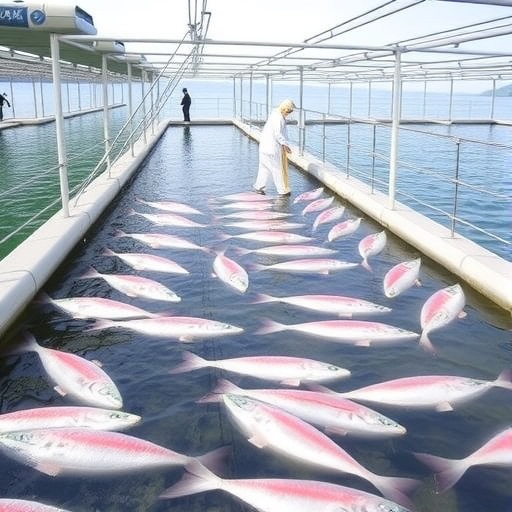
A groundbreaking venture is underway in Fukushima Prefecture, Japan, as Okayama University of Science, in collaboration with the NTT East Group and Ichii Inc., embarks on a pioneering project to revolutionize sockeye salmon (Benizake) aquaculture. This ambitious endeavor employs an innovative approach known as “The Third Water” to cultivate Benizake in an advanced land-based facility. The new site, located in the Tsushima district of Namie Town, marks a significant leap towards sustainable, high-efficiency aquaculture, with construction well underway and full-scale production slated to commence shortly.
The initiative addresses several pressing concerns in modern aquaculture, notably the environmental challenges posed by conventional open-net fish farming. By utilizing a closed, land-based system, the project aims to mitigate impacts such as water pollution, disease transmission to wild fish populations, and ecological degradation of coastal environments. “The Third Water” technology, developed by Okayama University of Science, is central to this vision, offering a refined water management and recirculation system that optimizes fish health and growth while conserving water resources.
The planned facility spans approximately 1,000 square meters and is designed to operate on a vast 8,000-square-meter site, inclusive of an administrative building and integrated solar power systems. This renewable energy setup ensures low carbon emissions by powering pumps and other critical infrastructure sustainably. The scale of the new tanks will eclipse the existing 20-ton capacity units by more than eightfold, enabling Ichii to significantly upscale its production capabilities. This marks a transition from experimental trials to robust commercial operations.
Technically, the Third Water system represents a state-of-the-art approach to recirculating aquaculture systems (RAS). It involves the precise filtration and reuse of water, removing harmful metabolites and pathogens while maintaining optimal oxygen levels and temperature control customized for sockeye salmon physiology. This tightly controlled environment accelerates growth cycles and enhances fish welfare—a critical advantage as farmed species face increasing susceptibility to disease under stressful conditions.
An essential aspect of the project is the location choice—Namie Town in Fukushima Prefecture, a region deeply affected by the 2011 nuclear disaster. The facility symbolizes a commitment to regional revitalization through innovative aquaculture, leveraging scientific advancements to restore and invigorate local economies. The Japanese government’s endorsement via the Subsidy for Business Location to Support Self-Reliance and Return underscores the social and economic importance embedded in this development.
Currently, Ichii Inc. maintains a modest operation with about 1,500 Benizake specimens in their headquarters. The anticipated expansion facilitated by this new infrastructure will enable year-round, high-volume production. After the initial cycle of raising fish from eggs to harvest, expected within two years post-completion, Ichii plans to initiate regular shipments to markets, delivering premium-quality Benizake to consumers.
The demonstration phase has already included trial sales, where Benizake was featured in sushi platters across retail outlets during the summer of 2023, garnering positive consumer reception. These trial efforts serve not only as market validation but also as data points to refine breeding, feeding, and harvesting protocols. Furthermore, the integration of advanced monitoring systems will allow for continuous real-time assessment of water quality and fish health, employing sensors calibrated for variables such as ammonia concentration, pH levels, and dissolved oxygen.
From an engineering perspective, the challenges of scaling up RAS for a species as physiologically sensitive as sockeye salmon are formidable. The salmon require specific migratory simulation in their life cycle, which the facility aims to replicate through water flow management and temperature gradients. These efforts are crucial to mimic natural developmental triggers, ensuring robust maturation and optimal flesh quality.
The solar power component reflects a growing trend in aquaculture towards carbon-neutral operations. By coupling photovoltaic arrays with battery storage, the facility anticipates maintaining near-continuous power to critical systems, even during peak demand or grid outages. This independence is particularly beneficial in rural Fukushima, where energy infrastructure may be variable.
Given these advancements, the project could serve as a blueprint for future aquaculture ventures, aligning technological innovation with environmental stewardship and economic revitalization. The synergies achieved through collaboration between academia, industry, and government exemplify the multidisciplinary approach required to meet global food security challenges sustainably.
As construction progresses and operational protocols are fine-tuned, the scientific community and industry stakeholders eagerly await data on the long-term viability of Third Water aquaculture. If successful, this model promises a scalable, eco-friendly solution for producing high-value seafood, reducing pressure on wild stocks, and offering fresh, locally sourced Benizake to discerning consumers.
This initiative, combining cutting-edge technology with a profound regional recovery mission, epitomizes the future of aquaculture where innovation drives sustainability and socio-economic progress hand in hand.
News Publication Date: Not explicitly provided; references to events up to October 27, 2025
Web References:
https://mediasvc.eurekalert.org/Api/v1/Multimedia/e4c49308-ba93-4ed0-bb47-75f2b976eb8d/Rendition/low-res/Content/Public
Cite Scienmag News
Alan Morgan. (March 30, 2026). New Aquaculture Facility Launches in Namie Town as Benizake Salmon Farming in Fukushima Advances Toward Full-Scale Commercialization. Scienmag. https://scienmag.com/new-aquaculture-facility-launches-in-namie-town-as-benizake-salmon-farming-in-fukushima-advances-toward-full-scale-commercialization/
Alan Morgan. "New Aquaculture Facility Launches in Namie Town as Benizake Salmon Farming in Fukushima Advances Toward Full-Scale Commercialization." Scienmag, 30 March 2026, https://scienmag.com/new-aquaculture-facility-launches-in-namie-town-as-benizake-salmon-farming-in-fukushima-advances-toward-full-scale-commercialization/. Accessed 5 September 2026.
Alan Morgan. "New Aquaculture Facility Launches in Namie Town as Benizake Salmon Farming in Fukushima Advances Toward Full-Scale Commercialization." Scienmag. March 30, 2026. https://scienmag.com/new-aquaculture-facility-launches-in-namie-town-as-benizake-salmon-farming-in-fukushima-advances-toward-full-scale-commercialization/


