
Saturday, February 7, 2026
Science
No Result
View All Result
  • Login
  • HOME
  • SCIENCE NEWS
  • CONTACT US
  • HOME
  • SCIENCE NEWS
  • CONTACT US
No Result
View All Result
Scienmag
No Result
View All Result
Home Science News Chemistry

New approach to identifying altermagnetic materials

June 14, 2024
in Chemistry
Reading Time: 3 mins read
0
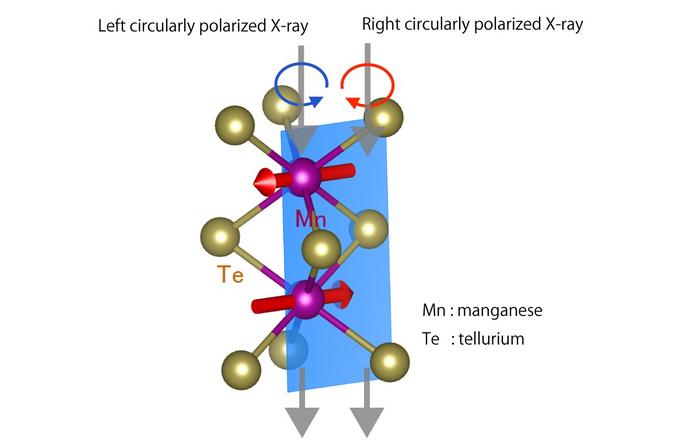
Radiating altermagnetic alpha-manganese telluride with X-rays
68
SHARES
621
VIEWS
Share on FacebookShare on Twitter
ADVERTISEMENT

Magnetic materials have traditionally been classified as either ferromagnetic, like the decorative magnets on iron refrigerator doors that are seemingly always magnetic, or antiferromagnetic, like two bar magnets placed end-to-end with opposite poles facing each other, canceling each other out so that the material has no net magnetism. However, there appears to be a third class of magnetic materials exhibiting what in 2022 was dubbed altermagnetism.

Radiating altermagnetic alpha-manganese telluride with X-rays

Credit: Osaka Metropolitan University

Magnetic materials have traditionally been classified as either ferromagnetic, like the decorative magnets on iron refrigerator doors that are seemingly always magnetic, or antiferromagnetic, like two bar magnets placed end-to-end with opposite poles facing each other, canceling each other out so that the material has no net magnetism. However, there appears to be a third class of magnetic materials exhibiting what in 2022 was dubbed altermagnetism.

Microscopically, magnetism arises from a collection of tiny magnets associated with electrons, called spin. In ferromagnetic materials, all the electron spins point in the same direction, while in antiferromagnetic materials, the electron spins are aligned in opposite directions, half pointing one way and half the other, canceling out the net magnetism. Altermagnetic materials are proposed in theory to possess properties combining those of both antiferromagnetic and ferromagnetic materials. One potential application of altermagnetic materials is in spintronics technology, which aims to utilize the spin of electrons effectively in electronic devices such as next-generation magnetic memories. However, identifying altermagnets has been a challenge.

An international research group led by Associate Professor Atsushi Hariki from the Graduate School of Engineering at Osaka Metropolitan University pioneered a new method to identify altermagnets, using manganese telluride (α-MnTe) as a testbed.

With the aid of a supercomputer, the researchers theoretically predicted a fingerprint of altermagnetism in X-ray magnetic circular dichroism (XMCD), which measures the absorption difference between left- and right-circularly polarized light. Then, using the Diamond Light Source synchrotron in England, they experimentally demonstrated the XMCD spectrum for altermagnetic α-MnTe for the first time in the world.

“Our results show that XMCD is an effective method for the simple identification of altermagnetic materials,” Professor Hariki said. “Also, it can be expected to further accelerate the application of altermagnets in spintronics.”

The findings were published in Physical Review Letters.

###

About OMU 

Established in Osaka as one of the largest public universities in Japan, Osaka Metropolitan University is committed to shaping the future of society through “Convergence of Knowledge” and the promotion of world-class research. For more research news, visit and follow us on social media: X, Facebook, Instagram, LinkedIn.


Journal

Physical Review Letters

DOI

10.1103/PhysRevLett.132.176701

Method of Research

Computational simulation/modeling

Subject of Research

Not applicable

Article Title

X-Ray Magnetic Circular Dichroism in Altermagnetic 𝛼-MnTe

Article Publication Date

23-Apr-2024

Share27Tweet17
Previous Post

Is magnesium the sleeping potion that enables sandhoppers to survive cold winters?

Next Post

High-precision measurements challenge our understanding of Cepheids

Related Posts

blank
Chemistry

Breakthrough in Environmental Cleanup: Scientists Develop Solar-Activated Biochar for Faster Remediation

February 6, 2026
blank
Chemistry

Cutting Costs: Making Hydrogen Fuel Cells More Affordable

February 6, 2026
blank
Chemistry

Scientists Develop Hand-Held “Levitating” Time Crystals

February 6, 2026
blank
Chemistry

Observing a Key Green-Energy Catalyst Dissolve Atom by Atom

February 6, 2026
blank
Chemistry

Saarbrücken Chemists Break New Ground: Iconic Aromatic Molecule Synthesized with Silicon After Decades of Global Pursuit

February 6, 2026
blank
Chemistry

How Cancer Cells Harness Water Pressure to Navigate the Body

February 6, 2026
Next Post
Cepheid Variable Star RS Puppis

High-precision measurements challenge our understanding of Cepheids

  • Mothers who receive childcare support from maternal grandparents show more parental warmth, finds NTU Singapore study

    Mothers who receive childcare support from maternal grandparents show more parental warmth, finds NTU Singapore study

    27610 shares
    Share 11040 Tweet 6900
  • University of Seville Breaks 120-Year-Old Mystery, Revises a Key Einstein Concept

    1017 shares
    Share 407 Tweet 254
  • Bee body mass, pathogens and local climate influence heat tolerance

    662 shares
    Share 265 Tweet 166
  • Researchers record first-ever images and data of a shark experiencing a boat strike

    529 shares
    Share 212 Tweet 132
  • Groundbreaking Clinical Trial Reveals Lubiprostone Enhances Kidney Function

    515 shares
    Share 206 Tweet 129
Science

Embark on a thrilling journey of discovery with Scienmag.com—your ultimate source for cutting-edge breakthroughs. Immerse yourself in a world where curiosity knows no limits and tomorrow’s possibilities become today’s reality!

RECENT NEWS

  • Enhancing Education: Effective Support for Gender Equality
  • Improving Dementia Care with Enhanced Activity Kits
  • TPMT Expression Predictions Linked to Azathioprine Side Effects
  • Evaluating Pediatric Emergency Care Quality in Ethiopia

Categories

  • Agriculture
  • Anthropology
  • Archaeology
  • Athmospheric
  • Biology
  • Biotechnology
  • Blog
  • Bussines
  • Cancer
  • Chemistry
  • Climate
  • Earth Science
  • Editorial Policy
  • Marine
  • Mathematics
  • Medicine
  • Pediatry
  • Policy
  • Psychology & Psychiatry
  • Science Education
  • Social Science
  • Space
  • Technology and Engineering

Subscribe to Blog via Email

Success! An email was just sent to confirm your subscription. Please find the email now and click 'Confirm Follow' to start subscribing.

Join 5,190 other subscribers

© 2025 Scienmag - Science Magazine

Welcome Back!

Login to your account below

Forgotten Password?

Retrieve your password

Please enter your username or email address to reset your password.

Log In
No Result
View All Result
  • HOME
  • SCIENCE NEWS
  • CONTACT US

© 2025 Scienmag - Science Magazine