


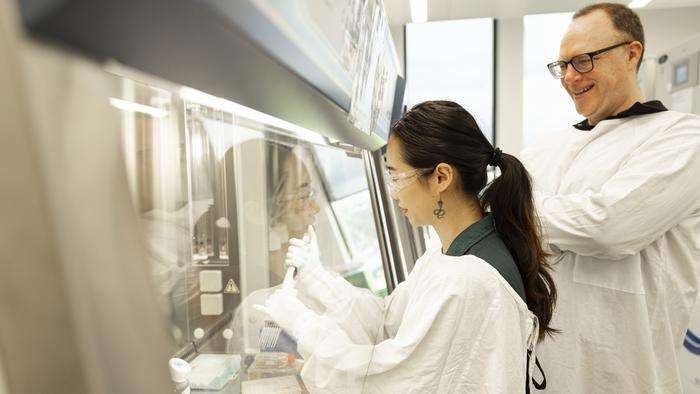
Scientists at the University of Sydney and Liverpool School of Tropical Medicine have made a remarkable discovery: a commonly used blood thinner, heparin, can be repurposed as an inexpensive antidote for cobra venom.

Credit: Fiona Wolf/University of Sydney
Scientists at the University of Sydney and Liverpool School of Tropical Medicine have made a remarkable discovery: a commonly used blood thinner, heparin, can be repurposed as an inexpensive antidote for cobra venom.
Cobras kill thousands of people a year worldwide and perhaps a hundred thousand more are seriously maimed by necrosis – the death of body tissue and cells – caused by the venom, which can lead to amputation.
Current antivenom treatment is expensive and does not effectively treat the necrosis of the flesh where the bite occurs.
“Our discovery could drastically reduce the terrible injuries from necrosis caused by cobra bites – and it might also slow the venom, which could improve survival rates,” said Professor Greg Neely, a corresponding author of the study from the Charles Perkins Centre and Faculty of Science at the University of Sydney.
Using CRISPR gene-editing technology to identify ways to block cobra venom, the team, which consisted of scientists based in Australia, Canada, Costa Rica and the UK, successfully repurposed heparin (a common blood thinner) and related drugs and showed they can stop the necrosis caused by cobra bites.
The research is published today on the front cover of Science Translational Medicine.
PhD student and lead author, Tian Du, also from the University of Sydney, said: “Heparin is inexpensive, ubiquitous and a World Health Organization-listed Essential Medicine. After successful human trials, it could be rolled out relatively quickly to become a cheap, safe and effective drug for treating cobra bites.”
The team used CRISPR to find the human genes that cobra venom needs to cause necrosis that kills the flesh around the bite. One of the required venom targets are enzymes needed to produce the related molecules heparan and heparin, which many human and animal cells produce. Heparan is on the cell surface and heparin is released during an immune response. Their similar structure means the venom can bind to both. The team used this knowledge to make an antidote that can stop necrosis in human cells and mice.
Unlike current antivenoms for cobra bites, which are 19th century technologies, the heparinoid drugs act as a ‘decoy’ antidote. By flooding the bite site with ‘decoy’ heparin sulfate or related heparinoid molecules, the antidote can bind to and neutralise the toxins within the venom that cause tissue damage.
Joint corresponding author, Professor Nicholas Casewell, Head of the Centre for Snakebite Research & Interventions at Liverpool School of Tropical Medicine, said: “Snakebites remain the deadliest of the neglected tropical diseases, with its burden landing overwhelmingly on rural communities in low- and middle-income countries.
“Our findings are exciting because current antivenoms are largely ineffective against severe local envenoming, which involves painful progressive swelling, blistering and/or tissue necrosis around the bite site. This can lead to loss of limb function, amputation and lifelong disability.”
Snakebites kill up to 138,000 people a year, with 400,000 more experiencing long-term consequences of the bite. While the number affected by cobras is unclear, in some parts of India and Africa, cobra species account for most snakebite incidents.
The World Health Organization has identified snakebite as a priority in its program for tackling neglected tropical diseases. It has announced an ambitious goal of reducing the global burden of snakebite in half by 2030.
Professor Neely said: “That target is just five years away now. We hope that the new cobra antidote we found can assist in the global fight to reduce death and injury from snakebite in some of the world’s poorest communities.”
Working in the Dr John and Anne Chong Laboratory for Functional Genomics at the Charles Perkins Centre, Professor Neely’s team takes a systematic approach to finding drugs to treat deadly or painful venoms. It does this using CRISPR to identify the genetic targets used by a venom or toxin inside humans and other mammals. It then uses this knowledge to design ways to block this interaction and ideally protect people from the deadly actions of these venoms.
This approach was used to identify an antidote to box jellyfish venom by the team in 2019.
Professor Casewell leads the Centre for Snakebite Research & Interventions at the Liverpool School of Tropical Medicine (LSTM). The centre has conducted a diverse portfolio of research activities to better understand the biology of snake venoms and improve the efficacy, safety and affordability of antivenom treatment for tropical snakebite victims for more than 50 years. It boasts some of the world’s leading snakebite experts and has access to LSTM’s herpetarium, the largest and most diverse collection of tropical venomous snakes in the UK.
DOWNLOAD videos, images and photos of snakes and researchers at this link.
INTERVIEWS
Professor Greg Neely | greg.neely@sydney.edu.au | +61 403 227 100
[NB: Professor Neely is currently in Canada, so please consider timezones]
Professor Nicholas Casewell | nicholas.casewell@lstmed.ac.uk | +44 151 702 9329
PhD student and lead author Tian Du | tian.du@sydney.edu.au
MEDIA ENQUIRIES
Sydney: Marcus Strom | marcus.strom@sydney.edu.au | +61 474 269 459
Liverpool: Dominic Smith | dominic.smith@lstmed.ac.uk | +44 7469 105 025
RESEARCH
Du, T. et al, ‘Molecular dissection of cobra venom highlights heparinoids as an effective snakebite antidote’. (Science Translational Medicine, 2024) DOI: 10.1126/scitranslmed.adk4802
DECLARATION
Greg Neely, Nicholas Casewell, Felicity Chung and Tian Du declare that a provisional patent application has been submitted based on these results. The remaining authors declare no competing interests.
Research funding was received from the National Health and Medical Research Council (Australia), the Australian Research Council, the Royal Society, the Wellcome Trust and UK Medical Research Council.
Thanks to Dr John and Anne Chong for ongoing funding of the Chong Laboratory for Functional Genomics at the University of Sydney.
ETHICS STATEMENT
All testing using animal models was conducted with the approval of the relevant ethics committees in the United Kingdom and Costa Rica. No animal testing occurred in Australia.
Journal
Science Translational Medicine
Method of Research
Experimental study
Subject of Research
Animals
Article Title
Molecular dissection of cobra venom highlights heparinoids as an effective snakebite antidote
Article Publication Date
17-Jul-2024
COI Statement
Greg Neely, Nicholas Casewell, Felicity Chung and Tian Du declare that a provisional patent application has been submitted based on these results. The remaining authors declare no competing interests.
Cite Scienmag News
Nathaniel Bowman. (July 17, 2024). New antidote for cobra bites discovered. Scienmag. https://scienmag.com/new-antidote-for-cobra-bites-discovered/
Nathaniel Bowman. "New antidote for cobra bites discovered." Scienmag, 17 July 2024, https://scienmag.com/new-antidote-for-cobra-bites-discovered/. Accessed 4 September 2026.
Nathaniel Bowman. "New antidote for cobra bites discovered." Scienmag. July 17, 2024. https://scienmag.com/new-antidote-for-cobra-bites-discovered/

